Important: This article contains factual educational information only. It is not financial product advice, personal financial advice, or a recommendation. SuperCalc Pro does not hold an AFSL and cannot tell you what to do. Always seek advice from a licensed financial adviser who can consider your personal circumstances. This article describes what retirement planning involves; it does not tell you whether any approach is suitable for you.
Scope note: Scott Pape has done more for Australian financial literacy than almost anyone, and his accumulation advice is sound for most people still building wealth. This article is about the point where that advice stops answering the retirement question, not a takedown of the book.
The Barefoot Investor recommends a simple approach: choose a low-cost industry fund (Hostplus Indexed Balanced), set and forget, don't tinker. For someone in their 30s or 40s building wealth, this is excellent advice. The logic is sound: low fees, diversification, long time horizon, consistent contributions. It works because the mathematics of accumulation favors simplicity.
Building wealth and drawing down wealth are different problems. Cash flows reverse, Age Pension rules start to bite, and a bad first decade can permanently shrink what the portfolio can support. You cannot run both stages on the same "leave it alone" settings and expect the same comfort.
The Logical Flaw in "Set and Forget" for Retirement
Consider this scenario. You're 65, retiring with $1 million in Hostplus Indexed Balanced (roughly 70% growth assets). The fund has served you well for 30 years. Markets crash 30% in your first year of retirement. Your balance drops to $700,000, and you're withdrawing $50,000 per year to live on.
Compare that with someone who retired two years later into a recovery year. Same starting balance, same fund, same $50,000 withdrawal habit, and the first-year path looks nothing like yours. Sequence of returns risk is not a vibe. It is what happens when withdrawals and returns hit the portfolio in the wrong order.
The "set and forget" approach that worked brilliantly during accumulation now exposes you to the most critical risk of retirement. A 30-year-old experiencing a market crash simply keeps contributing monthly at lower prices. A 65-year-old withdrawing monthly has no such luxury. The damage is permanent.
What Accumulation Strategies Don't Address
Scott Pape's book is intentionally simple. That's its strength. But simplicity means not covering everything. Here's what accumulation-focused advice typically doesn't address:
Age Pension integration. The Age Pension applies two tests: an asset test and an income test. The asset test reduces your pension by $3 per fortnight for every $1,000 over the threshold. That's a 7.8% annual taper rate. Your super balance directly affects how much pension you receive. Accumulation advice doesn't model this because it's not relevant yet.
Withdrawal strategy selection. You can withdraw a fixed dollar amount each year. You can withdraw a fixed percentage. You can use dynamic strategies that adjust based on performance. You can implement guardrails or floor/ceiling approaches. Each produces different results for income stability and portfolio longevity. Accumulation advice doesn't cover this because you're not withdrawing yet.
Transfer Balance Cap management. The $2 million Transfer Balance Cap limits tax-free pension phase balances. Amounts above this remain taxed at 15% in accumulation phase. Personal caps depend on when you first entered pension phase due to proportional indexation. Accumulation advice doesn't address this because it's a pension-phase issue.
Couples with different retirement dates. One partner retires at 60, the other at 67. Household income management during that transition, partial Age Pension eligibility, super balance equalisation, tax implications. These aren't covered in accumulation-focused advice because both partners are still working.
Historical stress testing. What if you retired in 1929? 1973? 2008? Testing your specific plan against every historical retirement period shows worst-case outcomes. Accumulation advice doesn't do this because time heals most wounds when you're still contributing.
The Mathematics Are Different
Here's the fundamental issue. During accumulation, you're optimizing for "how much will I have?" During retirement, you're optimizing for "how long will it last?" Those are different mathematical problems.
Accumulation favors high growth asset allocation because crashes are recovered through continued contributions and time. A 30% crash followed by recovery is just a buying opportunity. Retirement doesn't have that luxury. A 30% crash in year one, combined with withdrawals, creates a hole you may never recover from.
Take two people who both retire with $850,000 and both draw $45,000 a year in today's dollars. One starts just before a multi-year equity drawdown. The other starts after that drawdown has already happened. Even if long-run average returns look similar on a spreadsheet, the first household spends years selling into weakness while the second does not. By year ten the balances can be hundreds of thousands apart, which is why "the fund returned about 7% on average" is not a retirement plan.
Super fund projections (the kind that say "you'll have $1.2 million at retirement") smooth returns into averages. They assume you get 7% every single year. Real markets don't work that way. Some years are +20%. Some are -30%. The order matters enormously when you're withdrawing.
The Downsizer Contribution Example
Let's take a specific example that illustrates the gap between accumulation advice and retirement planning. People aged 55+ can contribute up to $300,000 from selling their home under downsizer contribution rules. This contribution doesn't count toward any caps, doesn't require work tests, applies regardless of total super balance.
The Barefoot Investor doesn't discuss this. Not because it's wrong or irrelevant, but because the book focuses on accumulation for younger people. Downsizer contributions are a retirement-phase consideration. Whether putting $300,000 into super is right for any individual depends on their circumstances, Age Pension implications, cash flow needs, estate planning goals.
That's the difference. Accumulation advice is broad and applicable to many. Retirement planning is specific and depends on individual circumstances. Both are valuable, but they solve different problems.
Testing the Logic
Here's a thought experiment. Let's assume you could have a retirement calculator that tested your exact plan against every historical period since 1928. Every possible retirement start year. Every market crash. Every combination of Age Pension rules and super balances. It would show you the worst case, the best case, the median.
Now, if someone said "you don't need that, just keep your money in Hostplus and withdraw $50,000 per year," what would be the logical response? If the calculator showed the same result as the simple approach, you'd ignore the calculator. But if the calculator showed materially different results, say showing that $50,000 per year would deplete your balance by age 80 in the worst historical scenarios, would you still ignore it?
That's the question accumulation-focused advice doesn't answer. Not because the advice is wrong for accumulation, but because it's answering a different question. "How do I build wealth?" versus "How long will my wealth last?"
The practical split: Build wealth with simple, low-cost accumulation rules. Once withdrawals start, test the plan against bad historical start years, Age Pension rules, and a withdrawal method you can actually live with. One setting rarely optimises both stages.
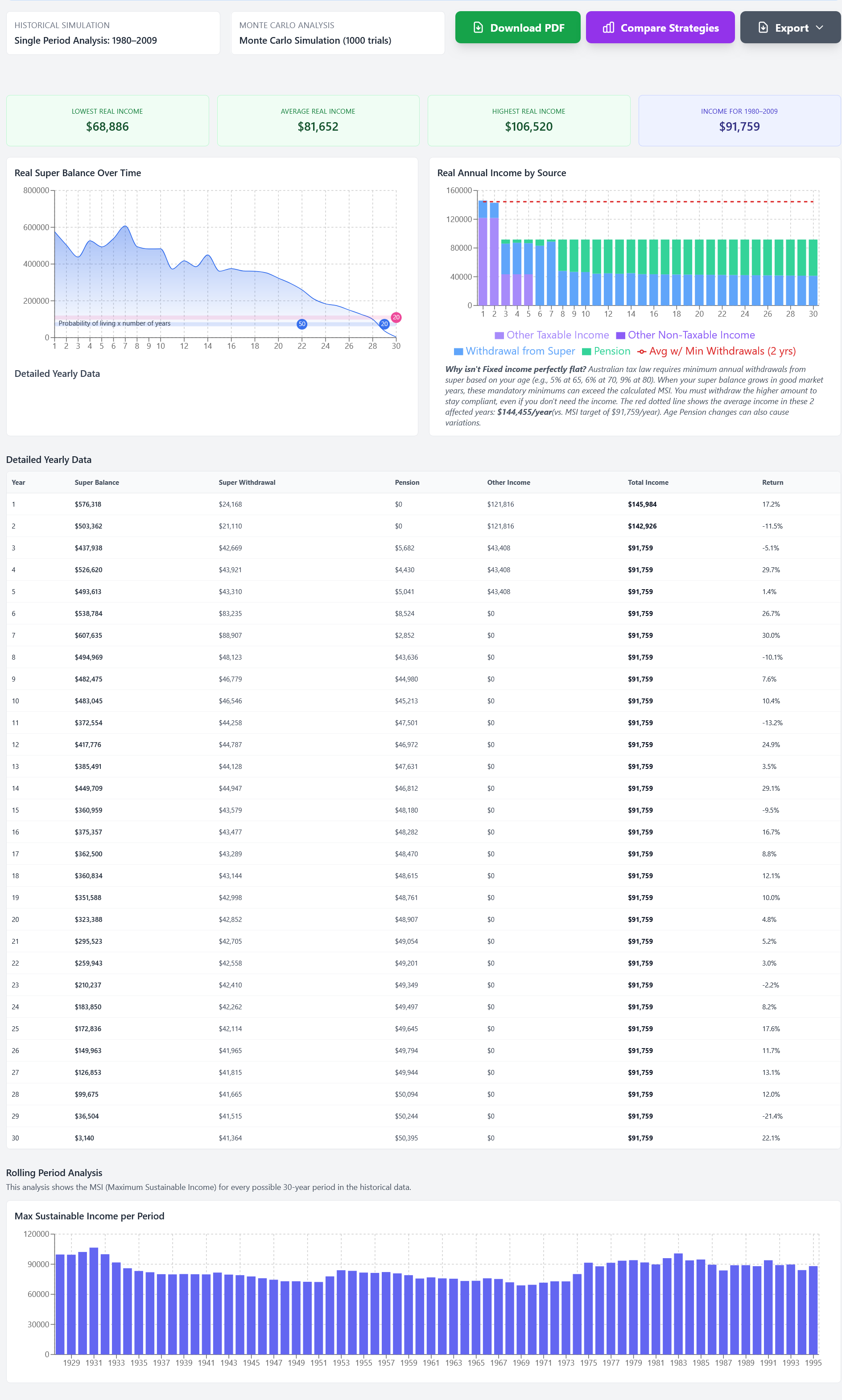
Testing retirement plans against historical periods shows outcomes that averaging masks
Where Licensed Advice Comes In
Here's what this article cannot do: tell you whether any of this applies to you. That requires personal financial advice from someone holding an AFSL. They can assess your specific circumstances, recommend strategies, provide Statements of Advice, take responsibility for ensuring recommendations are appropriate.
This article describes what retirement planning involves. It explains why accumulation and retirement are different problems. It outlines what calculations exist. But it cannot, and does not, tell you what to do. Only a licensed adviser who knows your situation can do that.
The Barefoot Investor provides excellent accumulation advice for the majority of Australians. Retirement planning exists as a separate field because the problems are different. Whether you need retirement-specific planning is not a question this article can answer. That's what licensed advisers are for.
What it costs to keep modelling
Run Advanced Retirement free first. Unlimited scenarios, historical stress tests, and PDF exports are $149 a year, or $14.99 a month if you’d rather not commit upfront, typically less than one hour of paid advice for the same modelling work.
Run the Advanced Calculator →No card required to try it. Subscribe only if the model is useful enough to keep using.