Retirement Planning Blog
Expert insights on Australian superannuation, SMSF, and retirement planning
Retirement outcome scenarios (by age & balance)
Illustrative model outputs for common combinations, same engine as the Advanced Calculator under fixed assumptions. Not personal advice.
Browse scenario pages →Run your own numbers, free, no signup, 60 seconds.
Run My 60-Second Stress-TestWhat makes this calculator different
Most free super calculators use a single assumed return and one retirement date. These pieces explain how SuperCalc Pro stress-tests plans with historical markets, Monte Carlo paths, dual MSI hit rates, and household phased retirement on the same inputs.
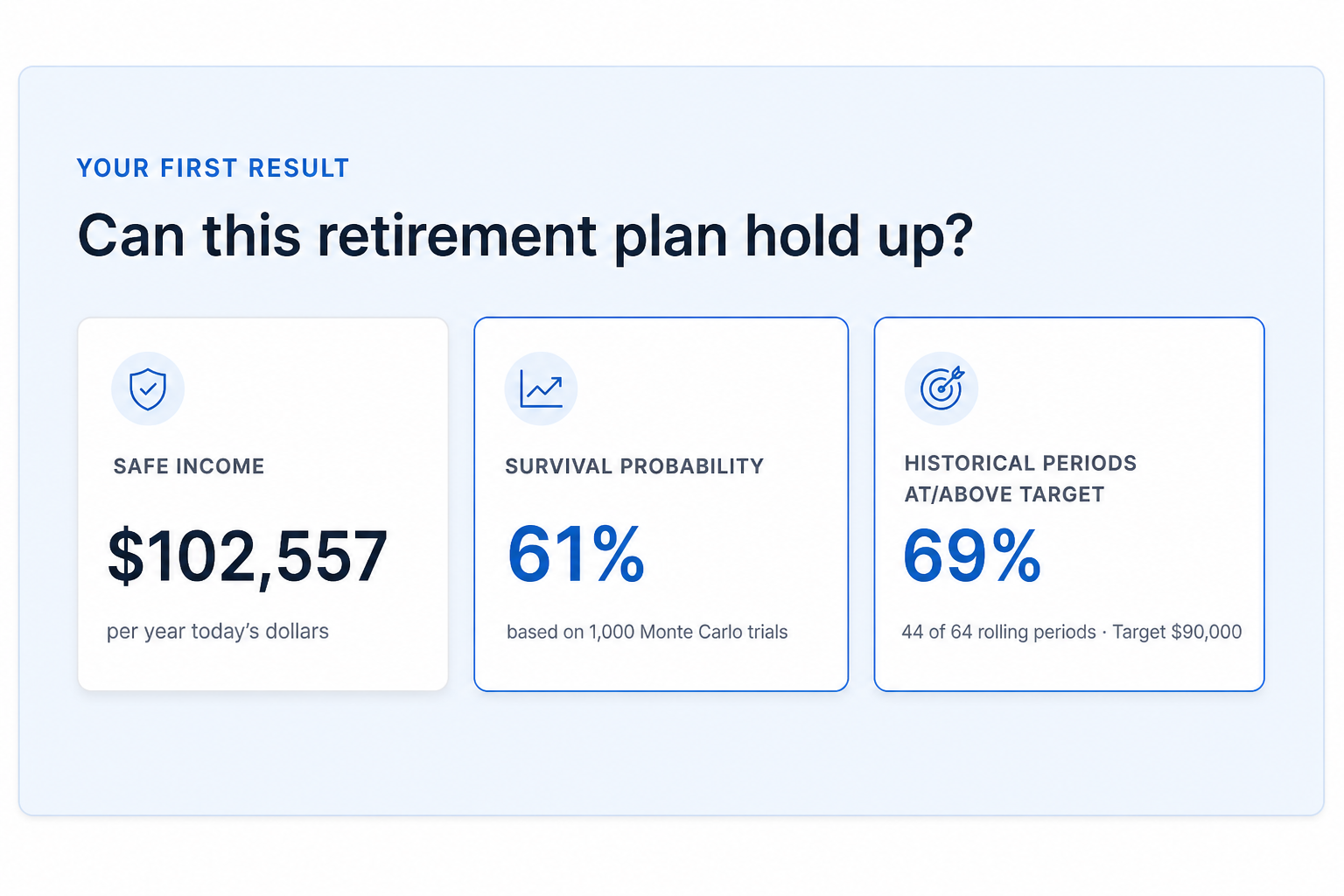
Monte Carlo vs Historical MSI: Why Two Stress Tests Disagree
Same $90k target on $1.5M super: about 61% Monte Carlo survival vs 69% of historical rolling periods clearing the bar. Engine-run on the Advanced Calculator — read both percentages together.
Phased Retirement Calculator for Couples (Different Ages)
Different exit ages, wages still on, Age Pension on Centrelink’s calendar — and a 1973 case where the flat model is drawing ~$61k from super alone by year five while phased still has a wage.
Monte Carlo Retirement Simulation Australia: What It Measures (and Misses)
~1,000 historical-year bootstrap paths plus ordered replay on the same Australian inputs — so you can see what a success rate means, and what it misses.
Stress-Test Your Retirement Plan: Lessons from History
Constant 7% forever hides sequence risk. Replay every start year since 1928 — crashes, recoveries, stagflation — with Age Pension and drawdowns on your plan.
Foundational Concepts
Start here. Core retirement planning ideas, plus how we think about return assumptions before you trust a projection.
How Much Can You Live On From Super and the Age Pension?
Retirement income is not one number, it is super, pension, and market history interacting over decades. How to model what is sustainable for your household.
Super Drawdown Strategy Australia: Rules, Sustainability, and Real Numbers
Minimum drawdown rules are a compliance floor, not a spending plan. Fixed and Dynamic SWR runs show how income shape changes over time, with and without Age Pension as a buffer.
Probability Retirement Fails Australia: Failure Rates from Real History
How often would fixed spending from $500,000 have failed across 71 historical paths? With Age Pension modelled, $50k failed 10% of the time. At $60k, 54%. The cliff is real.
True Cost of Retirement Australia: What 25 Years of Real Data Actually Shows
ASFA publishes $48k/year. Real retirees spend $30k to $100k+. We mapped what actually happened across historical paths to show the real distribution of retirement costs.
Safe Withdrawal Rate Australia: Fixed Spending Tested Against 70 Historical Years
What fixed spending actually survived when we replayed real Australian markets from 1955 onwards. Success rates at different balances, with and without Age Pension.
Sequence of Returns Risk in Australia: Why Order Beats Average Returns
Bad years at the wrong time can wreck a plan that looked fine on a smooth average. How sequence risk works with super drawdowns, and how to stress-test with real history.
Regression to the Mean and Future Returns: Useful Anchor or False Precision?
How we think about forward returns before trusting a projection. Rolling log regressions on S&P and Australian shares, when trend-fit estimates help planning, and when they mislead.
Scenario Guides
Common Australian retirement questions by age, balance, mortgage status, and household structure. Use them as starting points, then model your own numbers.
Can a Couple Retire on $650k Super in Australia?
A couple with $650k may be close, but ASFA, Age Pension, spending, and poor early returns decide whether it is resilient.
Retiring at 60 With a Mortgage in Australia
The mortgage changes the retire-at-60 bridge. Test repayments, living costs, and seven years before Age Pension.
Can a Single Person Retire on $500k Super in Australia?
For a single homeowner, $500k can work with pension support and controlled spending, but it is below ASFA comfortable.
Can a Couple Retire on $800k Super in Australia?
Above the ASFA comfortable lump sum, but still dependent on spending flexibility and sequence risk.
Retire at 60 With $1 Million Super in Australia
A $1m balance can be strong, but retiring at 60 means funding the pre-pension bridge and early market risk.
Retire at 62 in Australia: The Five-Year Super Bridge
A five-year bridge before Age Pension age needs cash-flow testing, not just a headline balance.
Retiring With $300k Super and Age Pension in Australia
When Age Pension is the foundation and super is the buffer, the key risk is using that buffer too quickly.
Can a Single Person Retire on $700k Super in Australia?
A strong single balance still needs a drawdown strategy, Age Pension context, and poor-market stress test.
One Partner Retired, One Still Working: Super and Age Pension Planning
Staggered retirement needs household modelling across two ages, one wage, and future pension tests.
Retiring at 67 With a Mortgage in Australia
The home may be exempt from the Age Pension assets test, but repayments still need reliable cash flow.
Latest Articles
Super Tax Concessions: Who Really Benefits?
Treasury TEIS figures show most contribution and earnings tax concessions go to above-median incomes. Here is the distribution, and what Div 293 and 296 already clip.
The Retirement Crisis: What the Numbers Actually Say
ATO medians sit below ASFA comfortable lump sums. Age Pension and housing status decide who is short and who is closer than the headlines claim.
Banks Exited Advice: Who Serves Middle Australia Now?
After Hayne, mass-market bank advice largely disappeared. Ordinary households face higher minimums and fees while they search for licensed advice.
Deeming Rates vs Reality: When Centrelink Assumes You Earn More Than You Do
Deeming applies fixed rates to financial assets. Cash-heavy retirees can face deemed income well above what their accounts actually pay.
Mandatory Super Drawdowns: Why You Must Withdraw Even When You Do Not Need To
Minimum pension percentages rise with age and with balance. Good market years can force cash out of super even when spending is lower.
What an Australian Retirement Calculator Must Show vs Centrelink and MoneySmart
Centrelink is a point-in-time check; MoneySmart uses smooth returns for orientation. A full model still needs dynamic Age Pension and historical market stress.
Division 296 Inside a 30-Year Retirement Plan
A one-year tax bill is not the plan. See how Division 296 changes sustainable income and exit timing for high Total Super Balance households.
Why Two Calculator Runs Fail Couples With Different Retirement Ages
MoneySmart and most fund tools assume one exit date or two singles. Australian couples with an age gap need one household model.
Indexation of Caps and Thresholds: How Often and What's Changed
AWOTE vs CPI, $2,500 and $100,000 steps, proportional transfer balance indexation, and which lines never move on 1 July.
Regression to the Mean and Future Returns: Useful Anchor or False Precision?
Rolling log regressions on S&P and Australian shares, backtested against Vanguard outlooks. When trend-fit estimates help planning and when they mislead.
Super Guarantee to 12%: What the Increase Means for Your Retirement
SG hit 12% on 1 July 2025. What the climb means for take-home pay, compounding, and Payday Super timing from 1 July 2026.
Lost Super and ATO Consolidation: How to Find and Combine Accounts
Find lost and ATO-held super in myGov, transfer unclaimed balances for free, and check insurance before you consolidate.
Super and Redundancy: ETPs, Tax, and What Goes Into Super
A redundancy payout is not one bucket. Genuine redundancy, ETPs, unused leave, tax-free limits, and contribution caps all run on different rules.
Death Benefits and Binding Death Benefit Nominations: What Trustees Need to Know
When a member dies, the super trustee pays under nominations and the deed, not the will. BDBN validity, lapsing, reversionary pensions, and SMSF documentation.
Super Rules and Rates From 1 July 2026: What Changes in 2026-27
Indexed caps, $2.1M transfer balance cap, bring-forward thresholds, Division 296 timing, and Payday Super from the new financial year.
Super and Divorce: How Splitting Works in Australia
Super is property on relationship breakdown, but splitting is not automatic. Orders, flagging, tax, preservation, and SMSF traps explained.
Recontribution Strategies: What They Are and Who They Can Help
Withdraw super and re-contribute as after-tax amounts to shift tax-free vs taxable components. Caps, estate planning, and traps.
Lump Sum vs Pension: When to Take Which (And Why It Matters)
Tax on withdrawals, earnings in pension phase, Centrelink deeming, and how each path affects long-term retirement income.
Transition to Retirement: How TTR Works and Where the Traps Are
The salary-sacrifice pairing can cut tax, but the 10% cap, 2017 earnings tax, concessional limits, and Age Pension rules catch many people out.
Minimum Drawdown Rates by Age: What You Must Take From Super Pension
The account-based pension percentages by age, why they are a floor rather than a ceiling, and how the rules fit with retirement income planning.
Government Co-Contribution and LISTO: Do You Qualify?
The ATO can match after-tax super contributions and refund contributions tax for low incomes. Different income tests, different contribution types, same need to lodge and check myGov.
Federal Budget 2026: Super, Retirees, and the Quiet Hits
Australians were told to work hard, build super, maybe buy property, and plan ahead. Now key tax rules are changing while many retirees are already living inside the plan they built.
Salary Sacrifice vs Personal Deductible Super Contributions (Australia)
Same concessional cap, different cash flow and paperwork. How payroll sacrifice and notice-of-intent deductions compare, and why the cap cares about the combined total with SG.
Non-Concessional Contributions and the Bring-Forward Rule (Australia)
After-tax caps, total super balance gates, and how bring-forward uses future years early when you are eligible. Confirm thresholds with the ATO before contributing.
First Home Super Saver Scheme: How It Works and What It Costs You
FHSS can help first home buyers save through super, but the tax benefit is not the whole story. Contribution caps, release tax, deemed earnings, and lost compounding all matter.
Division 296 Tax Australia 2026‑27: 15% Super Tax on Balances Over $3 Million
Enacted from 1 July 2026. Additional 15% on earnings above $3M and 10% above $10M. How final law differs from earlier drafts, payment options, and planning context.
Division 293 Tax Australia: Extra 15% on Super When Income Is High
Above the $250k income-for-surcharge-purposes test, part of your concessional contributions can pick up another 15% personal tax. How the lesser-of calculation works and how the ATO collects it.
Pension Loans Scheme Australia: Using Home Equity to Boost Your Pension
Borrow against your home to top up super income. How the Pension Loans Scheme works, who qualifies, costs, and whether it's better than downsizing.
Younger Partner and Age Pension: What Happens Before They Qualify
One partner qualifies at 67, the other is still 63. You get the couple rate, not the single rate, and Centrelink counts your partner's income and assets. How the transition and phased retirement fit together.
Income Test vs Assets Test: Which One Cuts Your Age Pension First?
Centrelink runs both tests and pays the lower result. Here is how income and assets interact, and why the binding test can flip over time.
SMSF Pension Rules: Minimum Drawdowns, Commutations & Documentation
Miss the minimum payment by 30 June and the ATO deems your pension to have ceased. Here's what the law requires.
Work Bonus: How Working in Retirement Affects Your Age Pension
If you work while receiving the Age Pension, the first $300 per fortnight from employment can be exempt under Work Bonus. Here is how the income bank and pension test interact.
SMSF vs Industry Fund: When Industry Funds Actually Win
For balances under $1M, industry funds often beat SMSFs once you add up costs and returns. Here is the data, not the marketing.
Deeming Rates Change 20 March: Our Calculator Has the Correct Rates Updated on the Day. Does Yours?
Centrelink deeming rates change today from 20 March 2026. See the impact for part-pensioners and run your own numbers in our updated Advanced Calculator.
SMSF Investment Strategy: Why Your "Set and Forget" Plan Can Be Non-Compliant
The ATO requires five specific elements in your investment strategy. Many trustees miss them. A set-and-forget approach can breach the rules.
SMSF Wind-Up Costs: Why Closing Can Cost $15K or More
Closing an SMSF costs far more than most trustees expect. Final audit, accounting, asset sales, CGT and other fees can add up to $15,000 or more.
SMSF Estate Planning: Why Your Will Won't Protect Your Super
Super does not form part of your estate. Your will does not control where your SMSF balance goes. Here is what does and what to do instead.
SMSF Insurance: The Coverage Gap Trustees Often Miss
Industry funds bundle life, TPD and income protection in their fees. Many SMSF trustees have no cover. The difference can be half a million dollars when it matters most.
SMSF Trustees Are Worse Investors Than They Think, Here Is the Evidence
Behavioural finance research and APRA return data show self-directed trustees systematically underperform through overconfidence, concentration, and timing errors.
SMSF vs Industry Fund: The $200,000 Cost of Self-Management
The standard pitch for SMSFs ignores most of the real costs. When you add them up properly, many SMSFs cost significantly more than a competitive industry fund over 30 years.
SMSF Compliance: Why 40% of Trustees Are Breaking the Law Without Knowing It
ATO data shows widespread non-compliance. The most common breaches and how the SMSF Suite helps you stay on the right side of the law.
SMSF Borrowing (LRBA) Trap: Why Leverage in Super Often Destroys Retirement
Limited Recourse Borrowing Arrangements are often oversold. The real costs, concentration risk, and what the numbers show.
SMSF Property Losing Money: Why Most Trustees Lose
The numbers don't lie. SMSF property often costs more than it returns. Hidden costs, illiquidity and concentration risk.
Health Care Costs in Retirement: Budget for Healthy, Average, or Unhealthy
Plan your retirement health expenses. How healthy, average, and unhealthy retirees differ in out-of-pocket costs, PBS, private insurance, and aged care.
Closing Your SMSF: When & How to Wind Up and Roll Back to Retail
SMSFs are not forever. Here is when it makes sense to close, the proper wind-up process, costs involved, and where your money goes.
SMSF Segregated vs Proportionate Method: Which Tax Approach?
How your SMSF calculates exempt pension income (ECPI) affects your tax. Segregated vs proportionate method explained.
SMSF In-Specie Transfers: Moving Shares Into Your Fund
Transfer shares and other assets into your SMSF without selling. Here's how in-specie contributions and rollovers work.
SMSF Contribution Reserving: Split Contributions Across Years
Receive a contribution in one year, have it count toward the next. SMSF-only, and the timing has to be right.
Where Your Super Goes When You Die: Death Benefit Nominations Explained
Your will does not control your super. Here is what does, and why it matters.
SMSF Property Investment: The Rules, Risks & Hidden Costs
Property in super sounds great. But the rules are strict and the costs are higher than you think.
SMSF Investment Strategy Requirements: What the Law Actually Says
Not a tick-and-flick. Under the SIS Act, your investment strategy is a legal covenant. Here is what the ATO and your auditor are actually looking for.
SMSF Compliance Checklist 2026: What Trustees Must Do Each Year
A practical checklist of SMSF trustee obligations: investment strategy, annual return, audit, arms-length rules, and record-keeping. Educational guide for Australian SMSF trustees.
SMSF vs Retail Super: Which Is Right for You?
The real costs, crossover points, and hidden factors that determine whether an SMSF makes sense for your situation.
What If You Retired in 1929? Testing Against the Great Depression
Retiring in 1929 was brutal timing. Here's what actually happened to a 60/40 portfolio through one of history's most severe market crashes.
The $27,000 Age Pension Modeling Problem
Research by Super Consumers Australia found no calculator tested was 100% accurate. Here's what $27,000/year of difference looks like with real 1973 data.
The Worst Years to Retire in History (And What Actually Happened)
Historical analysis of the five worst retirement start years: 1973, 1969, 1929, 2008, and 2000. Real data shows sequence of returns risk isn't theoretical.
Stress-Test Your Retirement Plan: Lessons from History
Most retirement calculators use constant returns. Test your plan against 98 years of real market crises, inflation shocks, and sequence risk.
How to Check Your Unused Concessional Cap on MyGov
You might have tens of thousands in catch-up contributions available. Step-by-step guide to finding your unused cap in 5 minutes.
Super Strategies for Your 50s: The Decade That Matters Most
Peak earnings, catch-up contributions, and 10 to 15 years of compound growth. Your 50s are when retirement gets built.
Age Pension for Couples vs Singles: How Much Will You Get?
Couples get higher thresholds but lower per-person rates. Singles get lower thresholds but higher per-person rates. The differences matter.
Age Pension Exempt Assets: What Centrelink Does Not Count
Your home, one car, funeral bonds up to $15,000, and more. Here is what Centrelink excludes when calculating your Age Pension entitlement.
The Downsizer Contribution Trap: How a $300K Super Boost Could Cost You in Pension
Downsizer contributions are powerful, but they count toward the Age Pension assets test. Here's when it helps and when it hurts.
Super vs Mortgage: Pay Off the Home Loan or Boost Super
It depends on tax, time, access, and risk. Here is the clean framework to compare mortgage savings against super's tax advantage.
Retirement Income Streams: Account-Based Pension vs Annuity
Account-based pension, annuity, or hybrid? Each has different trade-offs for flexibility, certainty, and longevity protection.
Spouse Super Contributions: Tax Offset and Balance Equalisation
The $540 tax offset is nice. The balance equalisation for Age Pension purposes is better.
Concessional Contributions Cap 2025-26: The $30,000 Line
Employer SG counts. Salary sacrifice counts. Exceed it and the ATO charges you your marginal rate plus interest. The cap mechanics explained.
Centrelink 5-Year Gifting Rules for Age Pension
$10K/year, $30K over 5 years. Exceed this and Centrelink treats the excess as "deprived assets." Here's how gifting affects your Age Pension.
Age Pension Asset Test: Homeowner vs Non-Homeowner Limits
Asset free areas differ by about $263,000. Non-homeowners get higher thresholds to account for rent. Here's how Centrelink assesses each case.
How Centrelink Deeming Works for Age Pension
Your actual returns don't matter. Centrelink deems your financial assets to earn 1.75% / 3.75%. Here's what that means for your Age Pension.
Retire at 60 in Australia: The Seven-Year Gap Before Age Pension
Age Pension starts at 67. Preservation age is 60. That's seven years you need to cover yourself. The maths gets interesting.
The Hidden Cost of 'Set and Forget' Super
Average Australian loses $100,000+ in super through fees and poor strategy. Here's how to avoid it.
Scott Pape's Advice Works Until It Doesn't
The Barefoot Investor changed Australian personal finance. But retirement planning requires different tools. Here's why.
How Financial Advice Fees Work (and Why Incentives Matter)
Financial advice costs 1-2% of your portfolio annually. Understand the fee structures and incentive models before paying.
Why Your Super Fund's Projection is Wrong (And How to Fix It)
Super funds assume you'll work to 67, contribute the minimum, earn consistent returns, and retire with no plan. Reality is different.
Monte Carlo vs Reality: Why Your Adviser's Projections Are Too Pessimistic
Monte Carlo simulations show your retirement plan failing 30% of the time. Historical backtesting tells a different story. Here's why both matter.
The Dangerous Assumption Destroying Retirement Plans: Why ASIC's 1.2% Wage Growth Guidance Could Leave You Short
Average wages doubled from $32k to $82k since 1995. Most retirees haven't adjusted their planning accordingly.
Preservation Age and Super Access Rules 2025: Complete Guide
Preservation age determines when you can access super. It's 60 for most, but Age Pension doesn't start until 67. That gap requires planning.
Downsizer Contribution 2025: Add $300K to Super When You Sell Your Home
Aged 55+? You can contribute up to $300,000 to super regardless of age, work status, or existing balance. Complete guide to eligibility and process.
Transfer Balance Cap: The $2M to $2.1M Limit Explained
The most misunderstood rule in super, and the proportional indexing trap that catches everyone. Learn how your personal cap changes over time.
The 7.8% Taper Trap: How the Age Pension Forces You to Spend Down Your Super
Unless your super returns exceed 7.8%, the taper rate forces you to draw down principal. Here's the shocking math most retirees don't understand.
Age Pension Asset Test Explained: 2025-26 Thresholds and Taper
Free areas, homeowner vs non-homeowner limits, the 7.8% taper, and what counts as an assessable asset.
How Much Super to Retire in Australia? 2026 Numbers That Hold Up
ASFA is a starting point, not the answer. Age Pension, singles vs couples, and historical stress tests change the number.
More Articles Coming Soon
We're working on comprehensive guides covering super strategies, withdrawal planning, and retirement optimisation.