Open most Division 296 explainers and you get the same package: earnings, the slice above the large super balance threshold, 15% (another 10% above $10 million), then pay from your pocket or release from super.
Fine if you only need the assessment shape.
Not fine if you are trying to fund twenty or thirty years of retirement.
When I was in Parliament, super tax changes usually arrived with a clean headline and a messier implementation story. Division 296 followed that script after I left the House. Years of noise about unrealised gains and SMSF liquidity. Then a realised-earnings base in the final Act. Almost nobody asked what the levy does to a spending path that already has to survive markets, Age Pension rules, and rising minimum drawdowns.
The arithmetic belongs in the Division 296 tax guide. This piece is about the plan problem.
Division 296 in plain terms
From 2026-27, if your Total Super Balance sits above $3 million (CPI-indexed in $150,000 steps), you face extra tax on Division 296 fund earnings attributable to the portion above that line, at 15%. Above $10 million (indexed in $500,000 steps), another 10% applies to that top slice. The enacted base is fund-reported earnings that are generally realised. Earlier drafts would have taxed raw Total Super Balance movement, including paper gains. That fight is over.
Confirm the ATO wording before you lean on any number. Thresholds move. Reporting sits with them.
Why the one-year bill misleads
A few thousand dollars on a strong earnings year looks small next to a $3.5 million household balance. People shrug. Then they forget that good markets can repeat the same hit for a decade, either as personal tax paid outside super or as a release that shrinks the accounts still funding spending.
Ignore the tax in a long projection and you pretend every dollar of earnings stays available to compound or draw. Model only the tax and you pretend the rest of life stands still. Real retirees do neither. Minimum drawdowns climb with age. Age Pension appears or tapers as balances move. Sequence risk forces higher withdrawals in the wrong years.
So ask the harder question: if years like that keep showing up while you draw for thirty years, what income is still left?
Where the plan actually bends
Pay the assessment from personal funds and you keep the super balance, but you burn outside cash that might have buffered a weak market. Use an ATO release authority and the fund pays, which cuts the account still subject to minimum drawdowns. Repeat either path over a long retirement and the capital left to earn and draw diverges.
Couples get another trap. Division 296 tests each member, not the household. Combined super of about $3.5 million can leave one partner above $3 million and the other below it. Centrelink still treats you as a couple. Drawdowns still hit each account. Blending the pots in a spreadsheet, or taxing one person for one year, does not describe that household.
And no, an earnings-year tax bill does not automatically mean you must work longer. Sometimes the honest answer is a lower sustainable spend than the tax-blind projection promised, or a cash buffer for years with large realisations. Those are plan adjustments, not slogans about leaving the country.
If the model cannot show Division 296 beside drawdowns and Age Pension year after year, it is stress-testing a world that stopped existing for high Total Super Balance members from 2026-27.
See Division 296 inside the retirement path
Opens Advanced with a high combined TSB split across a couple (example ~$3.5M household), Age Pension on, 30-year horizon. Change balances and retirement ages. Plan view, not a one-year tax bill.
Model the 30-year plan →One-year tax estimate: Division 296 calculator · explainer: Division 296 tax guide
A household worth putting through the model
Picture partners still a few years from both exits. One around 60, the other late 50s. Combined super near $3.5 million, split unevenly. Homeowner. Modest other assets. Age Pension maybe later. One balance can sit over $3 million while the other does not. Contributions may still land for a while. Then the exits diverge, drawdowns start, and Division 296 years arrive whenever earnings are strong.
Free tools that ignore the levy will flatter the income path. A one-year tax calculator will miss how the drag stacks beside drawdown choices and the wider how much super do we need question.
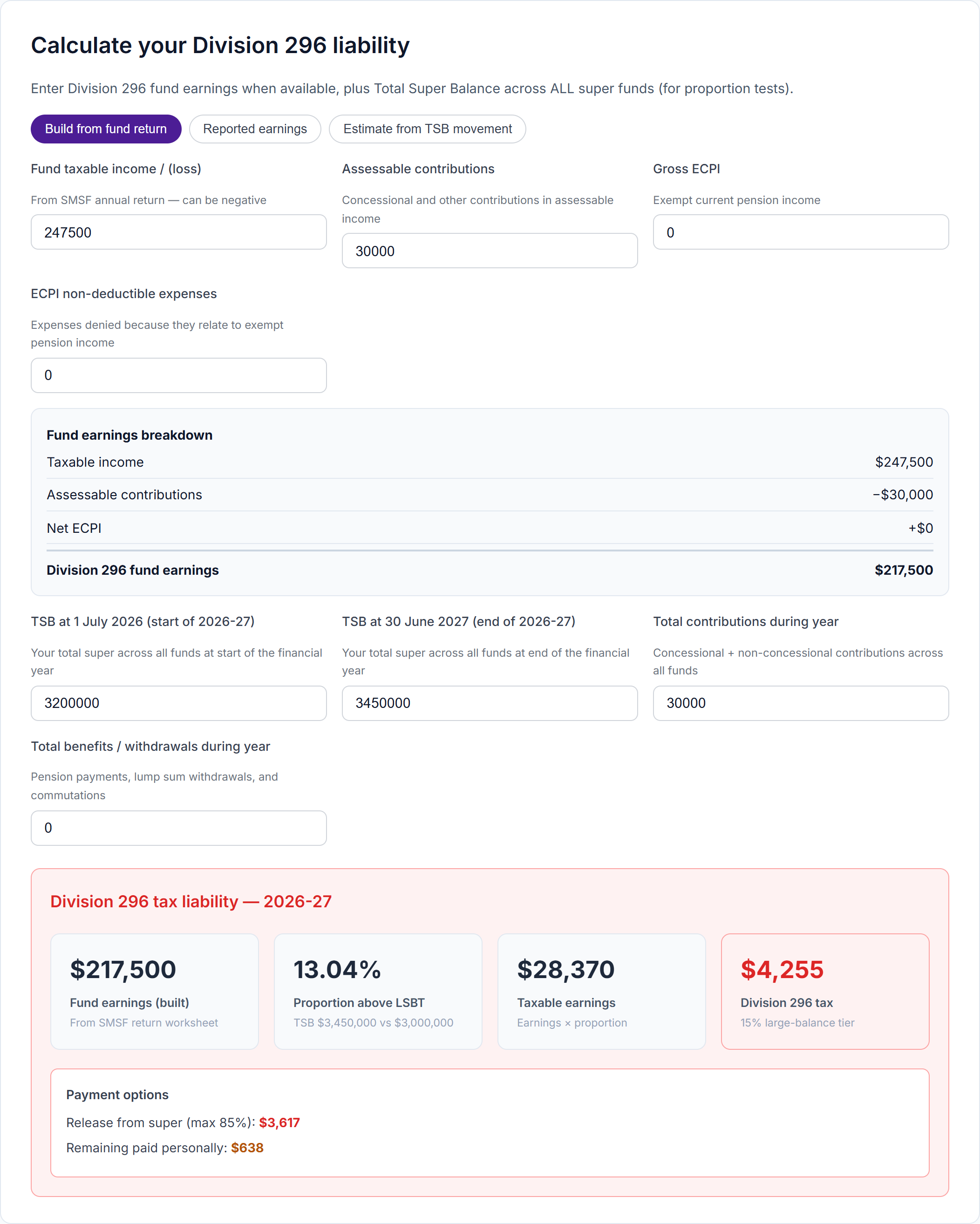
Advanced Retirement: high combined TSB on a 30-year household path. Use the Division 296 calculator for the single-year tax estimate.
Tax calculator versus plan calculator
Use the standalone Division 296 calculator when you want earnings, proportions, and the shape of this year’s assessment. Use Advanced Retirement when you want to know whether the household spending target still holds after those assessments recur, markets vary, and Centrelink moves with balances.
Run the one-year tool when you want a bill-sized answer. Run the plan when you want to know whether retiring at 65 versus 67 still works with the tax inside the path. Those are different questions. Answering only the first is how people discover the second the hard way.
What this is, and is not
General information. Not a recommendation to contribute less, split balances, or change any fund or product. Not a substitute for the ATO assessment. Near the thresholds, treat the numbers as illustrations and check them with licensed advice and current official guidance.
If your balances will never approach $3 million in today’s dollars, you can mostly ignore Division 296. If you are already there, or compounding will push you there within a decade, a one-year calculator is not a retirement plan.
Official sources
- Australian Taxation Office (search current Division 296 / better targeted super concessions guidance)
- Federal Register of Legislation (Treasury Laws Amendment (Building a Stronger and Fairer Super System) Act 2026)
- ASIC MoneySmart retirement planner
- Services Australia Age Pension
What it costs to keep modelling
Run the high-TSB 30-year scenario free first. Unlimited runs, historical stress tests, and PDF exports are $149 a year, or $14.99 a month if you’d rather not commit upfront, typically less than one hour of paid advice for the same multi-decade interaction work.
Model the 30-year plan →No card required to try it. Subscribe only if the plan view is useful enough to keep using.
General information only. This article is educational and does not consider your objectives, financial situation, or needs. It does not recommend that you open, close, or change any super fund or product. SuperCalc Pro Pty Ltd does not hold an Australian Financial Services Licence (AFSL). Division 296 thresholds, earnings rules, and payment options can change. Consider licensed financial and tax advice, and confirm current rules with the ATO, before making decisions about large super balances or retirement timing.