Many SMSF trustees assume closing their fund is as simple as stopping contributions and rolling to another fund. But winding up an SMSF is a formal process with significant costs that catch many trustees off guard. When you add up the final audit, accounting fees, asset transfer costs, capital gains tax, and other expenses, closing an SMSF can cost $10,000 to $20,000 or more if you have complex assets; for straightforward funds (1–2 members, listed assets only) total costs may be closer to $3,000–$6,000. For the process itself, see our guide to closing your SMSF and rolling back to retail. Here we focus on the costs. Comparing SMSF vs retail or industry fund running costs also helps you see when wind-up might make sense.
These costs are not optional. You cannot skip the final audit. You cannot avoid capital gains tax on asset sales. You cannot transfer assets without paying fees. And if you try to close the fund without following the proper process, you will create compliance problems that cost even more to fix.
Before starting an SMSF, or before deciding to close one, understand the full cost of wind-up. That $15,000 surprise could be the difference between a smooth transition and a financial disaster.
The final audit
Even if you are winding up mid-year, you need a final audit covering the period from your last audit to the wind-up date. This audit typically costs $800 to $1,500, similar to a regular audit. Some auditors charge more for wind-up audits because of the extra work involved in verifying that the wind-up has been conducted properly.
The auditor will verify that all assets have been dealt with appropriately, that all liabilities have been paid, and that there are no outstanding compliance issues. If they find problems, you will need to fix them before the wind-up can proceed, adding to costs.
Accounting and tax return preparation
You need final financial statements and a final tax return, marked as a "final return" to notify the ATO that the fund has wound up. The final return should be lodged only after all assets are disposed or transferred and the fund balance is nil. The ATO may take several months to confirm deregistration of the SMSF. Accountant fees for this work typically run $1,500 to $3,000, depending on the complexity of the fund.
If your fund has complex investments, multiple members, or historical compliance issues, fees can be higher. Some accountants charge $5,000 or more for complex wind-ups.
Asset transfer costs
Most receiving funds (industry and retail funds) only accept cash rollovers, so you will typically need to sell all investments. In-specie rollovers are technically permitted for some assets, but most retail and industry funds require cash transfers. Shares can be sold through your broker (brokerage fees apply). Term deposits can be broken (possibly with a penalty). Property must be sold on the open market, which involves real estate agent commissions (2% to 3% of sale price), conveyancing fees ($1,500 to $2,500), and potentially capital gains tax.
On a $1 million property, agent commissions alone are $20,000 to $30,000. Conveyancing adds another $1,500 to $2,500. If you have made capital improvements, these increase your cost base and affect your CGT calculation; tax in super is generally lower due to the 15% rate and potential CGT discount.
Capital gains tax
When you sell assets to wind up the fund, you may trigger capital gains tax. In accumulation phase, capital gains are taxed at 15% (or 10% if the asset was held for more than 12 months and the CGT discount applies). If your SMSF is in retirement (pension) phase, capital gains are generally exempt. However, if you commute pensions and sell assets after reverting to accumulation phase, gains may become taxable.
If you have a $500,000 property that you bought for $400,000, and you sell it to wind up the fund, you have a $100,000 capital gain. If the asset was held more than 12 months and the fund is in accumulation phase, the CGT discount applies: you pay tax on $50,000 at 15% = $7,500. If the discount does not apply, you pay tax on $100,000 at 15% = $15,000.
Other costs
There are other costs too. You may need to pay any outstanding ATO, accountant, auditor, or ASIC company fees (if your trustee is a corporate trustee) before the fund can wind up. You may need legal advice if there are complex issues. You may need to pay for asset valuations. And you may need to pay for professional advice on the wind-up process itself.
The $15K example
Say you have a $1 million SMSF with an $800,000 property and $200,000 in shares. To wind up:
- Final audit: $1,200
- Accounting and tax return: $2,500
- Property sale (agent commission 2.5%): $20,000
- Conveyancing: $2,000
- Share brokerage: $500
- Capital gains tax (on $200,000 gain with CGT discount): $15,000
- Other costs: $1,000
Total: $42,200
That is 4.2% of your fund balance, more than a year's returns in many cases. And this assumes everything goes smoothly. If there are compliance issues, legal problems, or delays, costs can be even higher.
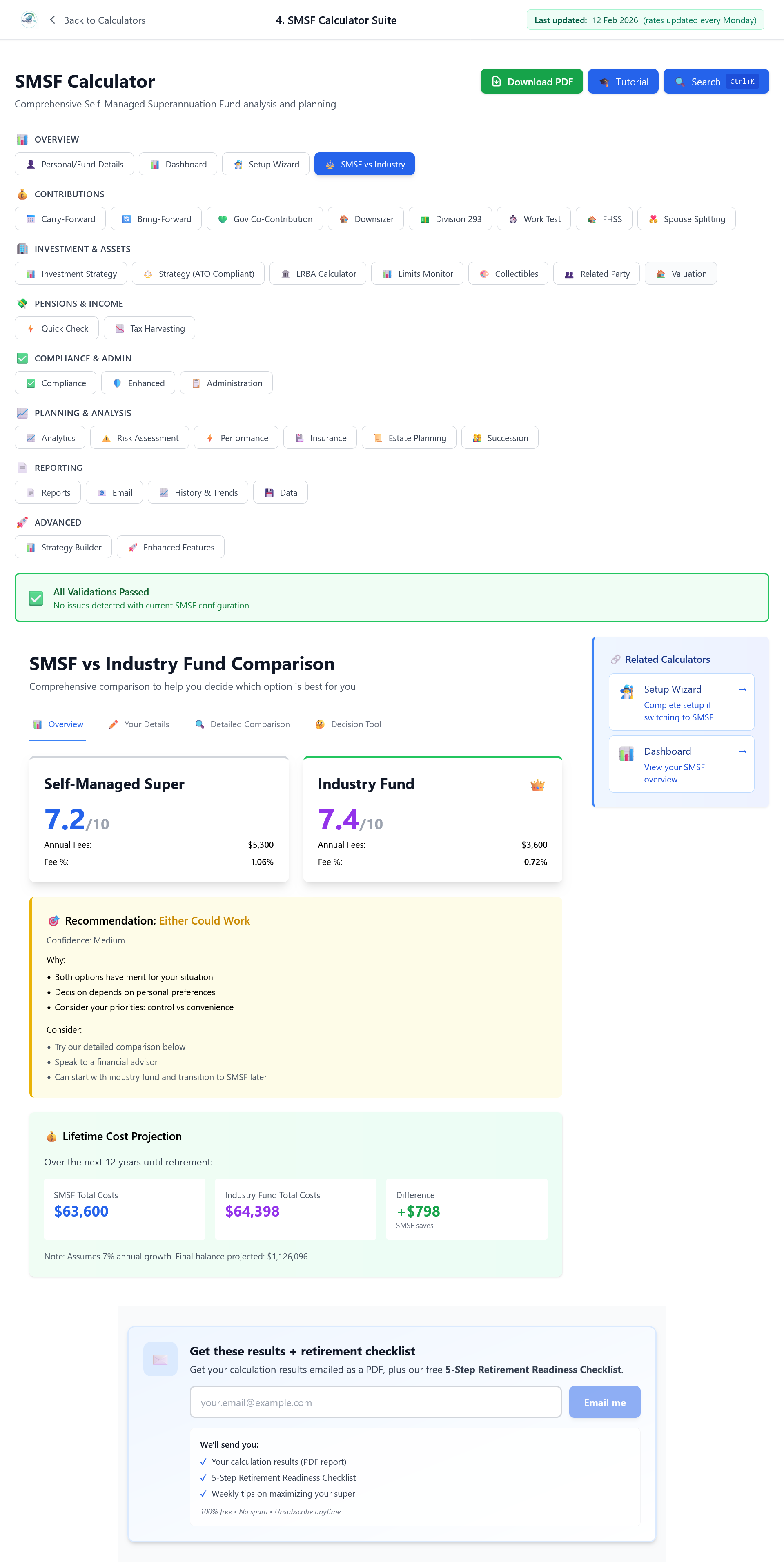
SMSF Suite: compare SMSF running costs vs industry fund fees to see when wind-up cost is outweighed by ongoing savings.
How to minimise wind-up costs
If you are planning to wind up your SMSF, plan ahead. Start the process early to avoid rushing. Do not overlook the time cost: trustee time, co-ordination with advisers, and delays can stretch the process to several months. Consider the tax implications of selling assets. You may be able to time sales to minimise CGT. And get professional advice early to understand all the costs involved.
If you are considering starting an SMSF, factor in the wind-up costs. SMSFs are not forever. Circumstances change, and you may need to close the fund one day. Understanding the full cost of ownership, including wind-up costs, helps you make an informed decision.
⚠️ The bottom line: Closing an SMSF costs far more than most trustees expect. Before starting an SMSF, or before deciding to close one, understand the full cost of wind-up. That $15,000 surprise could be the difference between a smooth transition and a financial disaster.
Compare SMSF running costs vs industry fund
Use the SMSF Suite to see your fund's running costs and compare them with retail or industry fund fees. See when wind-up cost is outweighed by ongoing savings.
Open SMSF SuiteWhat it costs to keep modelling
Try the SMSF Suite free first. Unlimited SMSF tools plus Advanced Retirement are All Access at $399 a year, or $39.99 a month if you’d rather not commit upfront.
Open the SMSF Suite →Free SMSF suite runs first, no card required. Subscribe only if the tools are useful enough to keep using.
Disclaimer: This article is general information only and does not constitute financial, tax or legal advice. SuperCalc Pro Pty Ltd does not hold an Australian Financial Services Licence (AFSL). We do not recommend that you open, close or change any super fund. SMSF wind-up costs vary. You should consult a licensed SMSF specialist or accountant for advice specific to your circumstances.