When you join an industry or retail super fund, the product typically includes default life insurance, total and permanent disability cover, and income protection. The cost is folded into the fund's fees, often around 0.1% to 0.2% of your balance per year. For a 45-year-old member, that might buy life and TPD cover in the hundreds of thousands of dollars and income protection of a few thousand dollars per month. They never see a separate insurance bill. The cover is just there.
Self-managed super funds do not work that way. An SMSF does not automatically provide any insurance. Trustees who want equivalent protection must arrange it themselves, usually through a retail life insurer or group policy, and pay the premiums from the fund or personally. The premiums are not hidden in a single fee. They are a separate, visible cost. For a 45-year-old in reasonable health, life and TPD cover can easily run to $2,000 to $5,000 per year, and income protection another $2,000 to $4,000. Many trustees look at that number, decide they cannot justify it or simply never get around to arranging it, and run their SMSF with no insurance at all.
That choice creates a gap. Take a trustee with $1 million in super and no life insurance. If they die, their dependants receive the $1 million balance. If the same person had been in an industry fund with, say, $500,000 of default life cover, their dependants would have received $1.5 million. The gap is $500,000. It is not a theoretical difference. It is the difference between what the family actually receives in one scenario and what they could have received in the other. For many households, that gap could determine whether they keep the family home, fund the children's education, or maintain something close to their previous standard of living.
What Industry Funds Provide by Default
APRA-regulated funds are required to offer default insurance to members unless the member has opted out or is in an eligible rollover fund. The default cover varies by fund and age, but it is common to see life and TPD in the range of $200,000 to $500,000 and income protection of $3,000 to $5,000 per month, often covering 75% of salary. Younger members and those with larger balances often have higher default sums. The premium is deducted from the member's account as part of the fund's overall fee structure. Members who never look at their insurance still have it.
For an SMSF trustee, matching that level of cover means going to an insurer, obtaining quotes, completing underwriting, and paying premiums that are not subsidised by the scale of a large fund. The result is that equivalent cover costs more when bought individually, and the full cost is visible. Some trustees conclude that the cost is too high and opt for minimal cover or none. Others intend to arrange insurance later and never do. In both cases, the family is left with whatever is in the fund and nothing more if the trustee dies or becomes permanently disabled.
When the Gap Shows Up
Consider a trustee who dies at 55 with $1 million in super and no life insurance. The family receives $1 million. If that balance is drawn down at 4% to 5% per year to supplement other income, it might generate $40,000 to $50,000 per year. For a household that had relied on the deceased's salary, that may be far short of what they need. If the same trustee had held $500,000 in life cover inside or alongside super, the combined $1.5 million could support $60,000 to $75,000 per year at the same withdrawal rates. The extra $500,000 does not just add a lump sum. It raises the sustainable income the family can draw for decades.
Total and permanent disability is the other side of the same problem. If a trustee becomes permanently unable to work, they lose future earnings but still have decades of living expenses ahead. TPD insurance pays a lump sum when the definition of permanent disability is met. That sum can fund medical and care costs, home modifications, and ongoing living expenses. Without it, the trustee has only their accumulated super. For someone in their forties or fifties with a moderate balance, that balance may be nowhere near enough to replace decades of lost income and meet higher expenses. TPD of $500,000 on top of a $1 million balance changes the equation. Again, the gap between having that cover and not having it can be half a million dollars or more.
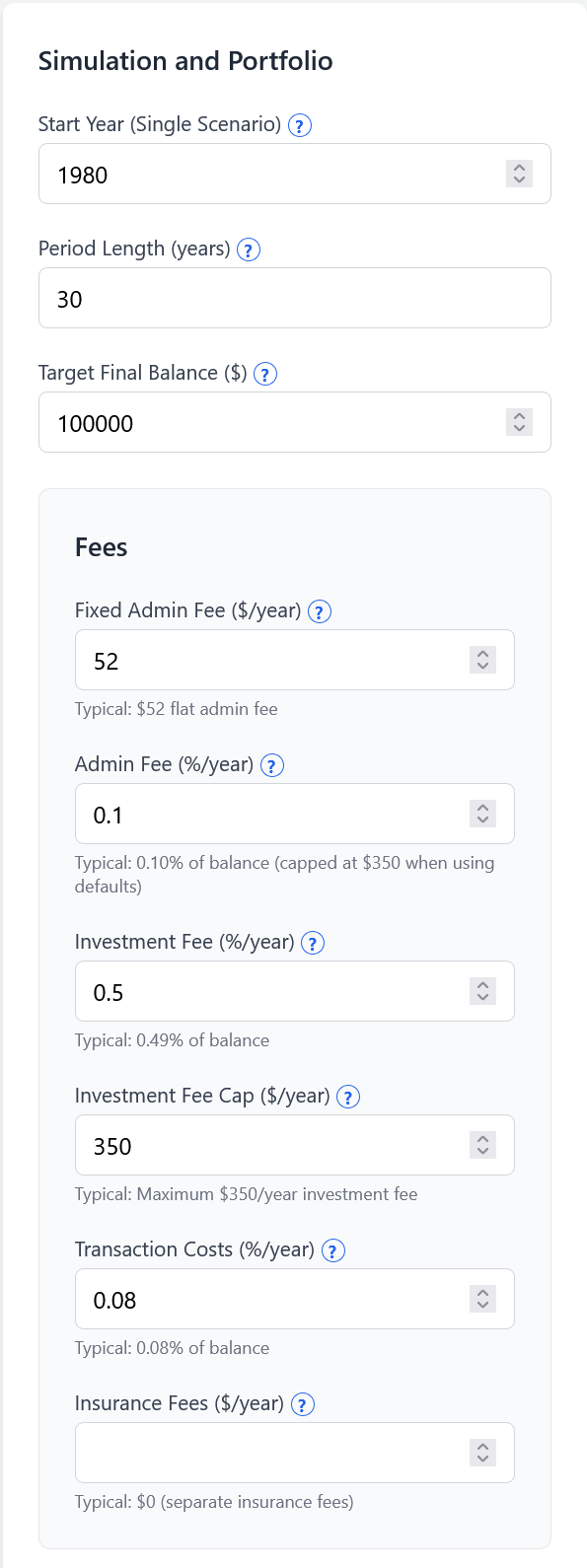
Advanced Calculator: enter Insurance Fees ($/year) to see how premiums affect your retirement projection.
Income Protection: The Safety Net for Earners
Income protection insurance pays a percentage of your salary, typically up to 75%, when you cannot work due to illness or injury. Industry funds often include it in their default offering, with waiting periods and benefit periods set by the fund. For an SMSF trustee who is still working and contributing to super, going without income protection means that any serious illness or injury that keeps them out of work for months or years is funded only by savings or early access to super. Drawing down super early to pay the mortgage or living expenses reduces the balance that would otherwise support retirement. Income protection does not fix the injury, but it can replace enough income to avoid raiding super and to keep contributions going when the trustee returns to work.
Factoring the Gap Into the SMSF Decision
Anyone comparing the cost of an SMSF with the cost of an industry fund should include insurance in the comparison. The industry fund fee already embeds a certain level of default cover. The SMSF has audit, accounting, ASIC and ATO levies, and often advice or administration costs. On top of that, the trustee who wants similar protection must add the cost of retail life, TPD and income protection. If the trustee chooses not to hold that cover, they should at least be aware that they are accepting a gap. In the event of death or permanent disability, the family or the trustee will receive only the fund balance, with no additional insurance payout. For many people, that gap is in the order of hundreds of thousands of dollars.
Trustees who already run an SMSF without insurance may want to review that decision periodically. Needs change. Dependants, debt, and health all shift over time. What looked too expensive five years ago may be worth revisiting. None of this is a recommendation to buy or cancel any product. It is a reminder that the structural difference between an APRA fund and an SMSF is that in one case default insurance is built in, and in the other it is not. Ignoring that difference does not make the gap go away.
Model Your Retirement With and Without Extra Protection
Use the Advanced Calculator to stress-test your plan. See how different income and balance scenarios affect your retirement outcome.
Try the Calculators2 free Advanced runs, no signup. See Pro pricing for unlimited scenarios.
What it costs to keep modelling
Try the SMSF Suite free first. Unlimited SMSF tools plus Advanced Retirement are All Access at $399 a year, or $39.99 a month if you’d rather not commit upfront.
Open the SMSF Suite →Free SMSF suite runs first, no card required. Subscribe only if the tools are useful enough to keep using.
Disclaimer: This article contains general information only. It is not financial product advice, personal advice, or a recommendation to acquire or hold any particular insurance or super product. It does not take into account your objectives, financial situation or needs. Before deciding whether to hold insurance inside or outside super, or to establish or maintain an SMSF, you should consider the relevant Product Disclosure Statement and seek advice from a holder of an Australian Financial Services Licence (AFSL) or an authorised representative. Insurance and super rules can change. SuperCalc Pro Pty Ltd does not hold an AFSL.