If your total super balance is under $500,000, you can carry forward unused concessional contribution caps from the previous five years. Many Australians potentially have $20,000-$50,000 in unused cap they don't know about, especially if they've had career breaks, worked part-time, or had variable income.
The problem is that most people don't know how much unused cap they have. Your super fund doesn't tell you. Your accountant might mention it, but they're not tracking it month-to-month. The only place you can see your exact unused cap is on MyGov, and even then, you need to know where to look.
Before You Start
Before you begin, make sure you have a MyGov account that's linked to the ATO. If you haven't set this up yet, you'll need to do that first. You'll also need your myGovID or other login credentials ready. The whole process takes about 5 minutes, so it's worth checking even if you're not sure you have unused cap.
Step-by-Step Guide
Step 1: Log into MyGov
Go to my.gov.au and sign in with your credentials. If you haven't linked the ATO to your MyGov account, you'll need to do that first by selecting "Link a service" and following the prompts to connect to the ATO.
Step 2: Access ATO Online Services
From your MyGov homepage, click on Australian Taxation Office to access ATO Online Services. This will take you to your ATO account dashboard.
Step 3: Navigate to Super
In the ATO menu, click on Super in the left sidebar or top menu. This section contains all your superannuation information as reported by your super funds to the ATO.
Step 4: Find Carry-Forward Contributions
Look for "Carry-forward concessional contributions" or "Concessional contributions cap". The exact wording may vary depending on ATO interface updates, but it should be clearly labeled. Click on it to see your available unused cap.
Step 5: Review Your Available Cap
You'll see a breakdown by financial year showing your cap for each year. Before 2021-22, the cap was $25,000. For 2021-24, it increased to $27,500. From 2024-25 onwards, it's $30,000.
The screen will show you:
- The cap for each year
- The contributions you made in each year
- The unused amount carried forward from that year
- Your total available unused cap across all years
This total is what you could potentially use in the current financial year, subject to meeting the eligibility criteria.
Found $30K in unused cap? That could be worth $80,000+ in your retirement. But timing matters, use it all this year or spread it over 3 years? Model your exact strategy in 2 minutes →
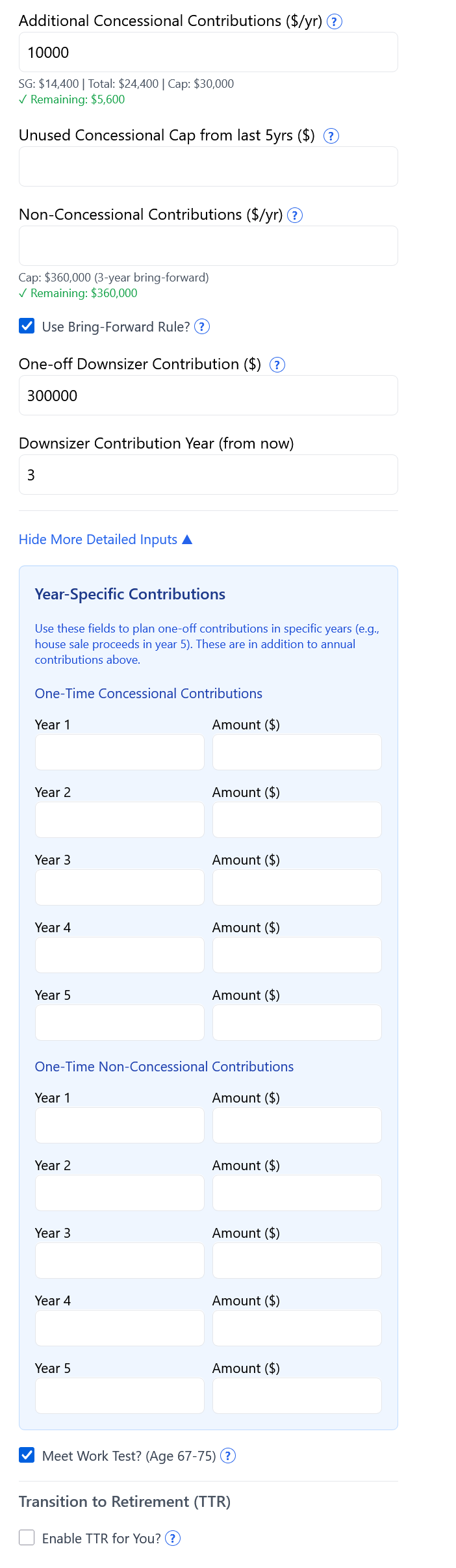
Example of the ATO carry-forward contributions screen showing unused cap amounts by year
Found Unused Cap? Before you contribute, model the impact. Using $30,000 in catch-up contributions now could add $80,000+ to your retirement balance over 20 years. But timing matters. Test Your Super Growth Strategy to see which contribution strategy maximizes your outcome.
Important Notes
Eligibility: You can only use carry-forward contributions if your total super balance was under $500,000 on 30 June of the previous financial year. This is a hard cutoff. If your balance was $500,001, you can't use carry-forward at all.
The carry-forward rule started on 1 July 2018, so the maximum you could have accumulated is five years of unused caps (from 2018-19 onwards). Unused amounts expire after five years, so if you had unused cap from 2018-19, it expired on 30 June 2024.
Your unused cap is based on what you actually contributed in previous years versus the cap for that year. If you contributed $15,000 in 2020-21 when the cap was $25,000, you have $10,000 of unused cap from that year. If you contributed nothing because you weren't working, you have the full cap amount as unused.
What To Do With Your Unused Cap
If you have unused cap available, there are two main ways to use it.
Salary Sacrifice
Arrange with your employer to contribute extra pre-tax money directly from your salary. This reduces your taxable income immediately and may provide tax savings, especially if you're in a higher tax bracket. For example, if you're on $150,000 and in the 37% tax bracket, contributing an extra $10,000 via salary sacrifice could potentially save you $3,700 in tax (subject to the 15% contributions tax within super).
Personal Deductible Contribution
You can contribute after-tax money from your bank account to your super fund, then claim a tax deduction when you lodge your tax return. This approach gives you more control over the timing and amount, but you need to wait until tax time to get the benefit. You must lodge a Notice of Intent to Claim a Deduction with your super fund before lodging your tax return, or the contribution won't be treated as concessional.
Timing and Strategy
You need to make contributions before 30 June to use this financial year's cap. If you're using carry-forward amounts, they're available in addition to your current year's cap, so you could potentially contribute significantly more than the standard $30,000 limit if you have unused cap from previous years.
However, remember that unused amounts expire after five years. If you have old unused cap from 2019-20, it will expire on 30 June 2025. You should consider prioritizing older unused cap before it expires, though all contributions are allocated to the current year's cap first, then to the oldest carried-forward amounts.
Also remember that using your unused cap affects your super balance for next year. If using your unused cap pushes your total super balance over $500,000, you won't be able to use carry-forward the following year. This isn't necessarily a problem, it's just something to be aware of when planning contributions over multiple years.
Use it all now or spread over 3 years? $30K now compounds to $95K+ by retirement. But spreading it might keep you under the $500K threshold for next year. Calculate your optimal strategy. See the compounding impact →
Common Questions
What if my balance is over $500,000?
You can't use carry-forward at all. You're limited to the standard $30,000 concessional cap for the current year. This is assessed on 30 June each year, so if your balance drops below $500,000 due to market movements or withdrawals, you may regain access to carry-forward the following year.
Does unused cap from before 2018-19 carry forward?
No. The carry-forward rule only started on 1 July 2018. Unused cap from earlier years doesn't count.
Can I use carry-forward if I'm over 67?
Yes, as long as your balance is under $500,000 and you meet the work test (if required for your age). The work test rules changed in 2022-23, making it easier for older Australians to contribute.
What happens if I exceed my cap?
You'll be charged excess concessional contributions tax. The ATO will send you a notice and offer you the option to release the excess amount from super or leave it in and pay extra tax at your marginal rate (minus a 15% offset). This is something you want to avoid, so it's worth tracking your contributions carefully throughout the year.
What it costs to keep modelling
Run Advanced Retirement free first. Unlimited scenarios, historical stress tests, and PDF exports are $149 a year, or $14.99 a month if you’d rather not commit upfront, typically less than one hour of paid advice for the same modelling work.
Run the Advanced Calculator →No card required to try it. Subscribe only if the model is useful enough to keep using.