Relationship breakdown is already stressful. Super adds a layer that many people only discover when lawyers ask for fund statements. Your balance may be the largest asset you hold after the family home, yet you cannot simply withdraw it and write a cheque to your former partner. Instead, Australian family law uses superannuation splitting under the Family Law Act 1975: Part VIIIB for married couples and Part VIIIC for de facto couples (including same-sex de facto partners in participating jurisdictions). The split can happen by consent, through court orders, or as part of a binding financial agreement. The mechanics look similar for many people, but the correct Part depends on whether the relationship was a marriage or a de facto relationship recognised under family law.
Super splitting is not the same as spouse contributions or contribution splitting during a happy marriage. Those are voluntary strategies to equalise balances over time. Divorce splitting is a one-off transfer driven by a family law outcome. It also differs from how the Age Pension assets test treats super while you are still a couple, because once you separate and Centrelink recognises that change, household means tests can shift from couple rates and combined assets to single assessments. This article explains how splitting works, what flagging orders do, and how tax and preservation rules follow the money. It is general information only. It does not tell you what split is fair in your matter or that you should pursue any particular settlement.
Super as property, but not like cash
Family courts treat superannuation as property available for division. That principle is straightforward. The mechanics are not. Super is held in trust by a fund trustee under super law, which means preservation ages, conditions of release, and tax components still govern what anyone can do with the money after a split. A property settlement might award you 60% of the combined super pool on paper, but the outcome is implemented as a transfer between super interests, not as cash in your hand unless you separately qualify to withdraw under normal rules.
Many settlements blend super with the home, investments, and personal property. A common pattern is for one party to keep more super and the other to keep more of the non-super assets, particularly when one partner has a much larger balance and liquidity elsewhere is limited. Others prefer a direct super split so each person leaves the relationship with their own account. Neither approach is universal. The overall settlement depends on contributions, future needs, care of children, health, income capacity, and the length of the relationship. Family lawyers and mediators work through those factors. This article stays on the super mechanics once a percentage or dollar split has been agreed or ordered.
Splitting orders, flagging, and payment splits
The main tool is a superannuation splitting order. It directs the trustee to transfer a specified percentage or base amount from the member spouse's interest to the non-member spouse's interest. If the non-member spouse has no account, the trustee may need to establish one or accept a rollover to another fund they nominate. The transfer is usually expressed as a percentage of the splittable amount at a valuation date, or as a fixed dollar base amount with an adjustment mechanism if the balance moves before implementation.
A flagging order is different. It does not split anything immediately. It tells the trustee to freeze dealings with the interest until the court or the parties resolve the final split. Flagging protects the balance while negotiations continue, so the member spouse cannot roll the account to a new fund, start a pension that complicates valuation, or otherwise reduce the amount available to split. Once the final splitting order is made, the flag lifts and the trustee implements the split. Flagging is common in contested matters where valuation timing matters.
If super is still in accumulation phase, the usual tool is a base-amount splitting order: a lump-sum transfer of part of the member's interest to the non-member spouse. There is no transfer balance cap interaction on that path because no retirement-phase income stream is in payment yet. If super is already in pension phase and an account-based pension or other income stream is being drawn, a payment split may apply instead of or as well as a base-amount split. A payment split divides future pension payments between the parties according to the order rather than treating the matter as a simple accumulation transfer.
Where one party is already drawing an account-based pension or other commenced retirement-phase income stream, a payment split divides future pension payments between the parties according to the order. The non-member spouse receives a transfer balance account credit linked to their share of the pension, and the member receives a corresponding debit on their transfer balance account. That credit counts toward the non-member spouse's personal transfer balance cap. If they already have a pension or are near their cap, an excess transfer balance can arise until the amount is commuted or otherwise corrected under ATO rules. Minimum drawdown rules still apply to the member's reduced stream. Payment splits are less common in retail and industry funds than in defined benefit or public sector schemes. Confirm cap arithmetic with the fund, the ATO, and a licensed adviser before relying on an order. The SMSF context adds trustee duties and deed rules on top of family law paperwork.
How the split is calculated and implemented
The starting point is the value of the member's super interest at the agreed or court-ordered date. For most accumulation accounts in APRA-regulated funds, that is the account balance on the valuation day, adjusted for any previous splits and certain exclusions. Defined benefit schemes and some public sector funds use actuarial or formula-based valuations instead of a simple balance. Those valuation methods sit in the Family Law (Superannuation) Regulations 2025, which replaced the 2001 regulations from 1 April 2025 and updated factors for certain interest types. Untaxed schemes and legacy products can produce splittable amounts that look nothing like the balance on a member statement. If either party has a defined benefit, specialist valuation is usually required before anyone signs consent orders.
Once the order is sealed, the member spouse gives the fund a copy together with the forms the trustee requires. The trustee has a limited time to implement the split under those regulations and super law. The non-member spouse receives a new preserved interest in their own name (or an increase to an existing interest). Tax components generally transfer in the same proportions as the original interest unless the order and fund rules specify otherwise. The split itself is typically not treated as a taxable withdrawal for either party when done correctly under family law provisions, though incorrect paperwork or partial rollovers can create tax and excess contribution issues that are expensive to unwind.
Timing matters for couples who separate but have not yet divorced. Splitting can occur while still legally married or in a de facto relationship that has broken down. It does not require a final divorce certificate first, though many people complete the property settlement around the same time as other family law steps. Waiting too long can allow balances to drift with markets, contributions, or pension commencements, which changes the dollar outcome even if the percentage stays fixed. It can also put you outside the formal time limits for bringing property settlement proceedings, which are separate from super preservation rules.
Time limits for property settlement
Family law imposes deadlines for starting property settlement proceedings, and missing them can block or complicate a claim even when super is clearly part of the pool. For married couples, the usual limit is 12 months from the date the divorce order takes effect. For de facto couples, it is generally two years from the end of the relationship. These limits apply to the overall property settlement, which includes super splitting orders, consent orders, and binding financial agreements that formalise the division.
If the deadline has passed, you may need leave of the court to commence proceedings. Leave is not automatic. The court weighs factors such as hardship to either party, the length of delay, and whether the other party would be prejudiced. Some people assume they can wait until retirement because super is preserved anyway. That confuses access rules inside super with the separate family law clock on settling property. If you are separated or divorcing, ask a family lawyer early how much time you have in your situation rather than assuming super can always be split later.
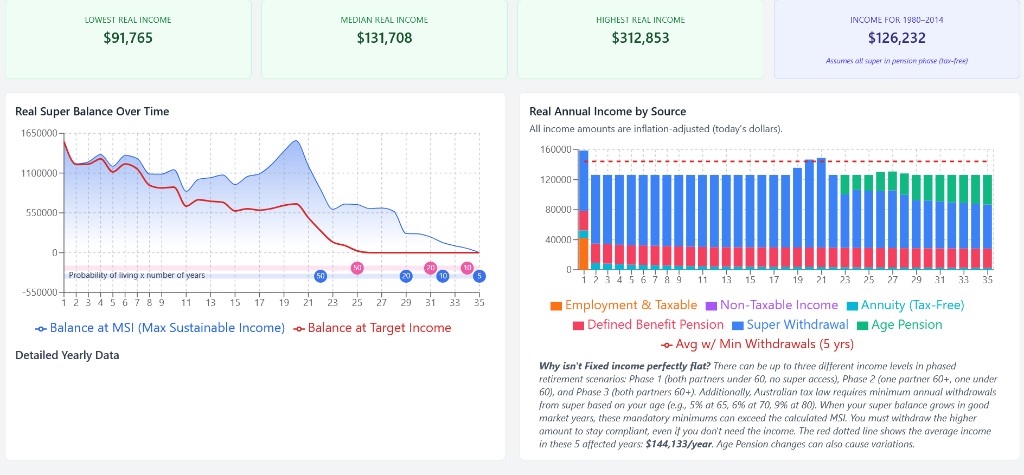
Advanced Calculator couple example: historical income summary (lowest, median, highest real income across periods) and year-by-year household super balance and income from super drawdown, Age Pension, and other sources. Adjust each partner's balance in the inputs to model a post-settlement split, then re-run to compare outcomes.
Preservation, tax, and access after the split
The non-member spouse does not get spending money from the split by default. The transferred amount lands in super under their own member number, still subject to preservation rules. If they are 52 and the money is preserved, they cannot withdraw it simply because the relationship ended. Access follows the same conditions of release as anyone else: reaching preservation age with a valid condition, severe financial hardship, terminal illness, and the other statutory pathways. If they are already 67, they may have full access, but that is because of age and release rules, not because of the divorce itself.
When they eventually withdraw, tax follows normal component rules. From age 60, lump sums from a taxed source are generally tax-free in their hands. Death benefit tax for non-dependants still depends on the tax-free and taxable mix inside the account, which is why some people later explore recontribution strategies in a completely different context. A divorce split does not automatically improve or worsen death benefit tax; it moves existing components into a new account in proportion.
Contribution caps can bite after a split. Receiving a large split does not count as a non-concessional contribution for cap purposes when implemented under a valid splitting order, but if someone later adds their own contributions, total super balance tests and bring-forward rules apply to them as an individual. A person who receives $400,000 from a split and already holds $1.7 million may have little or no non-concessional cap room left. Cap planning is separate from the split itself but becomes urgent if they want to keep contributing.
SMSF complications
Self-managed super funds add trustee governance to an already legal process. If both parties are members and trustees, the fund must implement the order without breaching sole-purpose test or deed restrictions. That can mean selling listed shares, calling in a related-party loan, or dealing with property inside the SMSF if the settlement requires cash or a proportional transfer of assets. An illiquid property portfolio makes member exits harder. One person's entitlement may require a partial sale or a transfer of units in a related entity, which triggers its own tax and stamp duty advice.
Many separated couples wind up with one member leaving the SMSF entirely. That rollover must be done cleanly so the splitting order is satisfied and the remaining trustee structure complies with super law (minimum two individual trustees or a corporate trustee with appropriate directors). Binding death benefit nominations and reversionary pensions need review after separation. A nomination favouring a former partner may no longer match intentions, though changing it is a separate step from the property settlement and must follow fund deed rules. See binding death benefit nominations for how nominations interact with wills; family law outcomes do not automatically update SMSF paperwork.
De facto couples, Western Australia, and Centrelink after separation
De facto partners use Part VIIIC of the Family Law Act, not Part VIIIB. The orders, flagging, and payment-split concepts parallel marriage, but eligibility depends on the relationship being recognised as de facto under family law and on whether the state or territory participates in the federal scheme. Most separated de facto couples in participating jurisdictions can split super the same way married couples do, subject to evidence of the relationship and its breakdown.
Western Australia is the practical wrinkle many articles gloss over. WA de facto couples could not split super under the federal family law framework until 28 September 2022, when the Family Law Amendment (Western Australia De Facto Superannuation Splitting and Bankruptcy) Act 2020 commenced and inserted Part VIIIC for WA de facto relationships. Settlements that pre-date that change, or advice written before it, may still say WA de facto super cannot be split. That was true historically; it is no longer the starting point for new matters from late 2022 onward. Married couples in WA have long used Part VIIIB. If you are a WA de facto partner separating now, confirm with a family lawyer that Part VIIIC applies to your circumstances rather than relying on older summaries.
Centrelink treats you as a member of a couple until Services Australia accepts that you are separated under social security law, which has its own tests and documentation. While assessed as a couple, combined assets and income tests apply, including super in accumulation for partners under Age Pension age in many cases. After separation is recognised, each person is generally assessed as a single for pension purposes, which changes thresholds, taper rates, and the rate of payment. A super split executed late in the process can shift balances between ex-partners after Centrelink has already re-assessed household assets. Reporting obligations continue after separation. Modelling single versus couple outcomes in the Advanced Calculator is a useful sanity check, but Services Australia makes the formal determination.
Common misunderstandings
The first misunderstanding is that super is always split 50/50. There is no default equal split in family law. The percentage follows the overall property settlement. The second is that a split puts cash in the bank. It usually does not. The third is confusing divorce splitting with annual contribution splitting, which is capped and voluntary during a relationship. The fourth is ignoring defined benefit or untaxed schemes until the last minute, when actuarial valuations delay consent orders by months. The fifth is assuming an SMSF can ignore an order because both parties are trustees. Trustees must comply; personal disputes do not suspend regulatory obligations. The sixth is waiting too long to start property settlement proceedings. Super may stay preserved for years, but family law time limits (12 months after divorce for married couples, two years after relationship end for de facto couples) can still bar or complicate a claim unless the court grants leave.
Another trap is treating super in isolation from spousal maintenance, child support, and non-super property. A settlement that looks fair on super alone may be unfair overall if one party keeps the home with a large mortgage and little liquid super. Conversely, keeping the house might mean accepting a smaller super share. Integrated advice from a family lawyer, and where appropriate a financial adviser or accountant who understands super, is the practical path through those trade-offs.
What to gather before you talk to a lawyer
Fund statements for every super account each party holds, including lost super searches through myGov if balances might be missing. Details of any pension already commenced, including transfer balance cap history. For SMSFs, the latest financial statements, asset list, and deed. For defined benefit funds, the member guide and any estimate of splitable amount the scheme provides. A rough timeline of separation, contributions during the relationship, and any prior flagging or interim orders.
With those facts, a family lawyer can explain whether a splitting order, payment split, or offset against other assets makes more sense. You can then use the Advanced Calculator to stress-test retirement income under different balance assumptions, particularly if one party keeps more super and less home equity or vice versa. The calculator shows directionally how sustainable income and Age Pension might change when balances move between partners or when a couple household becomes two single projections.
Model unequal balances and separated households
See how different super splits affect household income, Age Pension, and long-run drawdown before you finalise numbers with your adviser.
Open the Advanced CalculatorWhat it costs to keep modelling
Run Advanced Retirement free first. Unlimited scenarios, historical stress tests, and PDF exports are $149 a year, or $14.99 a month if you’d rather not commit upfront, typically less than one hour of paid advice for the same modelling work.
Run the Advanced Calculator →No card required to try it. Subscribe only if the model is useful enough to keep using.
Disclaimer: This article is general information only. It is not financial product advice, legal advice, or personal advice. SuperCalc Pro Pty Ltd does not hold an Australian Financial Services Licence (AFSL). We do not recommend that you open, close, or change any super fund or product, or that you pursue any particular property settlement or superannuation splitting order. Family law and super rules change and depend on individual circumstances. For advice tailored to your situation, consult a family lawyer, the ATO, your super fund trustee, Services Australia, or a licensed financial adviser, SMSF specialist, or tax agent.