In the weeks around 1 July the inbox fills with the same question in slightly different clothes: what went up? Often the writer means the super rates sheet. Sometimes they mean Age Pension. Those sit under different statutes, different indexes, and different rounding rules, so treating "indexation" as a single CPI lift across every threshold is how the wrong number ends up in a spreadsheet.
What follows is the machinery itself: how often caps move, why a quiet year can follow a noisy one, and what changed from 2025-26 into 2026-27. Use it as a reference beside the dollar table, not as a contribution schedule. The headline amounts also live on the super and Age Pension rates hub.
Two indexes, two step sizes
Super contribution caps track wages. The general concessional contributions cap rises in line with Average Weekly Ordinary Time Earnings (AWOTE), in $2,500 increments. When wage growth is soft, the formula can sit under the next step for a year or two. That is why the cap held at $30,000 across 2024-25 and 2025-26, then jumped to $32,500 from 1 July 2026 once AWOTE cleared the hurdle.
The annual non-concessional cap is generally four times the concessional cap, so it usually moves when concessional moves. A $2,500 concessional step typically means a $10,000 non-concessional step. Bring-forward room, where eligible, is built from those annual figures (up to three years), which is why after-tax contribution planning ends up on the same AWOTE escalator as salary sacrifice and SG.
The general transfer balance cap tracks prices instead. It indexes to the Consumer Price Index in $100,000 increments. From $1.6 million in 2017 it stepped through $1.7 million, $1.9 million, and $2.0 million, and from 1 July 2026 it sits at $2.1 million. Large round numbers, infrequent moves, CPI under the hood: wages and prices are both "indexation," but they are not the same dial.
Personal transfer balance cap is not the general cap
The trap that still catches people who stop at the newspaper figure is that the general transfer balance cap is the public ceiling, while your personal cap is an ATO ledger. It depends on when you first entered retirement phase and how much of the then-available general cap you used. If you used the lot under an earlier general cap, you do not wake up on 1 July with a free extra $100,000 of pension-phase space just because the general cap indexed. Unused space can attract proportional indexation; full use locks the proportion.
Accumulation members still care about the general figure because it sets total super balance cut-offs for non-concessional eligibility. Someone who started a pension years ago under a smaller general cap has a different remaining personal ceiling again, even though both households talk about "the transfer balance cap" as if it were one shared number.
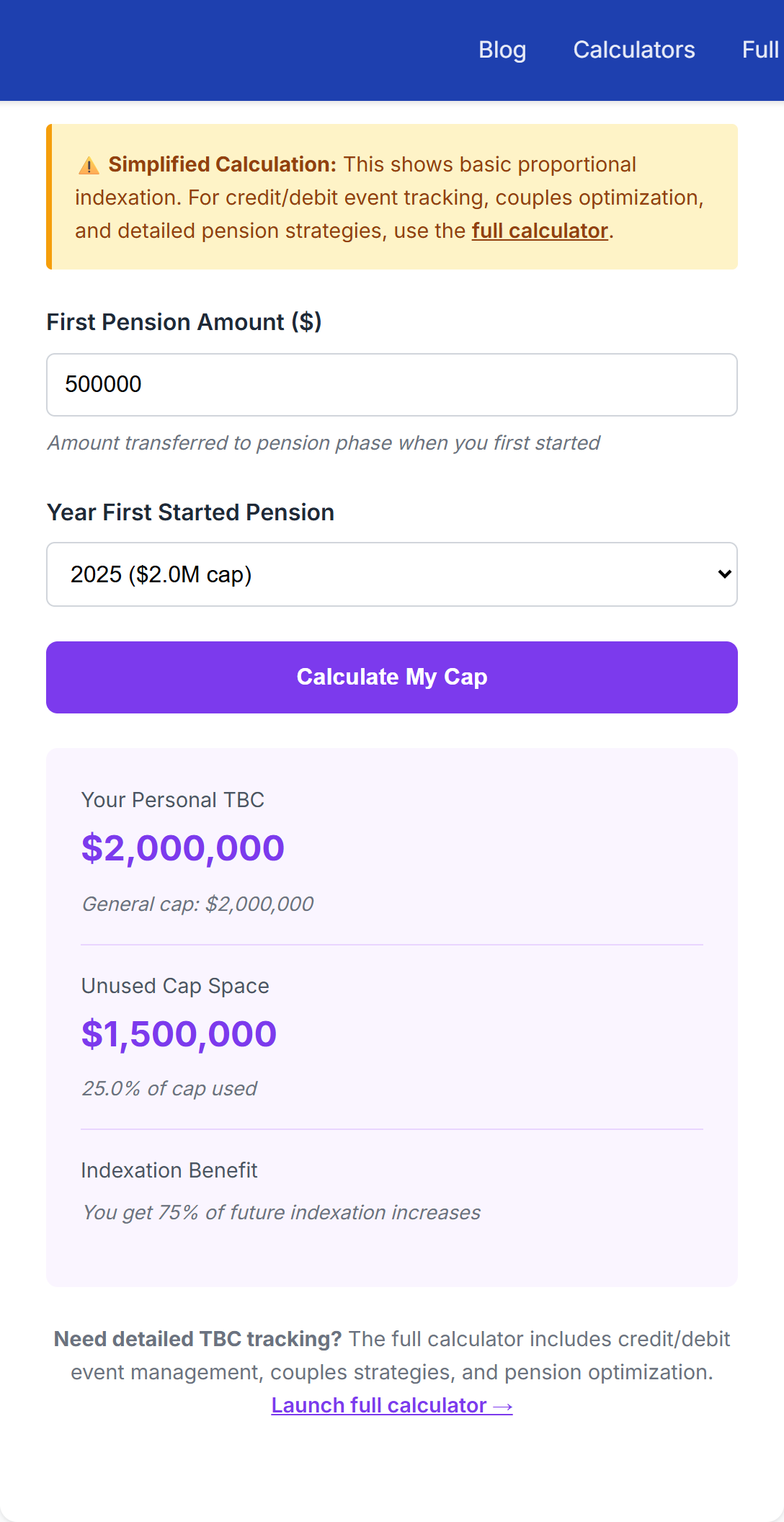
Same plan, different financial year: contribution room and transfer balance settings follow the year you model.
What moved for 2026-27
After two years stuck at $30,000, the concessional cap stepped to $32,500. Non-concessional followed to $130,000. Full three-year bring-forward where eligible: $390,000. General transfer balance cap: $2.1 million. Defined benefit income cap: $131,250. Small business CGT cap: $1,935,000 (that one also tracks AWOTE, in $5,000 steps, usually published earlier in the calendar year).
| Measure | Index / step | 2025-26 | From 1 July 2026 |
|---|---|---|---|
| Concessional contributions cap | AWOTE / $2,500 | $30,000 | $32,500 |
| Non-concessional cap (annual) | 4× concessional | $120,000 | $130,000 |
| Bring-forward maximum (3 years) | From annual NCC | $360,000 | $390,000 |
| General transfer balance cap | CPI / $100,000 | $2,000,000 | $2,100,000 |
| Defined benefit income cap | Linked to TBC path | $125,000 | $131,250 |
| CGT cap (small business) | AWOTE / $5,000 | $1,865,000 | $1,935,000 |
| Division 293 income threshold | Not indexed on 1 July | $250,000 | $250,000 |
| Super Guarantee rate | Legislated schedule | 12% | 12% |
ATO tables: contributions caps, transfer balance cap. Deeper dollar walk-throughs: bring-forward rule, Division 293.
What does not ride the July escalator
Division 293's $250,000 income threshold for surcharge purposes does not bump with the concessional cap. Bigger contribution room can mean a bigger surcharge bill for people already over that income line. In parliamentary debate the contribution-cap story and the high-income surcharge story were often treated as separate files; in a July payslip they land on the same dollars. Someone who salary-sacrifices straight up to the new $32,500 ceiling can still face the extra 15% on concessional contributions once Division 293 income is above $250,000
Minimum pension drawdown percentages by age band stay put on 1 July. Preservation age and Age Pension age are fixed in statute rather than CPI-stepped. Downsizer contribution rules are their own regime. The Super Guarantee rate follows a legislated schedule rather than AWOTE; it reached 12% on 1 July 2025 and stays there for 2026-27. Payday Super changed when employers must pay from 1 July 2026, while the percentage itself did not move.
Division 296 applies from 1 July 2026 to very large balances. Treat the large and very large thresholds as the amounts published for that income year, and confirm them on the ATO pages rather than assuming they move on the same AWOTE or CPI staircase as contribution caps.
Age Pension and deeming run a different clock
Centrelink does not run on the super financial year. Rates and assets tests for Age Pension are reviewed on Services Australia's March and September timetable. Deeming rates have their own change dates; the most recent shift many households still track is the March 2026 deeming change. Asking "did the pension go up on 1 July because the concessional cap did?" is mixing two departments' calendars.
In a household model that mismatch shows up as false precision. Super contribution room can expand on 1 July while Age Pension thresholds sit still until the next Services Australia review, so a July spreadsheet can look current and still misstate September cashflow if both calendars were not updated.
Why quiet years happen
Indexation with large step sizes is deliberately sticky. AWOTE has to clear enough growth to justify another $2,500 on the concessional cap. CPI has to clear enough to justify another $100,000 on the general transfer balance cap. Soft inflation or soft wages leave the printed number unchanged even when the underlying series moved a little, because the statute rounds in chunks rather than inching the cap each year.
The practical habit is boring: check the ATO key rates page when ABS releases the relevant AWOTE and CPI prints, then again when the ATO publishes the financial-year table. Guessing from last year's spreadsheet is how people contribute against the wrong cap.
30 June snapshots still gate the new year
Indexation changes the ceilings. Total super balance on 30 June still decides non-concessional eligibility for the year that follows. A higher general transfer balance cap from 1 July cannot rewrite a 30 June balance that was already over the line for that year's test, and a withdrawal booked after 30 June may help a later year without unlocking the snapshot already locked for the year just started.
Carry-forward concessional room has its own $500,000 total super balance gate at 30 June of the previous year. The new $32,500 annual cap raises the fresh-year ceiling before any catch-up applies; it does not recreate unused room from years you already filled.
Model the year the caps actually apply
Set 2025-26 or 2026-27 explicitly, then see how contribution room and pension-phase space change on the same inputs.
Open the Advanced CalculatorOfficial sources
- ATO: Contributions caps
- ATO: Transfer balance cap
- ATO: Key superannuation rates and thresholds
- Services Australia: Age Pension
What it costs to keep modelling
Run Advanced Retirement free first. Unlimited scenarios, historical stress tests, and PDF exports are $149 a year, or $14.99 a month if you’d rather not commit upfront, typically less than one hour of paid advice for the same modelling work.
Run the Advanced Calculator →No card required to try it. Subscribe only if the model is useful enough to keep using.
Disclaimer: This article is general information only. It is not financial product advice, personal advice, or a recommendation to contribute to, withdraw from, open, close, or change any superannuation fund or product. SuperCalc Pro Pty Ltd does not hold an Australian Financial Services Licence (AFSL). Caps, thresholds, and indexation outcomes change; confirm current figures with the ATO and Services Australia, and seek advice from a licensed financial adviser, SMSF specialist, or accountant about your own circumstances.