AWOTE and CPI landed in early 2026. The ATO published the 2026-27 caps, and from 1 July the concessional cap is $32,500, the general transfer balance cap is $2.1 million, Division 296 applies to very large balances, and employers face Payday Super timing rules. Super Guarantee stays at 12%. The companion super and Age Pension rates hub keeps the calculator-facing thresholds in one place. Nothing in that list tells you to contribute more or start a pension. It just changes the arithmetic if you were already planning to.
The numbers that move
Indexation does the heavy lifting for 2026-27 super rates. Concessional cap: $32,500. Non-concessional cap (four times concessional): $130,000. Full bring-forward where eligible: $390,000. General transfer balance cap: $2.1 million. Defined benefit income cap: $131,250. Small business CGT cap: $1,935,000.
Division 293 still bites above $250,000 income for surcharge purposes, and that threshold does not move on 1 July.
Snapshot below. Your room depends on age, work status, and total super balance on 30 June.
| Measure | 2025-26 | From 1 July 2026 |
|---|---|---|
| Concessional contributions cap | $30,000 | $32,500 |
| Non-concessional cap (annual) | $120,000 | $130,000 |
| Bring-forward maximum (3 years) | $360,000 | $390,000 |
| General transfer balance cap | $2,000,000 | $2,100,000 |
| Defined benefit income cap | $125,000 | $131,250 |
| CGT cap (small business) | $1,865,000 | $1,935,000 |
| Super Guarantee rate | 12% | 12% (unchanged) |
| Division 293 income threshold | $250,000 | $250,000 (unchanged) |
ATO tables for 2026-27: contributions caps, transfer balance cap. Deeper dives: concessional cap, bring-forward rule.
Concessional contributions cap: $32,500
Employer SG, salary sacrifice, personal deductible: all one pool. The $2,500 step-up is AWOTE indexation in $2,500 steps.
High earners fixate on the cap and forget Division 293. Above $250,000 income for surcharge purposes you still pay an extra 15% on concessional contributions, and that line does not index on 1 July. I have lost count of how often someone maxes salary sacrifice in July and only then discovers the surcharge in the same year: bigger headline cap, bigger tax bill.
Carry-forward is the opposite problem: people who could use it simply do not look until it is too late. Total super balance under $500,000 at 30 June 2026? You may still have unused concessional cap from up to five prior years, if you were eligible in those years. That check belongs in May or early June. Every year, without fail, someone rings in July asking what they missed.
The cap is $32,500.
Non-concessional contributions and bring-forward
Total super balance at 30 June 2026 gates non-concessional room for 2026-27, not your balance on 1 July and not what you wish it were after a withdrawal you are still processing. At or above the general transfer balance cap of $2.1 million, the annual cap is zero, even when your personal transfer balance cap is lower because you started a pension years ago under a smaller general cap. That mismatch catches people who read "my TBC" and ignore "general TBC".
Below $1.84 million at 30 June, an eligible member under 75 can trigger up to $390,000 via bring-forward; the bands step down through $260,000 and $130,000 as TSB rises. Plenty who were locked out when the general cap sat at $1.7 million or $2 million may have a window again, but only if the 30 June snapshot cooperates. The ATO does not care that you intended to be under the line.
Bring-forward is not a bonus.
July 2026 money can consume 2027-28 and 2028-29 entitlements. Anyone eyeing recontribution needs the three-year picture, not the headline $130,000 non-concessional cap.
Transfer balance cap: $2.1 million
The general transfer balance cap limits how much super can sit in retirement-phase pension where earnings are tax-free in the fund. From 1 July 2026 it rises to $2.1 million. Your personal cap is a separate ATO ledger. It tracks when you first entered retirement phase and how much proportional indexation has been credited since. Someone who used the full $1.7 million cap in 2022-23 does not inherit the full march to $2.1 million overnight; indexation accrues in proportion, and the maths annoys people who assumed "general cap went up" equals "mine went up by the same amount".
Accumulation members still care because the general cap sets TSB thresholds for after-tax eligibility. Defined benefit income cap for tax: $131,250. Minimum pension drawdown percentages do not move on 1 July.
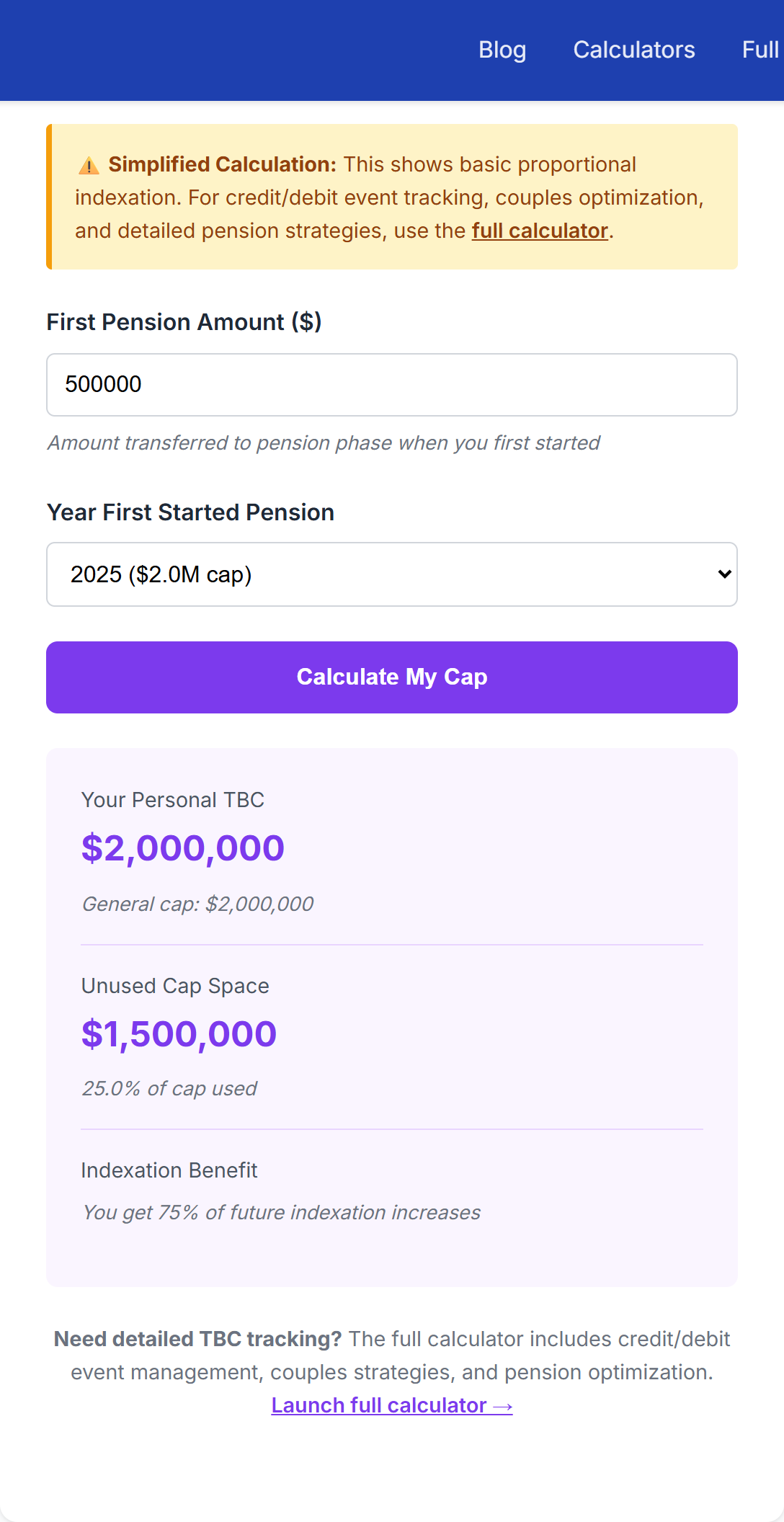
2026-27 caps in the Advanced Calculator. Same session, June vs July strategy? Set the year.
Payday Super from 1 July 2026
Employees will notice super landing more often. Employers will notice payroll software invoices.
From 1 July, Super Guarantee generally has to reach the fund within seven business days of payday, not batched quarterly. New employees, or first SG payment to a new fund for that worker: 20 business days for the first hit. Qualifying earnings now sweeps in commissions, sacrificed amounts that would otherwise count, and more contractor payments where labour is the main game. If your payslip SG line moves but take-home does not, the rate is still 12%; something changed in timing or the earnings base.
Division 296 tax from 1 July 2026
I watched Division 296 crawl through Parliament for years: flagged, amended, shelved, revived, argued about in estimates, sold as fairness and attacked as retrospectivity, depending on which side had the microphone. Royal Assent on 13 March 2026 finally made it real. From 1 July 2026 it is law, not a green paper to worry about later. Total super balance above $3 million at year end: an additional 15% tax on the earnings proportion above that threshold. Above $10 million: another 10% on the slice above that line. See the full Division 296 guide for calculation detail. The ATO will not accept "I thought it was still draft".
Division 293 taxes high income on concessional contributions. Division 296 taxes high balances on earnings. Different animals. If you are anywhere near those thresholds, the 2026-27 year is the first where the invoice actually arrives.
What does not change on 1 July 2026
Age Pension rates and assets tests: March and September for Services Australia. Deeming from 20 March 2026 until Services Australia says otherwise.
Preservation age, Age Pension age (67), downsizer rules, minimum pension percentages, Division 293's $250,000 threshold, individual income tax brackets in the budget material we reviewed: all unchanged on this date.
Centrelink does not run on the super financial year.
30 June vs 1 July: timing traps
This is where competent plans still come unstuck. Non-concessional eligibility for 2026-27 uses TSB at 30 June 2026. Withdraw on 29 June to get under $2.1 million? Too late if 30 June was already above the line. Withdraw in July? Maybe helps a later year, not 2026-27. Concessional allocations before 1 July count against the $30,000 cap; after, $32,500. The same dollars on 28 June versus 2 July can land in different financial years, different bring-forward bands, different stories, and people still treat 30 June as a suggestion rather than a ledger date.
Pension minimums for 2025-26 still tie to the 1 July 2025 balance. Modelling June and July in one calculator session without setting the scenario year? You get a number that matches neither year.
Run the numbers under 2026-27 caps
Accumulation, pension, or a contribution straddling 30 June: set the year and see what changes.
Open the Advanced CalculatorWhat it costs to keep modelling
Run Advanced Retirement free first. Unlimited scenarios, historical stress tests, and PDF exports are $149 a year, or $14.99 a month if you’d rather not commit upfront, typically less than one hour of paid advice for the same modelling work.
Run the Advanced Calculator →No card required to try it. Subscribe only if the model is useful enough to keep using.
Disclaimer: This article is general information only. It is not financial product advice or personal advice. SuperCalc Pro Pty Ltd does not hold an Australian Financial Services Licence (AFSL). We do not recommend that you open, close, or change any super fund or product, or that you make particular contributions or start a pension. Tax rules, contribution caps, total super balance tests, transfer balance cap rules, and employer Super Guarantee obligations can change. For advice tailored to your situation, see the ATO, your super fund, Services Australia, or a licensed financial adviser, SMSF specialist, or tax agent.