What is the non-concessional bring-forward rule?
The non-concessional bring-forward rule lets eligible people make up to three years of after-tax super contributions in a shorter period. Eligibility depends on age, total super balance, and contribution caps, so a large contribution can block or reduce future after-tax contribution room.
Important: General information only, not financial product advice or personal advice. SuperCalc Pro does not hold an Australian Financial Services Licence (AFSL). This article does not recommend contributing, withdrawing, or changing any super arrangement. Caps and total super balance cut-offs are indexed and can change on 1 July. Confirm the figures for your year with the ATO and seek advice from a licensed financial adviser or accountant before acting.
Non-concessional contributions (NCCs) are the main way Australians move after-tax savings into super without claiming a personal deduction. They sit alongside concessional contributions (employer SG, salary sacrifice, personal deductible), which use the separate annual concessional cap. If you are weighing a large after-tax lump sum, the interaction with the bring-forward rule and your total super balance (TSB) on the prior 30 June usually decides whether the contribution is allowed at all, and how much room you really have.
What counts as a non-concessional contribution
In ordinary language, NCCs are amounts your fund accepts as non-concessional because no deduction is claimed (or available) for them in the same way as concessional amounts. Common sources include personal transfers from your bank account, spouse contributions that are not deductible to the contributor, and some recontribution flows where the tax character matches non-concessional rules. Amounts with special rules, such as the downsizer contribution or eligible amounts under the First Home Super Saver Scheme, can sit outside the usual cap tests. Always read the specific ATO topic for those pathways.
The annual non-concessional cap
The general non-concessional contributions cap is an annual limit that moves with indexation. For recent years from 1 July 2024 the headline cap has been $120,000 per financial year for members who are otherwise eligible. If you do not trigger the bring-forward rule, that annual figure is normally the ceiling for a single year (subject to age and other eligibility rules that change from time to time).
NCCs are made from money that has generally already been taxed personally, so they do not attract the same 15% contributions tax entry story as concessional amounts. Inside super in accumulation phase, investment earnings are still typically taxed at 15% until you move to retirement phase, which is a different layer of law from the contribution cap itself.
Total super balance (TSB) gates
Before you rely on any cap, your TSB at 30 June of the previous financial year is the gatekeeper. If your TSB is at or above the general transfer balance cap (currently $2 million, indexed over time), you generally cannot make non-concessional contributions for that income year. Between lower indexed thresholds and that upper cutoff, the law scales down how much of the bring-forward you can access. The dollar breakpoints are updated on 1 July; copying last year table into a spreadsheet without checking is a common mistake.
Practical habit: Each June, download your myGov ATO super snapshot and note total super balance across all funds, not only the account you plan to contribute to. The test is aggregate.
How the bring-forward rule works (conceptually)
If your TSB is below the relevant lower threshold on the prior 30 June and you are otherwise eligible, contributing more than the standard annual NCC cap in one year can trigger the bring-forward arrangement. Instead of treating only the first $120,000 as valid and the rest as excess, the law may allow you to treat the extra amount as pulling forward future years of unused non-concessional cap. In the maximum case that has often been described as up to three years of cap in one go (for example, a $360,000 ceiling pattern when three full annual caps line up), but the exact maximum depends on the indexed caps and thresholds for the year you trigger.
Once you trigger bring-forward, you normally cannot treat the same future years as spare cap again. Timing a large contribution the day before 30 June versus the week after can change which year the trigger falls in, which matters when thresholds jump on 1 July. That is a reason people involve an adviser for sequencing, not something a generic article can optimise for you.
Two-year and scaled bands
If your TSB sits in the middle bands below $2 million, you may only access a two-year bring-forward cap, or only the standard one-year cap, depending on where you fall relative to the indexed cut-offs published by the ATO. The pattern is: more super already accumulated, less future cap you are allowed to pull forward. The precise dollar bands change; use the official table for the financial year in which you contribute.
Illustrative shape only (not advice)
Suppose (hypothetically) the general annual NCC cap is $120,000 and a member is fully eligible for a three-year bring-forward. A single contribution of $200,000 in one year might be framed as $120,000 using the current year plus $80,000 brought from future cap space, rather than $80,000 being automatically excess. The ATO runs the exact allocation and reporting. Your fund and myGov notices are the source of truth after the event.
Age and eligibility
Parliament has adjusted the maximum age for voluntary contributions several times. As of common 2024-25 onward settings, many members under 75 have been able to access non-concessional and bring-forward rules subject to TSB and other conditions, but transitional rules and fund acceptance policies still matter. If you are between 67 and 75, confirm both the ATO age fact sheet and your fund deed before counting on a contribution being accepted.
Interaction with concessional tax rules
Large non-concessional contributions do not by themselves trigger Division 293 tax, because Division 293 tests income for surcharge purposes together with concessional contributions. NCCs can still shift your super balance and future components of any transfer balance cap planning when you later move assets into retirement phase, so the topics connect even when the tax line items differ.
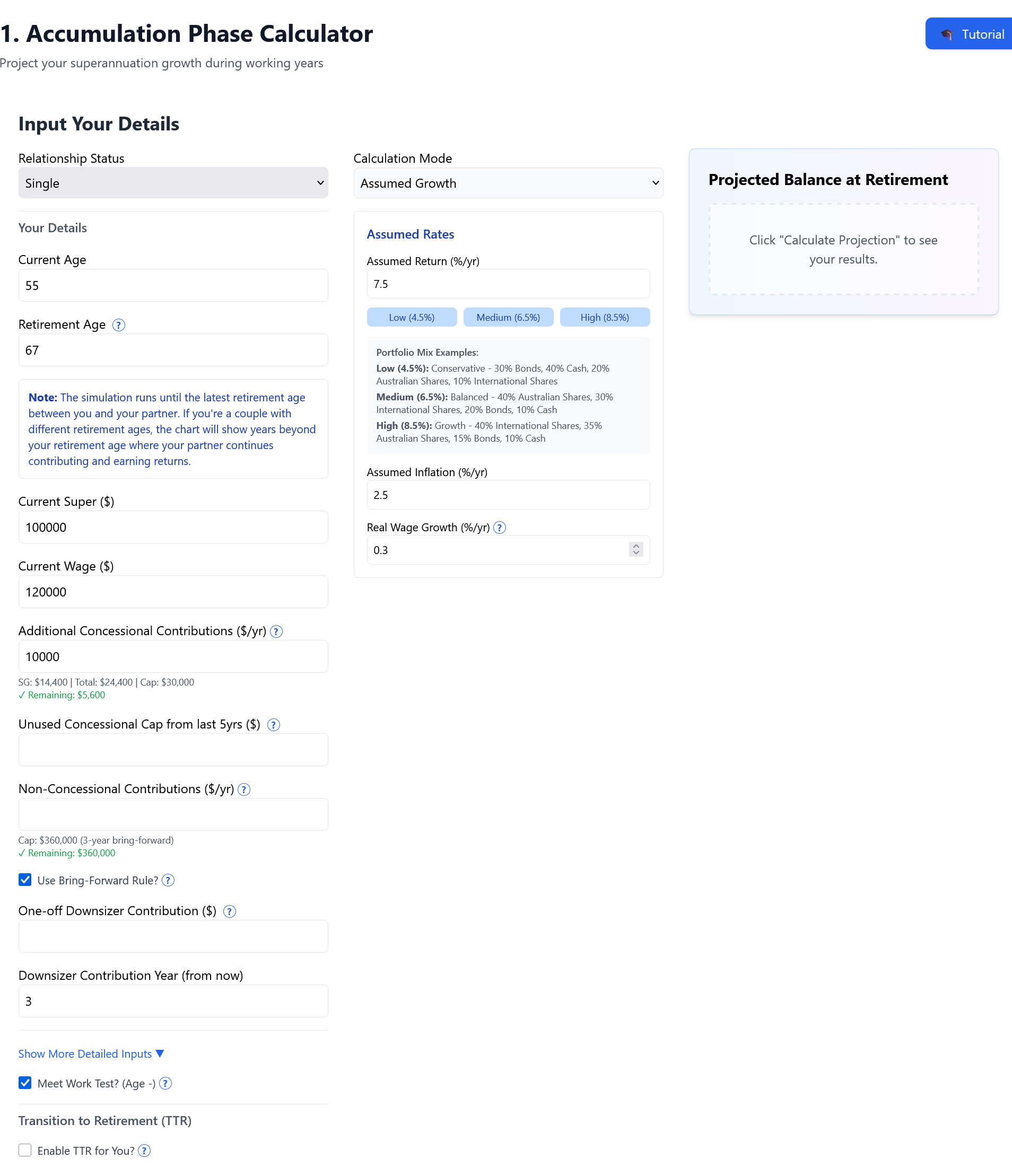
Cap and contribution planning sits in the same conversation as long-run retirement modelling.
What goes wrong in practice
- Wrong TSB date: Using a current-year balance instead of 30 June prior year.
- Split across funds: Forgetting a small account when adding total super balance.
- Double trigger: Assuming you can run a second full bring-forward immediately after using one.
- Mixing with downsizer or FHSS: Treating special contributions as if they consumed ordinary NCC cap the same way (they often do not, but the rules are specific).
See long-run retirement impact
Stress-test balance paths and sustainable income after large super movements.
Open Advanced CalculatorBottom line
Non-concessional contributions move after-tax wealth into super within an annual cap that indexation can change. Your total super balance on the prior 30 June decides whether you can contribute at all, whether standard annual limits apply, or whether a bring-forward window is available and how wide that window is. The bring-forward rule is powerful when it fits, easy to misread when thresholds move, and always secondary to the ATO tables and personal advice for your facts.
Disclaimer: Legislation, thresholds, and ATO administration change. Examples are simplified. Nothing here is tax, legal, or financial product advice. Confirm eligibility, caps, and reporting with the ATO and a qualified professional.