Important: This article contains factual educational information only. It is not financial product advice, personal financial advice, or a recommendation. SuperCalc Pro does not hold an AFSL and cannot provide advice. Always seek advice from a licensed financial adviser who can consider your personal circumstances. This article describes what exists; it does not tell you what to do.
The concessional contributions cap is $30,000 for the 2025-26 financial year. This is the total amount of pre-tax super contributions that can receive the 15% concessional tax treatment. Contributions above this cap are taxed at your marginal rate plus an excess contributions charge.
Pre-tax contributions are taxed at 15% inside super. Your marginal tax rate outside super can be 19%, 30%, 37%, or 45% depending on your income. The difference is the potential tax saving.
What Counts Toward the Cap
Three types of contributions count toward your $30,000 concessional cap.
Superannuation Guarantee (SG): Your employer's mandatory 12% contribution. If you earn $150,000, that's $18,000 of your cap gone before you do anything else.
Salary sacrifice: Pre-tax contributions you arrange with your employer. These come out of your pay before income tax is calculated. The super fund then applies 15% tax when it receives the contribution.
Personal deductible contributions: After-tax money you contribute yourself, then claim as a tax deduction on your return. You notify your super fund that you intend to claim a deduction. The fund taxes it at 15%. You receive the deduction at your marginal rate.
All three types count toward the same $30,000 cap. There is no separate cap for employer contributions vs salary sacrifice vs personal deductible. They all share the same limit.
Sarah earns $150,000
Her employer contributes 12% SG = $18,000.
Remaining cap: $30,000 - $18,000 = $12,000
If Sarah salary sacrifices the full $12,000:
� Tax inside super: $12,000 � 15% = $1,800
� Tax outside super (37% bracket): $12,000 � 37% = $4,440
� Tax saved: $4,440 - $1,800 = $2,640
The Cap is Annual, Not Lifetime
The cap resets every financial year (July 1). You can't "carry over" exceeded contributions to next year. If you contribute $35,000 in one year, you've exceeded the cap by $5,000. That $5,000 will be included in your assessable income and taxed at your marginal rate, plus you'll pay an excess contributions charge.
The ATO won't automatically stop contributions when you hit $30,000. You need to track your total across all sources yourself.
$30K cap. Exceed it and you pay marginal rate + penalty. Track YOUR employer SG, salary sacrifice, and any personal deductible contributions across all funds. Model your contribution strategy →
How the Advanced Calculator helps: Model employer SG, salary sacrifice, catch-up contributions and multi-year cap usage in one place. Open the Advanced Calculator
Catch-Up Contributions (Carry-Forward)
If your total super balance was below $500,000 on June 30 of the previous financial year, you can carry forward unused concessional cap amounts from the past 5 financial years.
This provision exists to help people who've had career breaks, variable income, or periods where they didn't contribute the full amount. The unused cap expires after 5 years on a first-in, first-out basis.
Michael's carry-forward scenario
June 30, 2025: Total super balance = $420,000 (under $500,000 threshold)
Past 5 years' contributions:
- 2020-21: Used $20,000 of $27,500 cap (unused: $7,500)
- 2021-22: Used $22,000 of $27,500 cap (unused: $5,500)
- 2022-23: Used $25,000 of $30,000 cap (unused: $5,000)
- 2023-24: Used $28,000 of $30,000 cap (unused: $2,000)
- 2024-25: Used $24,000 of $30,000 cap (unused: $6,000)
Total unused cap carried forward: $7,500 + $5,500 + $5,000 + $2,000 + $6,000 = $26,000
In 2025-26, Michael can contribute: $30,000 (current year cap) + $26,000 (carried forward) = $56,000
The ATO tracks this automatically. You can check your unused cap space by logging into myGov and accessing ATO online services. The information appears under "Super" ? "Information" ? "Carry-forward concessional contributions".
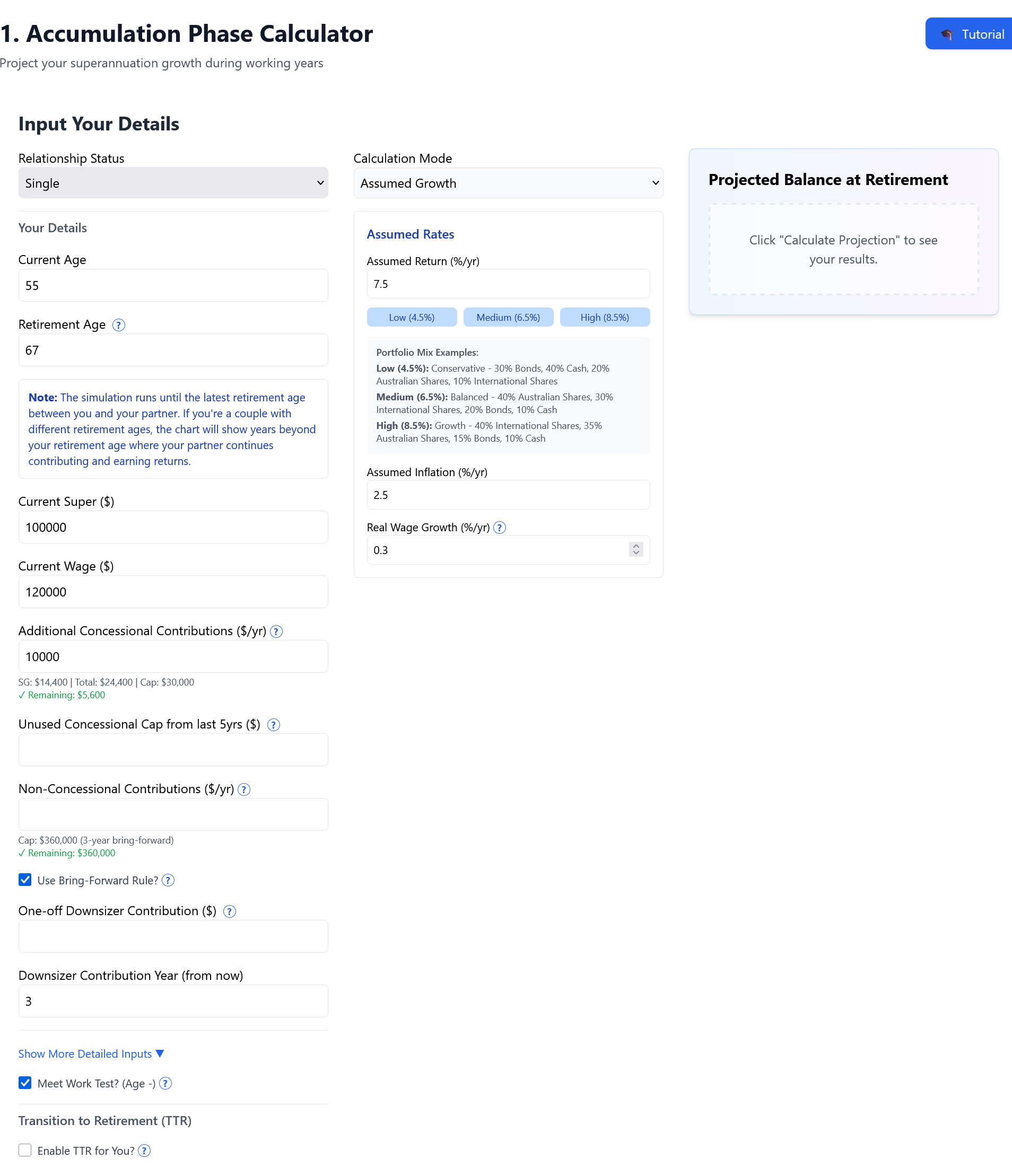
The accumulation calculator models salary sacrifice and catch-up contributions over time.
$26K in unused caps from last 5 years? That's $56K you could contribute THIS year. Model the exact compounding impact before your old caps expire. Calculate catch-up contributions →
Division 293 Tax
If your income plus concessional contributions exceeds $250,000, you pay an additional 15% tax on the excess concessional contributions. This brings the total tax on those contributions to 30% (15% standard super tax + 15% Division 293 tax).
Division 293 applies to the lesser of:
- Your concessional contributions for the year, or
- The amount by which your combined income and contributions exceed $250,000
Division 293 calculation
Income: $270,000
Concessional contributions: $30,000
Combined: $300,000
Amount over threshold: $300,000 - $250,000 = $50,000
Division 293 tax applies to the lesser of $30,000 (contributions) or $50,000 (excess).
Result: Division 293 tax on $30,000 = $30,000 � 15% = $4,500
Total tax on contributions: 15% standard + 15% Division 293 = 30%
The ATO issues a notice of assessment for Division 293 tax after you lodge your tax return. You can choose to pay the tax from your own funds or have it deducted from your super (creating a debt against your account).
Tax Savings by Income Bracket
The potential tax saving from concessional contributions depends on the difference between your marginal tax rate and the 15% super tax rate.
| Taxable Income | Marginal Rate | Tax Saved per $10,000 Contributed |
|---|---|---|
| $45,001 - $135,000 | 30% | $1,500 |
| $135,001 - $190,000 | 37% | $2,200 |
| $190,001 - $250,000 | 45% | $3,000 |
| $250,001+ | 45% (but Division 293 applies) | $1,500 (net, after Division 293) |
Note: These figures assume no Medicare Levy Surcharge and ignore LITO. The actual amount will vary based on your specific circumstances.
Tracking Your Contributions
You need to track your own contributions throughout the year. The ATO won't stop you from exceeding the cap. Most super funds send quarterly statements showing year-to-date contributions, but by the time you receive a statement, you may have already exceeded the cap.
Check with:
- Your employer (for SG and salary sacrifice amounts)
- Your super fund (for personal contributions)
- myGov ATO online (for a consolidated view, though this lags by several weeks)
If you have multiple employers or multiple super funds, tracking becomes more complex. Each employer contributes SG independently. Each fund receives contributions independently. You need to aggregate them yourself to ensure you stay under the cap.
The cap is indexed: The $30,000 cap has been indexed to Average Weekly Ordinary Time Earnings (AWOTE) in $2,500 increments since 2021. The next indexation increase will occur when AWOTE grows sufficiently to trigger a $2,500 rise, likely taking the cap to $32,500 at some future point. The ATO announces indexation changes well in advance.
Exceeding the Cap
If you exceed the cap, the ATO will issue an excess concessional contributions determination. You have two options:
Option 1: Release the excess amount from super. The excess is added to your assessable income and taxed at your marginal rate. You also pay an excess contributions charge (essentially interest on the delayed tax). The super fund releases 85% of the excess (the remaining 15% was already paid as tax when the contribution entered the fund).
Option 2: Leave the excess in super. The excess is still added to your assessable income and taxed at your marginal rate, plus you pay the excess contributions charge. But the money stays in super (now counting toward your non-concessional cap if you have space).
Neither option is penalty-free. Exceeding the cap costs you.
Stop Guessing Your Cap Space
Model YOUR exact contributions: SG, salary sacrifice, catch-up caps, Division 293 tax. See the precise compounding impact over 10-20 years.
Test Your Super Growth StrategyDisclaimer: This article contains factual educational information only. It is not financial product advice, personal financial advice, or a recommendation. SuperCalc Pro does not hold an Australian Financial Services Licence (AFSL) and cannot provide financial advice.
� Does not consider any person's objectives, financial situation, or needs
� Does not recommend any product, strategy, or action
� Does not suggest when, whether, or why any concept might apply to any individual
� Cannot replace licensed financial advice
Before making any financial decisions, seek advice from a licensed financial adviser (AFSL holder), read relevant Product Disclosure Statements, and ensure advice considers your personal circumstances. Tax and super rules change; verify current rules with the ATO or a licensed professional.