Deeming rates for the Age Pension (and other means-tested payments) changed from 20 March 2026. The government assumes your financial assets earn a set rate of return for the income test. When that assumed rate goes up, your "deemed" income goes up, so more of your pension is tapered away under the income test taper. For superannuants with savings, super in account-based pensions, and other financial assets, the result is often a lower part pension from the first pay period after the change.
This article explains what changed on that date, who was affected, and how much it could cost in pension income. The Advanced Calculator uses the current deeming rates and July-indexed thresholds, so you can see your entitlement under today's settings.
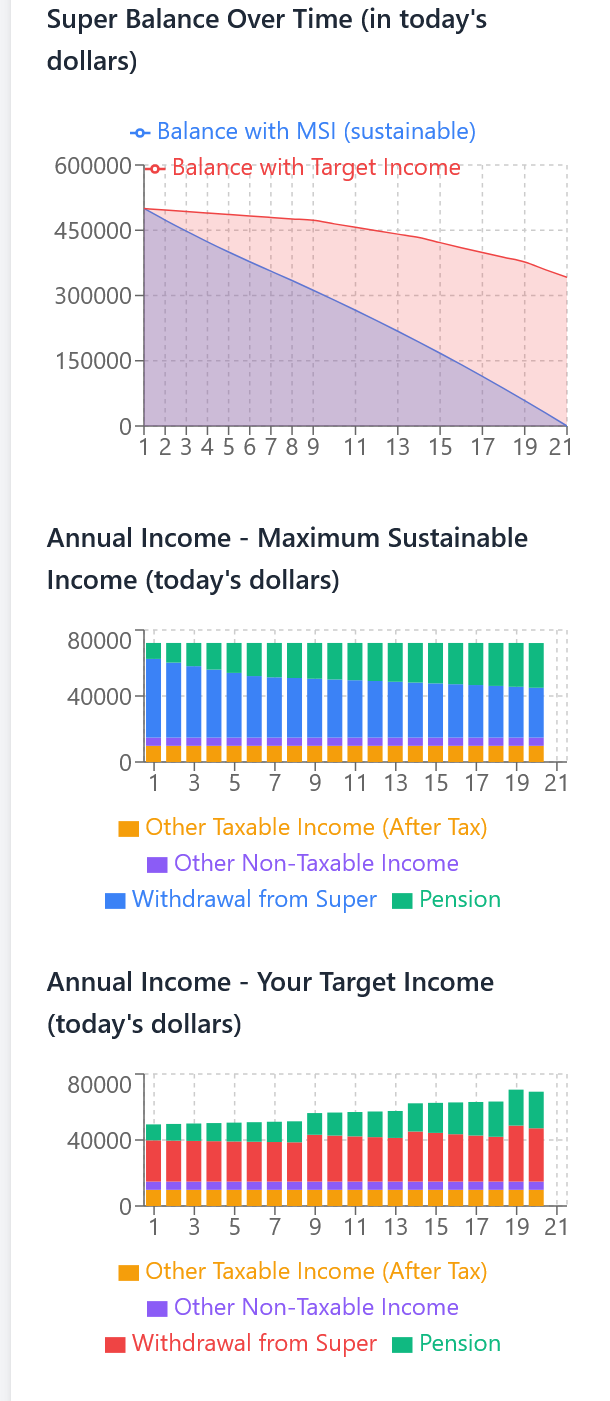
See how deemed income flows through to Age Pension in your projections
What's Changing from 20 March 2026
Deeming has two tiers: a lower rate on the first slice of your financial assets (up to the threshold for singles or couples), and a higher rate on the rest. At the March 2026 change, thresholds stayed at $64,200 / $106,200 while the rates rose. (Those thresholds later indexed from 1 July 2026 — see the note at the top of this article.)
| Asset tier | Threshold (as at 20 Mar 2026) | Previous rate (before 20 Mar) | New rate (from 20 Mar 2026) |
|---|---|---|---|
| First tier (lower rate) | $64,200 single / $106,200 couple | 0.75% | 1.25% |
| Above threshold (upper rate) | Balance of financial assets | 2.75% | 3.25% |
Financial assets include super in retirement (account-based pensions), bank accounts, term deposits, shares, managed funds, and similar investments. Your home is not deemed.
Who Is Affected: Superannuants and Part-Pensioners
If you're on the full Age Pension with very low assets and little deemed income, the change may have little or no effect: you're already under the income-free area. The people who feel it are:
- Part-pensioners whose entitlement is limited by the income test (rather than the asset test)
- Retirees whose combined actual income and deemed income sit just above the income-free threshold
- Couples and singles with moderate to high financial assets (e.g. $200k to $800k in super and savings) where the extra deemed income pushes them further into the taper
It is also worth remembering that 20 March 2026 includes regular indexation. For people on the full rate of Age Pension, the indexation increase is about $22 per fortnight for singles (and about $33 per fortnight combined for couples). So for some part-pensioners, the indexation rise can partially or fully offset what higher deeming does to the income-test component. The net effect depends on whether the income test is the binding test and how much of your pension is affected by deemed income.
Centrelink always pays the lower of the amount from the asset test and the amount from the income test. So if the asset test already gives you a lower pension than the income test, a small rise in deeming might not change your payment. But when the income test is the one that applies, every dollar of extra deemed income reduces your pension by about 50 cents (until you hit the cut-out).
Impact in Dollars: Examples from the Calculator
We ran scenarios in the Advanced Calculator (using current and projected deeming rates) to illustrate typical impacts. These are illustrative only; your result depends on your exact assets, other income, and whether you're single or a couple, homeowner or not.
Under pre-March 2026 deeming: first $64,200 at 0.75%, remainder at 2.75% → about $8,341 p.a. deemed income. With the March rates (1.25% and 3.25%) on those same thresholds, deemed income rises to about $10,091 p.a. That extra ~$1,750 of deemed income can reduce Age Pension by roughly $875 per year (about $34 per fortnight) where the income test applies.
Current (pre-March) deeming gives about $14,376 p.a. deemed; after the March change, about $17,376 p.a. The increase of ~$3,000 in deemed income can mean a drop in pension of around $1,500 per year (about $58 per fortnight) where the income test is the binding test.
Larger balances produce larger dollar cuts. Because both deeming tiers increase by the same absolute amount, the extra deemed income from 20 March is roughly 0.5% of your total financial assets. So for $800k in financial assets, the increase in deemed income is about $4,000 per year, and the associated pension reduction is roughly $2,000 per year (about $77 per fortnight) where the income test applies. The Advanced Calculator shows this year by year, including how drawdowns and changing balances interact with the new rates.
Why This Matters for Retirement Planning
Deeming doesn't care what your super or investments actually earn. Even if you hold cash or low-yield assets, Centrelink assumes you earn the deemed rate. So when rates go up:
- Your total "income" for the test goes up
- Your pension can go down even if your real income hasn't changed
- Over a full retirement, the cumulative effect can be thousands of dollars in foregone pension
Superannuants who are close to the income test cut-out may find they lose their part pension entirely after the change. Anyone modelling retirement income should rerun their numbers with the new rates to see the effect on Age Pension and total retirement income.
What You Can Do
You can't change the deeming rates. What you can do is:
- Know your position. Use a calculator that applies the real income test and deeming and is updated on the day (ours is). Check whether yours has the correct 20 March rates.
- Plan for a slightly lower pension from 20 March if you're on the income test and have meaningful financial assets.
- Review drawdowns and asset mix in the context of both tests; sometimes the asset test dominates, sometimes the income test. Only a year-by-year model can show which applies when.
If you're not sure whether the asset or income test applies to you, or how much the 20 March change will cost you, run your scenario in the Advanced Calculator. It has the correct rates updated on the day and integrates deeming, thresholds, and the 50 cents in the dollar taper so you get a clear picture of your entitlement.
What it costs to keep modelling
Run Advanced Retirement free first. Unlimited scenarios, historical stress tests, and PDF exports are $149 a year, or $14.99 a month if you’d rather not commit upfront, typically less than one hour of paid advice for the same modelling work.
Run the Advanced Calculator →No card required to try it. Subscribe only if the model is useful enough to keep using.