Every June someone asks whether Super Guarantee is going up again on 1 July. For 2026 the answer on the rate is no. The climb finished on 1 July 2025, when the legislated SG percentage reached 12%. What did change from 1 July 2026 is when most employers must pay those amounts: with wages under Payday Super, not in a quarterly batch weeks later. That matters for cashflow, compliance, and for anyone still modelling retirement as if SG arrives once a quarter.
The rate story and the timing story get mashed together in headlines. Keep them separate. Twelve percent is the contribution percentage on ordinary time earnings (subject to the maximum contribution base). Payday Super is the payment schedule. Both feed into how much super you need to retire, but they answer different questions.
How the Super Guarantee climbed to 12%
For years SG sat at 9.5%. Parliament then locked in a stepped path. From 1 July 2021 the rate rose half a percentage point a year until it landed at 12% on 1 July 2025. There is no further automatic half-point step in the schedule after that. For the 2025-26 and 2026-27 years the rate in the ATO tables is 12%.
| From | SG rate |
|---|---|
| 1 July 2020 | 9.5% |
| 1 July 2021 | 10% |
| 1 July 2022 | 10.5% |
| 1 July 2023 | 11% |
| 1 July 2024 | 11.5% |
| 1 July 2025 | 12% |
Two and a half percentage points does not sound dramatic until you run it on ordinary wages over a decade. On $90,000 of ordinary time earnings, 9.5% was $8,550 a year before any salary sacrifice. At 12% the same earnings base is $10,800. That is $2,250 more into super each year from the employer contribution alone, before investment returns and before any salary sacrifice or personal deductible contribution.
The catch is the maximum contribution base. SG is not calculated on unlimited earnings. Amounts above the quarterly (and annual) maximum contribution base are outside the compulsory percentage. High earners already knew that. What changed for everyone else is simply that the percentage on the covered base is now 12%.
Take-home pay versus the super balance
People hear "SG went up" and assume their net bank deposit fell by the same amount. Sometimes that is roughly true. Sometimes it is not. It depends whether total remuneration was fixed and the cash wage was compressed when SG rose, or whether SG sits on top of an unchanged cash figure. Awards, enterprise agreements, and individual contracts handle that differently. The payslip is the evidence, not a newspaper summary.
From a retirement-planning angle the trade-off is clearer even when cash feels tighter. Money that lands in super under SG is preserved. It compounds inside the concessional environment (subject to caps and tax rules). Money that stayed in the take-home pay can be spent, saved outside super, or contributed later under the 2026-27 contribution caps. Neither path is "better" in the abstract. The useful habit is to model both: the balance path with 12% ongoing employer contributions, and a cautious case if your hours or ordinary time earnings fall.
Simple arithmetic, not advice: $2,250 a year extra at 12% versus 9.5% on a $90,000 OTE base is about $188 a month. Over 20 years, even a flat accumulation with no wage growth and modest returns adds a meaningful wedge to the finishing balance. Your numbers will differ. Run them.
Payday Super from 1 July 2026
Payday Super did not raise the SG percentage. It changed the due date culture. Instead of the old quarterly cycle, contributions must generally reach the employee's fund within seven business days of payday (with a longer window, around 20 days, for a new starter or a newly nominated fund). For employees, that means super lands closer to each pay. For employers, late or missing payments are harder to bury until quarter-end.
If you changed jobs around mid-2026 and watched your fund balance, the practical difference is fewer long gaps between pay day and contribution day. If you are self-employed or a contractor outside the SG rules for employees, Payday Super is not your contribution calendar. Different animals. Check the ATO pages for who is an employer for SG purposes and what Payday Super requires of them.
For modelling, the old habit of assuming one lumpy SG credit every quarter is less accurate for many employees now. A projection that spreads employer contributions through the year sits closer to how Payday Super behaves, especially if you also salary sacrifice each pay.
What 12% does not change
Twelve percent does not unlock early access. Preservation age still governs when ordinary super can be drawn, and Age Pension rates keep moving on Centrelink's own calendar regardless of the SG figure. A higher contribution rate also does nothing about the fees and insurance sitting inside whichever funds you actually hold, which still matters if years of job changes left you with several accounts.
It also does not mean everyone is on track. A higher compulsory rate helps a long accumulation phase. It does not fix a short work history, long career breaks, or a balance that must support two people with a large age gap. Those problems still show up when you run household cashflow and Age Pension together, not when you recite the SG percentage.
Putting the rate into a long-term projection
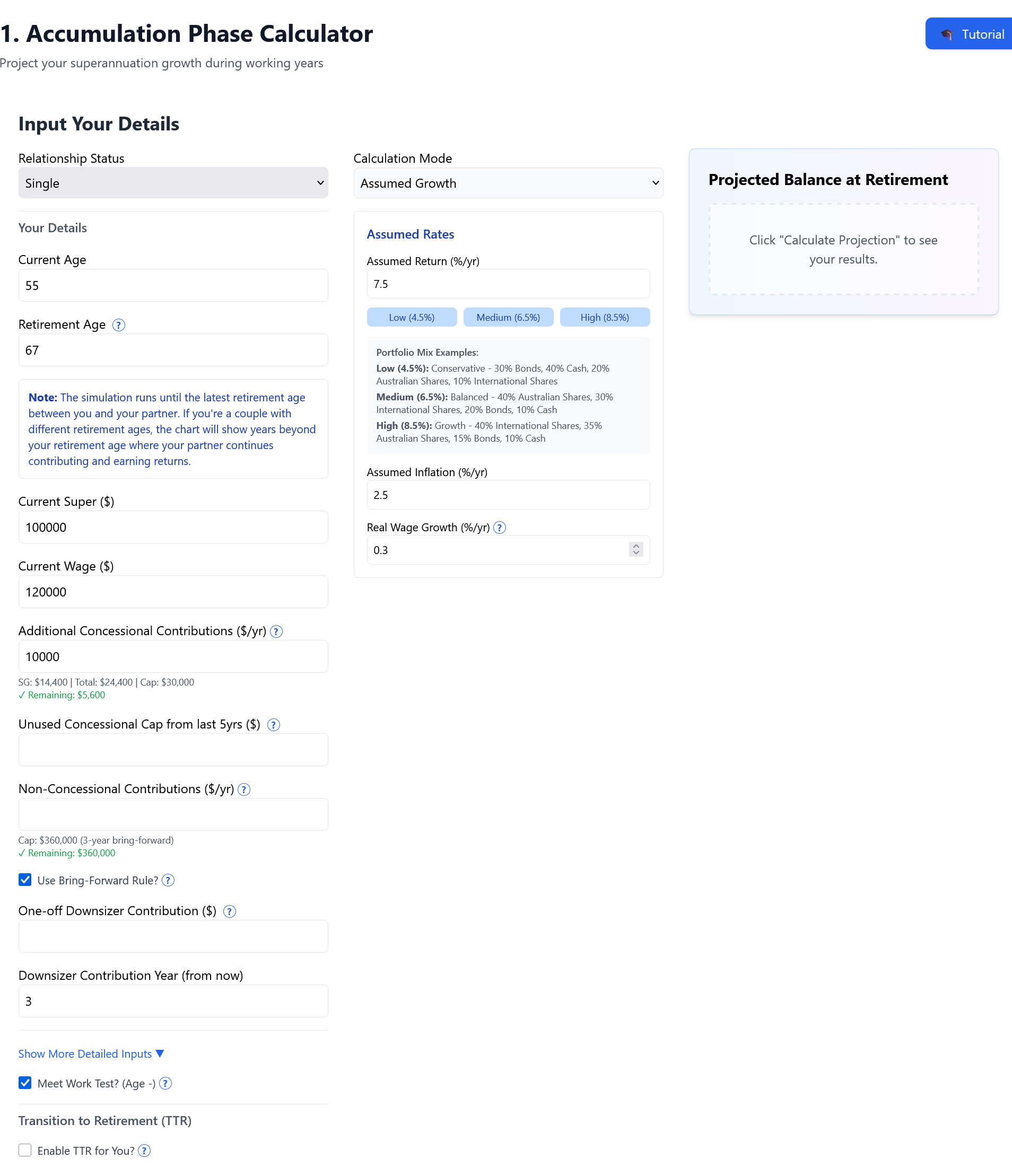
Three inputs do most of the work when you want to see what 12% means for you. First, ordinary time earnings (or a realistic wage path if you expect promotions or part-time years). Second, the employer contribution rate at 12% on the covered base, not an outdated 9.5% or 11% leftover from an old spreadsheet. Third, any voluntary concessional or non-concessional amounts you actually make, checked against the current caps.
Then stress the result. Constant returns hide sequence risk. A plan that looks fine at 12% SG with smooth growth can still wobble if the first decade of retirement is a bad market. That is why the useful next step after updating the contribution rate is a historical or Monte Carlo pass on the same balance, not another debate about whether Parliament might lift SG again next July.
For 2026-27, treat 12% as the working assumption for employee SG unless your situation is outside the ordinary rules. Update the timing assumption for Payday Super if you still have quarterly lumps in the model. Then see whether the finishing balance and income path still match the lifestyle you have in mind.
Official sources
Confirm the current percentage and maximum contribution base on the ATO key superannuation rates and thresholds page. For payment timing, use the ATO material on super for employers and Payday Super. MoneySmart’s overview of the Super Guarantee is a plain-language companion. Rules and bases change; check the date on the page you are reading.
Update the SG rate, then see the retirement path
Lock employer contributions at 12%, add any voluntary amounts you actually make, and stress-test the result against market history.
Open retirement calculator →What it costs to keep modelling
Run Advanced Retirement free first. Unlimited scenarios, historical stress tests, and PDF exports are $149 a year, or $14.99 a month if you’d rather not commit upfront, typically less than one hour of paid advice for the same modelling work.
Run the Advanced Calculator →No card required to try it. Subscribe only if the model is useful enough to keep using.
Disclaimer: This article is general information only. It is not financial product advice, legal advice, tax advice, or personal advice. SuperCalc Pro Pty Ltd does not hold an Australian Financial Services Licence (AFSL). We do not recommend that you open, close, change, or contribute to any super fund or product. Super Guarantee rates, maximum contribution bases, Payday Super rules, and contribution caps depend on personal circumstances and change over time. Confirm current rules with the ATO, MoneySmart, your employer or fund, a registered tax agent, or a licensed financial adviser.