Important: General information only, not financial product advice or personal advice. SuperCalc Pro does not hold an Australian Financial Services Licence (AFSL). This article does not recommend salary sacrifice, personal deductible contributions, or switching funds or strategies. Caps and rules change with legislation and ATO administration. Confirm eligibility, timing, and reporting with the ATO and a licensed financial adviser or accountant before acting.
Most working Australians build super through compulsory employer Superannuation Guarantee, and many also add voluntary concessional contributions on top. Those voluntary amounts usually arrive either as salary sacrifice (your employer redirects part of your pre-tax pay) or as a personal deductible contribution (you transfer money, then claim a deduction). Both types land in the same regulatory bucket: they count toward your concessional contributions cap together with SG. First-home buyers sometimes route voluntary concessional dollars through the First Home Super Saver Scheme instead; that still uses the same concessional room. If you are working out how much concessional cap space you have left, your starting point is total concessional use across every fund, not a separate allowance for each pathway.
Why the cap treats them the same
The law cares about how much concessional pressure hits your super each financial year, less about whether payroll or your bank account moved the dollars first. Once an amount is concessional, your fund generally withholds contributions tax at 15% on entry for a standard taxed accumulation account. Eligible low-income earners may receive the low income super tax offset (LISTO) through their tax assessment, which can make the effective fund-level hit lower than 15% when the offset applies. At the other end of the scale, high-income surcharge rules still apply in the usual way. Your personal income tax story differs between sacrifice and deduction, but the concessional character of the contribution is the same.
That symmetry breaks when people forget aggregation. A common slip is to salary sacrifice up to an imagined limit while also planning a large personal deductible contribution, without tallying SG from every job in the year. The excess concessional rules sit behind that arithmetic. Many readers quietly pair cap tracking with myGov views; our companion piece walks through checking unused concessional cap space in myGov at a high level.
Salary sacrifice in plain terms
Salary sacrifice is an agreement between you and your employer to forgo part of your cash salary and receive additional employer contributions instead. Because the amount never lands in your bank account as wages, income tax and Medicare levy are calculated on a smaller taxable income in each pay cycle, subject to ordinary PAYG settings.
Employers differ wildly on how quickly they action paperwork, cut-off dates, and whether they offer sacrifice at all. Industrial awards, HR policy, and payroll systems matter as much as tax law. Salary sacrifice also locks timing to the payroll calendar. If you realise late in June that you still have cap space, payroll might not process another deduction before 30 June even when the idea stacks up on paper.
Personal deductible contributions
A personal deductible contribution usually starts as money you contribute from your own resources. To characterise it as concessional, eligible members give their fund a valid notice of intent to claim a deduction within ATO timeframes and receive acknowledgement before lodging the deduction in the income tax return. The sequence matters. Treating it casually is how people end up with money inside super that does not match what they intended for their tax return.
Cash flow differs from sacrifice. You move the dollars first, then wait for the deduction through annual tax lodgment or refund timing. Some households prefer that pattern when liquidity sits outside payroll or when an employer does not support sacrifice. Others dislike tying up cash early in the year.
Tax brackets, Division 293, and carry-forward
The attractiveness of either concessional route depends on your marginal tax rate outside super compared with the usual 15% contributions tax pattern in the fund (again subject to LISTO and other personal circumstances).
Division 293 is an extra tax charge that catches many upper-middle income earners who never think of themselves as "rich." The ATO adds your income for surcharge purposes, which is broader than taxable salary alone, to your concessional contributions for the year. If that combined figure is above the Division 293 threshold (often quoted around $250,000 for recent income years, indexed over time; confirm the number for your year with the ATO), extra tax may apply on part of your concessional contributions. The pathway into super does not matter: sacrificed salary and personal deductible amounts both sit inside the same concessional total for that test.
If your total super balance was below the indexed threshold on prior 30 June, unused concessional cap from earlier years may be available under carry-forward rules. That topic interacts with both pathways because carry-forward simply expands how much concessional headroom you might access if eligible. It does not create a separate contribution type.
Practical habit: Keep one running spreadsheet row per financial year with SG from each employer, sacrificed amounts from payroll reports, and personal deductible totals after acknowledgement. Reconcile to myGov at least twice a year, not only after lodgment.
Illustrative shape only (not advice)
Suppose your concessional cap for the year is $30,000 and employer SG across jobs will be $18,000. You have $12,000 of voluntary concessional room left before considering carry-forward. You might fill that $12,000 entirely through sacrifice across pays, entirely through a personal deductible contribution after giving notice, or split across both. The cap cares about the combined $12,000, not the split ratio.
Choosing between them in practice
Many members end up with salary sacrifice when payroll makes it frictionless, and personal deductible contributions when flexibility or employer limits push the other way. Some use sacrifice for steady drip-feeding and top up with a personal deductible amount once actual SG for the year is certain. That blended approach can still breach the cap if estimates drift.
A narrow slice of strategy commentary talks about timing deductions across financial years. That is specialised territory tied to your lodgment dates, fund processing times, and advice relationships. This article stops at the observation that getting the paperwork sequence wrong is more expensive than picking the mathematically perfect pathway on a spreadsheet.
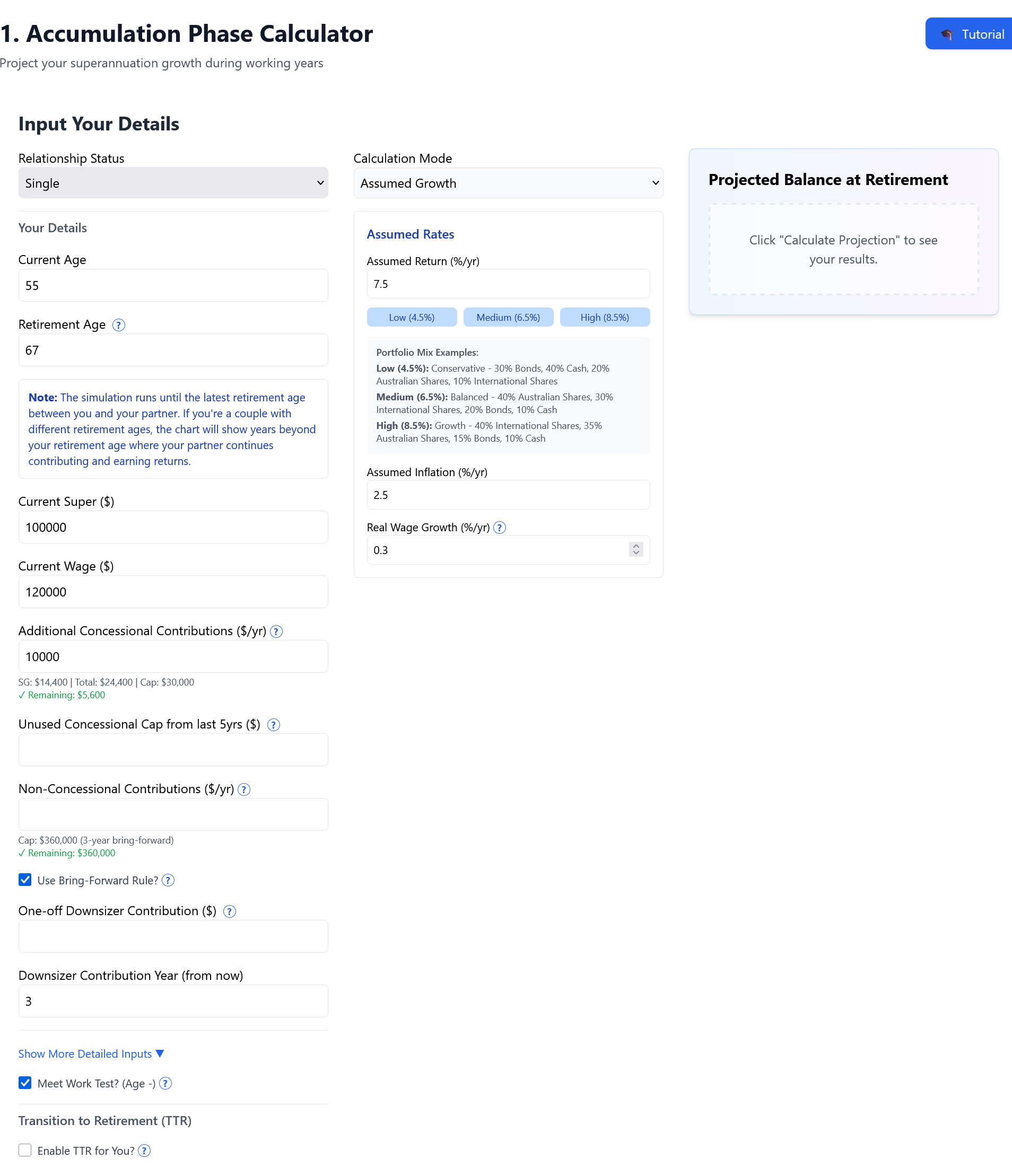
Long-run modelling sits beside short-run cap arithmetic.
Where people stumble
- Forgetting SG across jobs: Second employers still consume concessional cap.
- Late June payroll: Expecting one more sacrificed pay that never clears.
- Notice timing: Claiming a deduction without a valid acknowledged notice.
- Double counting carry-forward: Assuming unused cap from five years ago stacks blindly without checking eligibility rules.
- Division 293 blind spot: Focusing only on the annual concessional cap while forgetting that an expanded income definition plus concessional contributions can cross the surcharge threshold (commonly discussed around $250,000 combined for recent years; verify your income year).
Stress-test contribution paths
See how extra concessional inputs interact with retirement income and Age Pension tests over decades.
Open Advanced CalculatorBottom line
Salary sacrifice and personal deductible contributions are two delivery mechanisms for the same concessional cap story. The usual fund-side picture is contributions tax at 15%, with LISTO able to soften that for eligible low-income members. Cash flow and employer paperwork still differ by pathway. Neither replaces careful tally of SG, neither ignores notice rules on the personal side, and neither escapes Division 293 arithmetic when surcharge income plus concessional contributions crosses the relevant threshold. The useful question is rarely which label wins on a forum thread. It is whether your combined concessional picture fits the law for your year and whether your timing matches payroll and fund processes.
Disclaimer: Legislation, thresholds, and ATO administration change. Examples are simplified. Nothing here is tax, legal, or financial product advice. Confirm eligibility, caps, and reporting with the ATO and a qualified professional.