Where the tax case still works
Under a salary sacrifice arrangement, part of your salary goes to your fund as an employer contribution instead of hitting your bank account. Those dollars are concessional. The fund generally taxes them at 15%. From 1 July 2026 your employer still owes Super Guarantee on qualifying earnings: ordinary time earnings, plus commissions and any salary-sacrificed amounts that would otherwise have counted, still excluding overtime. Sacrifice sits on top of SG rather than replacing it.
From 1 July 2026 the general concessional contributions cap is $32,500. SG, salary sacrifice, and personal deductible contributions share that one pool across every fund you use. MoneySmart puts the same two facts next to each other: 15% in the fund, and watch the cap.
On a $90,000 salary, SG at 12% is about $10,800. That leaves roughly $21,700 of 2026-27 cap space before salary sacrifice or a personal deduction starts crowding the limit. Someone in the 30% personal band (plus Medicare levy where it applies) really can move dollars from a higher personal rate into 15% fund tax. That is the clean case. Below that band, above the Division 293 threshold, or once cash is scarce, the year looks different.
When 15% fund tax is no bargain
Contributions tax does not care that your personal rate was zero. If taxable income would otherwise sit under the $18,200 tax-free threshold, those sacrificed dollars still meet 15% inside the fund. You have moved money from untaxed pay into a taxed contribution.
LISTO can refund up to $500 of contributions tax when adjusted taxable income is at or below $37,000 for 2026-27 (from 1 July 2027 the threshold rises to $45,000 and the maximum to $810). That $500 equals 15% of about $3,333 of concessional contributions. At a 12% SG rate, employer contributions alone hit that figure around $27,800 of qualifying earnings. Above that income, extra salary sacrifice usually gets no further LISTO refund even if you are still under the $37,000 ATI test.
From 1 July 2026 the next personal band is 15% on ordinary income between $18,201 and $45,000, before Medicare levy. It drops again to 14% from 1 July 2027. Before Medicare, that band matches fund tax dollar for dollar. Add the 2% Medicare levy where it applies and the personal rate on the slice is about 17%. Low Income Tax Offset phase-out in the top of the band can push the effective rate higher again: no gap before Medicare, a small one after, and offsets in the middle.
| Where that $1,000 would have been taxed as salary | Rough personal tax (ex Medicare) | Tax in the fund on a concessional contribution |
|---|---|---|
| Under the $18,200 tax-free threshold | $0 | $150 |
| $18,201 to $45,000 (15% band in 2026-27) | $150 | $150 |
| $45,001 to $135,000 (30% band) | $300 | $150 |
| $135,001 to $190,000 (37% band) | $370 | $150 |
| Above $190,000 (45% band), no Division 293 on this slice | $450 | $150 |
Medicare levy, LITO, and HELP repayment income change individual results. The 37% band saves about $220 per $1,000 before Medicare, well ahead of the 30% band’s $150. The 45% band saves about $300 per $1,000 on the same basis, before Division 293.
The cap already includes your employer
People hear “$32,500 of salary sacrifice” and treat the whole number as spare room. SG counts first. On a $200,000 qualifying-earnings package, 12% SG alone is $24,000. Cap space left for sacrifice is about $8,500 unless unused carry-forward amounts apply and your total super balance on the prior 30 June was under $500,000.
Exceed the cap and the excess is included in assessable income, taxed at your marginal rate with a 15% offset for contributions tax already paid. The old excess concessional contributions charge does not apply to excesses from 1 July 2021 onward. The ATO is clear that the increase in assessable income can still affect Medicare levy and other obligations. Check year-to-date concessional totals in ATO online services before you lock a percentage into payroll for the rest of the year, especially with two employers.
Under Payday Super, employers generally have seven business days after payday to get the contribution to the fund. Contributions from a late-June payday can therefore reach the fund in July and count against the new financial year’s concessional cap, sitting alongside ordinary July pay-cycle contributions.
To see how SG and extra concessional inputs share the $32,500 2026-27 cap, use the free concessional cap optimizer.
Division 293 narrows the high-earner pitch
Division 293 adds another 15% when income for surcharge purposes plus concessional contributions exceeds $250,000. On the slice above the threshold, effective contributions tax is about 30%. Against a 45% top rate plus Medicare levy, salary sacrifice can still win. The gap is narrower than a plain 15% fund-tax pitch implies.
You can pay the Division 293 assessment from personal cash or ask the ATO to release it from super. Paying from cash keeps the balance compounding. Releasing from super eases the cash-year hit and shrinks the nest egg.
Locked until preservation age
Tax arithmetic ignores liquidity. Money sacrificed into super is generally preserved until you meet a condition of release. For people born on or after 1 July 1964, preservation age is 60. A house deposit next year, an emergency fund you do not have yet, or a credit card at 20% is a cash decision first. Paying down costly debt or building a buffer outside super can dominate a modest contributions-tax saving, especially early in a career when balances are small and compounding has less room to work.
Salary sacrifice and personal deductible contributions share the same concessional cap. Payroll sacrifice reduces take-home pay every cycle. A personal contribution you later claim as a deduction needs cash up front and a valid notice of intent. When the question is timing rather than tax rate, read the salary sacrifice versus personal deductible guide before treating payroll as the only tool.
The Age Pension taper blunts the payoff
Assume the tax case is clean, the cap has room, and you can spare the cash. The next question for anyone who will still sit in the Age Pension assets-test band is household income after Services Australia, not the balance alone. As at June 2026, about 15% of Age Pension recipients were on a part rate because of the assets test (DSS Benefit and Payment Recipient Demographics, June 2026, Payment by Rate sheet: 397,790 of 2,718,425). That is a minority of pensioners, and a weaker claim still among people who salary-sacrificed heavily: the taper zone for a single homeowner runs from about $333,000 to about $746,000 of assessable assets, and the high earners who gain most from sacrifice are also likely to retire above the cut-off.
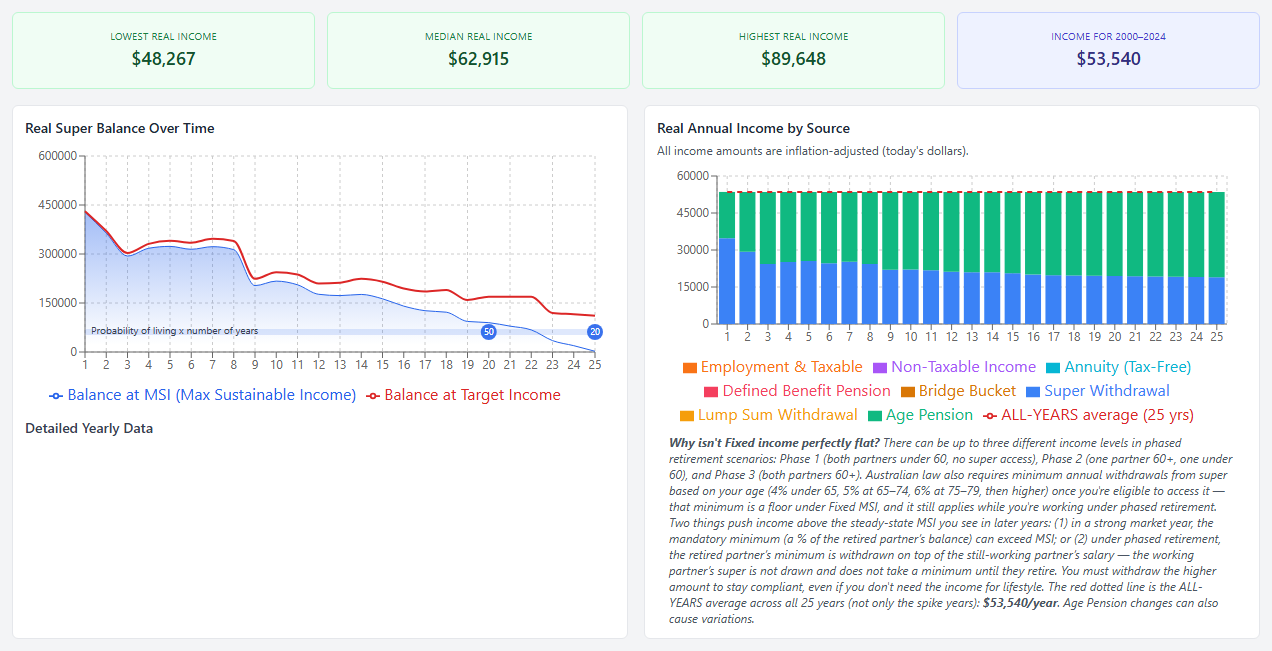
I ran a single homeowner, aged 67, with $500,000 in super and $40,000 outside super, through 2000 to 2024 on the Advanced Calculator. The figures below are illustrative: the calculator’s historical overseas sleeves (S&P 500 and international shares) are local-currency returns, not converted to Australian dollars, while Australian CPI deflates the path. Absolute income levels and the year-1 pension gap therefore depend on that convention. The run applies those years’ investment returns and Australian inflation to Services Australia’s rates from 20 September 2026, in real terms. Constant real income with the Age Pension included is about $53,540 a year for 25 years on that path. Drop the starting balance to $420,000 and the same settings produce about $50,941. Roughly $80,000 of extra balance bought about $2,600 a year of constant real income, or about $65,000 over 25 years on this illustrative path.
| Year | Age Pension ($500,000 start) | Age Pension ($420,000 start) | Pension gap |
|---|---|---|---|
| 1 | $18,749 | $24,555 | $5,806 |
| 5 | $28,037 | $29,801 | $1,764 |
| 10 | $31,403 | $32,036 | $633 |
| 20 | $34,065 | $34,065 | $0 |
The model uses a free area of $333,000 for a single homeowner, a taper of $78 a year per $1,000 above that, and a full single package of about $32,180. In the model, assessable assets are other assets plus the super balance after that year’s investment return and before the withdrawal. Services Australia assesses at the assessment date; assessing after the return is a modelling convention.
On a flat opening-balance taper, $540,000 of assessable assets would yield about $16,000 of Age Pension and $460,000 about $22,300. Year 1 of the 2000 path pays a higher pension than those opening figures because the assessed assets are lower: the portfolio return in 2000 is about −7% after Australian CPI on that series, so the $500,000 start was assessed near $505,000 rather than $540,000. That shrinks the year-1 gap slightly ($5,806 against $6,240, which is 80 × $78) and mildly favours the larger balance.
Year 1 is close to a sustained $6,240 taper cost. The gap then shrinks as both accounts are drawn down. Across all 25 years the average pension cost of the extra capital is about $900, while extra withdrawals average about $3,500 (about $87,300 in total). That withdrawal total from $80,000 of extra capital implies under 1% real growth on the extra dollars on this convention, after a 0.5% investment fee with no dollar cap. So the first-year taper overstates the lifetime cost. Net household income still rises by about $2,600 a year. Later years show a full-rate package above today’s $32,180 because the run applies 0.3% a year real pension growth above CPI.
Two limits still sit on that result. First, the comparison starts from balances already in the fund. It does not debit the take-home pay forgone during the working years that built the extra $80,000, so it flatters sacrifice relative to keeping the cash outside. Second, it is one historical path for a single homeowner in the assets-test taper, on the calculator’s local-currency overseas series. A renter, a couple, a household already off the pension, or an AUD-converted unhedged path would see a different trade. If the sacrificed dollars never arrive because the household needed them earlier, the larger balance never exists to argue about.
Who still fits the classic case
For someone in the 30% band or above, with an emergency buffer, no punitive consumer debt, clear concessional room after SG, and a horizon long enough that preservation rules are acceptable, the classic case still holds. Personal deductible contributions can be the better twin when payroll is inflexible or you want to decide the amount after year-end. Low earners chasing a co-contribution need non-concessional personal contributions, which salary sacrifice does not supply. See the co-contribution and LISTO guide for that split.
Check your band, your cap room, your cash need, and where a larger balance would sit under the Services Australia assets test: below the free area (full pension), inside the taper (part pension), or above the cut-off (no pension). Inside the taper the extra balance can still raise household income, about $2,600 a year on this path, even while it buys a smaller Age Pension cheque. The live question is whether that net gain is worth the take-home pay forgone while working and the lock until preservation age.
Official sources
- ATO: Salary sacrificing super
- ATO: Concessional contributions cap
- MoneySmart: Salary packaging
- ATO: Division 293 tax on concessional contributions
- ATO: Tax rates for Australian residents
- ATO: Personal income tax - new tax cuts for every Australian taxpayer
- ATO: What payments are qualifying earnings
- Services Australia: Assets test for Age Pension
- DSS: Expanded Benefit and Payment Recipient Demographics - June 2026 (Payment by Rate)
Model the balance you might actually keep
Open the $500,000 path used above, then cut the start toward $420,000 and compare constant real income. The first Advanced runs are free. Unlimited historical runs and PDF exports are $149 a year, or $14.99 a month ($179.88 over twelve months).
Open the calculator →No card required for the first run. Subscribe only if you keep using the full model.