"I switched to an SMSF and saved $12,000 in fees over five years." You've probably heard stories like this. Maybe from a colleague, a friend at a barbecue, or that guy at your golf club who won't stop talking about his self-managed super fund. But here's what they don't tell you: for every person who saves money with an SMSF, there's someone else who's paying more than they would with a simple retail fund.
whether an SMSF makes financial sense depends almost entirely on two factors: your super balance and how involved you want to be. Understanding these factors helps explain why some people benefit from SMSFs while others don't.
What Exactly Is an SMSF?
A Self-Managed Super Fund is exactly what it sounds like: a superannuation fund that you manage yourself. Instead of handing your money to AustralianSuper, REST, or another retail fund and letting them invest it for you, you become the trustee. You make all the investment decisions. You handle the compliance. You're responsible for everything.
An SMSF can have up to six members, which is why they're popular with couples and families who want to pool their super together. But with that control comes responsibility. The ATO regulates SMSFs strictly; see our SMSF compliance checklist, and the penalties for getting things wrong can be severe. For example, having your fund declared non-complying triggers a 47% tax on your entire balance.
The Real Costs of an SMSF
Let's look at what an SMSF actually costs to run. These are the typical expenses SMSF trustees face each year.
Setup costs typically run between $1,000 and $3,000. This includes establishing the trust deed, registering with the ATO, and setting up your investment accounts. Some accountants offer cheaper packages, but a poorly drafted trust deed can cause problems for years.
Annual audit is mandatory. Every SMSF must be audited by an approved SMSF auditor each year. This costs between $500 and $1,500 depending on the complexity of your investments. If you hold property or have related-party transactions, expect to pay more.
Accounting and administration is where costs vary most. A basic SMSF with simple investments might cost $1,500 per year for accounting. A complex fund with property, multiple members, and pension phase accounts could cost $3,000 or more. Many people underestimate this cost.
ASIC fees are $65 per year. This is the one predictable cost.
| SMSF Cost | Low End | High End |
|---|---|---|
| Setup (one-time) | $1,000 | $3,000 |
| Annual Audit | $500 | $1,500 |
| Accounting/Admin | $1,500 | $3,000+ |
| ASIC Fee | $65 | $65 |
| Total Annual | $2,065 | $4,565+ |
What matters is that these costs are largely fixed. Whether your SMSF has $200,000 or $2 million, you're paying roughly the same for auditing and accounting. This is what creates the crossover point.
What Does Retail Super Actually Cost?
Retail super funds charge percentage-based fees. The more you have, the more you pay. A typical retail fund charges:
- Administration fee: 0.5% to 1.5% of your balance
- Investment fees: 0.2% to 0.8% depending on investment options
- Insurance premiums: Variable, but often $500-2,000 per year
Let's do the maths for different balance levels:
| Balance | Retail Super Cost (est.) | SMSF Cost (mid-range) | Winner |
|---|---|---|---|
| $200,000 | $2,000-3,000 | $3,000-4,000 | Retail |
| $400,000 | $4,000-6,000 | $3,000-4,000 | SMSF |
| $700,000 | $7,000-10,500 | $3,000-4,000 | SMSF |
| $1,000,000 | $10,000-15,000 | $3,000-4,500 | SMSF (significantly) |
The Crossover Point
Based on current fee structures, here's the general guidance on when SMSF makes financial sense:
Important note: These are general observations based on typical fee structures. Some retail funds, especially industry funds, have become very competitive on fees. It's worth comparing your specific fund's fees against SMSF costs for your situation.
Beyond Fees: The Control Factor
Fees aren't the only reason people choose SMSFs. For many, it's about control over investments that simply aren't available through retail funds.
Direct property investment is one option. With an SMSF, you can buy residential or commercial property directly, including using borrowed funds through a Limited Recourse Borrowing Arrangement (LRBA). This isn't available with retail super.
Specific stock selection appeals to active investors. Instead of choosing between "Australian shares" and "international shares" options, you can buy individual ASX stocks, build your own portfolio, and implement specific strategies.
Alternative investments like cryptocurrency, precious metals, collectibles (under strict rules), and unlisted assets are all possible with an SMSF. Try asking your retail fund to buy Bitcoin for you.
Business real property is an option for business owners. An SMSF can own the premises your business operates from, and your business pays rent to your super fund. This is one way some business owners structure their retirement savings.
Estate planning flexibility gives you more control over what happens to your super when you die. You can structure binding death benefit nominations with more precision than most retail funds allow.
The Hidden Costs That Rarely Show Up in Marketing
There are also costs that don't appear on any fee schedule.
Your time is often the biggest hidden cost. Even with an accountant handling compliance, many SMSF trustees spend 10-20 hours per year minimum on their SMSF. Investment decisions, paperwork, trustee meetings (which need to be documented), and staying across rule changes all take time. If you value your time at $100 per hour, that's $1,000-2,000 in potential hidden costs.
Compliance risk is real. The ATO takes SMSF compliance seriously. Common mistakes include lending money to relatives, using fund assets for personal benefit, or failing to meet contribution caps. Penalties range from administrative fines to having your fund declared non-complying, which triggers tax of up to 47% on your entire balance.
Investment mistakes can be costly. Retail funds have professional investment teams. In an SMSF, you're making the decisions. Studies show that on average, SMSFs underperform retail funds on a risk-adjusted basis, though the best SMSFs outperform significantly.
Insurance complexity catches many people off guard. Retail funds offer group insurance at competitive rates. In an SMSF, you need to arrange your own insurance, which is often more expensive and requires more effort to maintain than group insurance.
When SMSF Might Not Make Sense
SMSF might not be suitable if:
- Your balance is under $200,000 (fixed costs can be proportionally high)
- You have no interest in finance or investing
- You're approaching retirement with simple needs
- You don't want the responsibility of being a trustee
- You don't have time to manage it properly
SMSF might be worth considering if:
- Your balance is over $500,000 (fee savings become more meaningful)
- You want direct property investment options
- You're an active investor who enjoys managing investments
- You're pooling super with family members
- You own a business and want to hold business premises in super
- You have specific estate planning needs
The Hybrid Option
Here's something most articles don't mention: you don't have to choose one or the other. Some people successfully run a hybrid strategy.
Some people keep some super in a retail fund for the insurance benefits and simplicity, while using an SMSF for specific investments that require it, like direct property or a concentrated stock portfolio. This approach can provide competitive insurance, professional management for part of your wealth, and control where you want it.
The key consideration is whether the additional complexity is worth it. Running two super structures means additional administration, so the benefits need to justify the extra work.
Factors to Consider
If you're considering an SMSF, here are some factors to evaluate:
Factor 1: Calculate your current retail super fees. Log into your fund and find the actual dollar amount you're paying, not just the percentages. Include admin fees, investment fees, and insurance.
Factor 2: Get quotes for SMSF setup and ongoing costs. Talk to at least two SMSF accountants and get written quotes for your specific situation.
Factor 3: Consider your time and interest. Will you actually enjoy managing your super, or will it become a chore?
Factor 4: Consider what you want to invest in. If you're happy with diversified index funds, you can get those through a retail fund at low cost. SMSF typically makes more sense if you want investments that aren't available elsewhere.
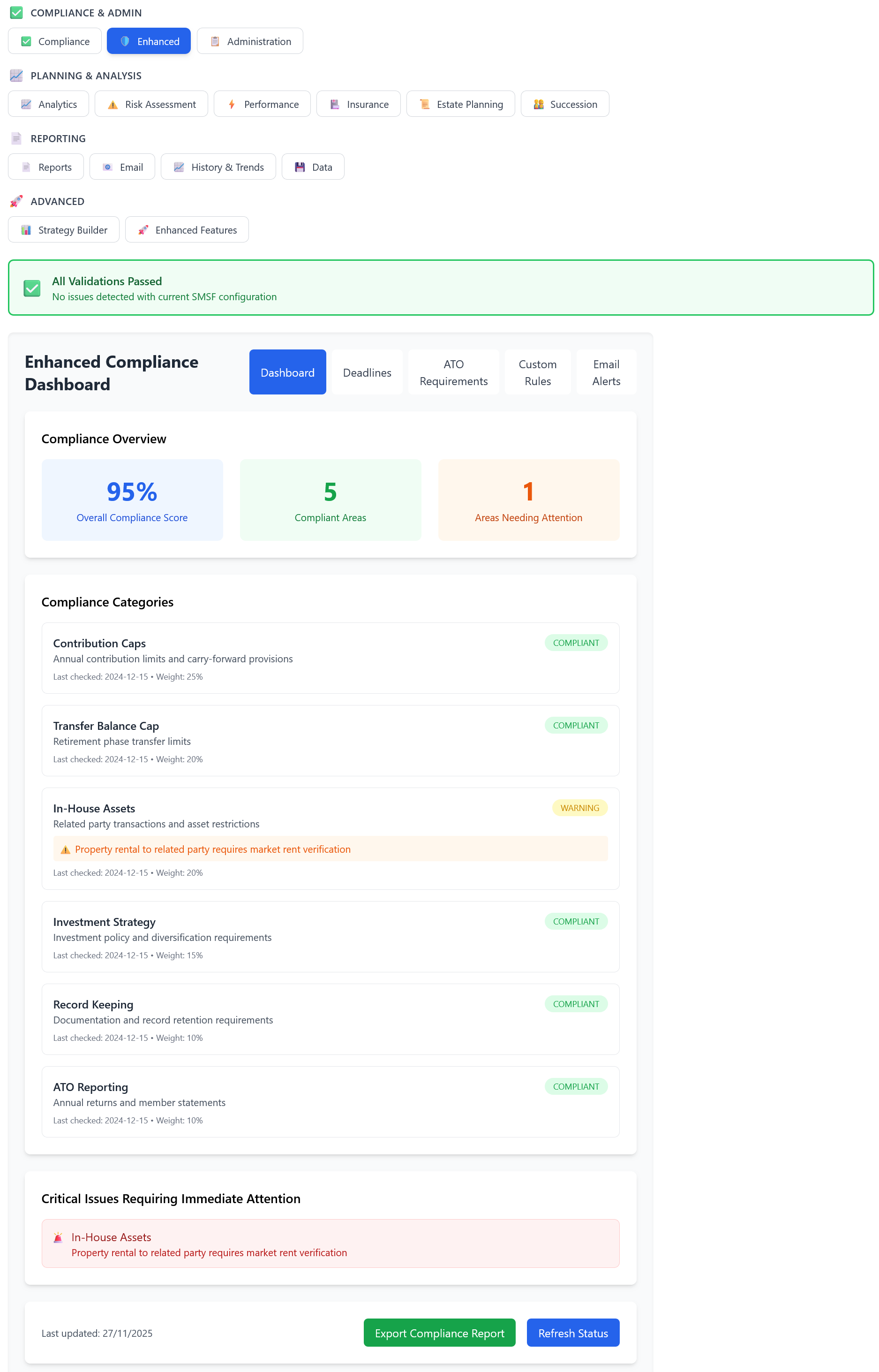
Factor 5: Model both scenarios. Use the calculator to project outcomes under both structures, including the impact of fees on your final balance.
Model Your SMSF Decision
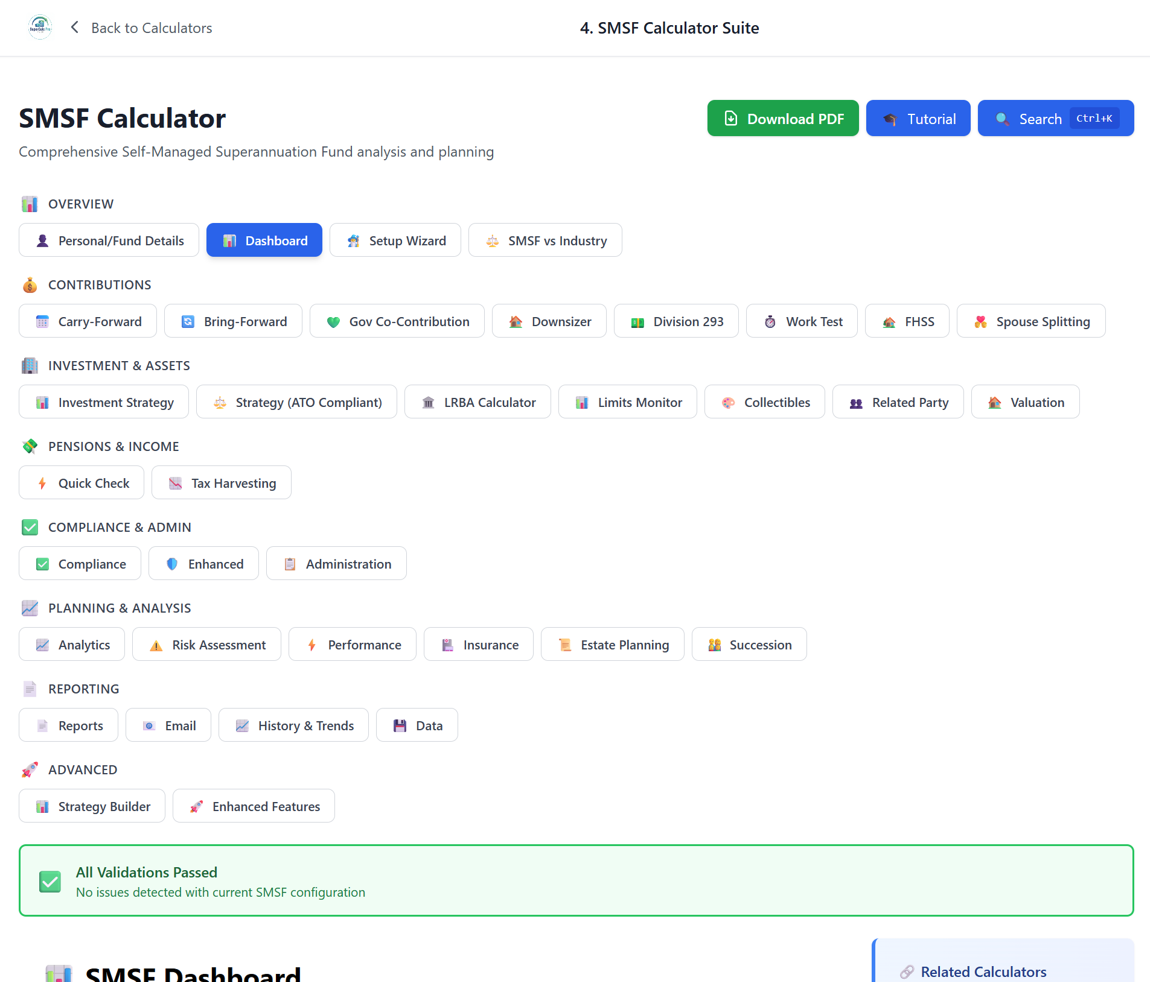
The SMSF calculator helps you compare costs, track compliance, and project outcomes. See whether an SMSF makes sense for your specific situation.
Open the SMSF SuiteThe Bottom Line
An SMSF can be a powerful wealth-building tool, but it's not for everyone. The crossover point where SMSF becomes cheaper than retail super is typically around $400,000-500,000, but cost shouldn't be your only consideration.
Some people value control over specific investments, have the time and interest to manage their fund properly, and understand the compliance responsibilities. Others prefer the simplicity of a low-cost industry fund where they can set and forget.
Setting up an SMSF because someone said it would save money, then neglecting it because you're not interested, often leads to ATO penalties and underperforming portfolios.
The key is understanding what you actually want, not what sounds impressive at a barbecue.
Disclaimer
This article is for informational purposes only and does not constitute financial advice. SMSF decisions have significant tax and legal implications. Consult a licensed financial adviser and SMSF specialist accountant before making any decisions about your superannuation structure. SuperCalc Pro Pty Ltd does not hold an Australian Financial Services License (AFSL).
What it costs to keep modelling
Try the SMSF Suite free first. Unlimited SMSF tools plus Advanced Retirement are All Access at $399 a year, or $39.99 a month if you’d rather not commit upfront.
Open the SMSF Suite →Free SMSF suite runs first, no card required. Subscribe only if the tools are useful enough to keep using.