What is a safe withdrawal rate in Australia?
A safe withdrawal rate is the starting percentage of retirement savings that could be withdrawn each year without running out over a chosen time horizon. In Australia it should be tested with super rules, Age Pension interaction, fees, inflation, and real Australian market history rather than copied from US 4% rule assumptions.
What it costs to keep modelling
Run Advanced Retirement free first. Unlimited scenarios, historical stress tests, and PDF exports are $149 a year, or $14.99 a month if you’d rather not commit upfront, typically less than one hour of paid advice for the same modelling work.
Run the Advanced Calculator →No card required to try it. Subscribe only if the model is useful enough to keep using.
Important: This article is general information only, not financial product advice. SuperCalc Pro does not hold an Australian Financial Services Licence. Consider your own circumstances and seek advice from a licensed adviser before acting.
Search for “safe withdrawal rate Australia” and you will find opinions, US blog posts, and calculators that quietly assume a smooth return every year. A smooth return makes almost any spending rate look survivable. Real retirement is different. Returns arrive in order, super fees compound, and for many households, the Age Pension changes how much must come from the balance each year. This piece gives concrete percentages from our historical simulation engine so you can anchor intuition in data, not slogans.
If you have not read it yet, sequence of returns risk in Australia explains why order matters; this article focuses on how much you can withdraw under fixed-spending rules before history says “no” too often.
What we mean by "safe" here: For each historical retirement start year, we ask whether a fixed annual dollar spend could be met for a full planning horizon without the super balance failing to cover the gap (after modelled pension). Safe is shorthand for "succeeded in most tested paths." Not a guarantee about your future.
Spending rule in these tables: For each historical start year the engine asks whether a fixed annual amount in today's dollars (constant real purchasing power) could be met for the full 28-year horizon without the super path failing (after modelled pension where included). That matches the Advanced Calculator Fixed MSI loop: portfolio returns are real (nominal return less that year's CPI), and the spend target does not get inflated away. It is a harder test than holding the same nominal dollars while inflation erodes the real draw.
Methodology (so the numbers are comparable)
All figures below use the same core sustainability loop as the Advanced Calculator. Balanced portfolio weights (35% US equities, 15% Australian shares, 20% international shares, 20% bonds, 10% cash), franking set to match the calculator preset, investment and admin fees as implemented in the engine, and real returns built from nominal returns and Australian inflation year by year. The retiree is 67 at the start, with a 28-year horizon (through to age 95). The series in code runs 1928-2025 (98 years), so a 28-year plan has 71 valid start years (1928 through 1998). Adjacent starts overlap on the return path; treat the set as historical coverage, not 71 independent samples.
Not comparable to earlier published versions of these tables. On 10 August 2026 the panels were regenerated end-to-end on the current Fixed MSI engine across all 71 starts (1928–1998), with spend stated as constant real purchasing power (today's dollars). Earlier July 2026 versions used the same 71-start window but older rate/fee stacks; still-older pages used a 70-start window. Treat this as a corrected shared panel with the drawdown-strategy and Monte Carlo cornerstone posts, not a one-year sample-size tweak.
Horizon vs the ASFA data report: True Cost of Retirement uses a 25-year horizon to age 92 to match ASFA's methodology. This article uses 28 years to 95. Different horizons change how many paths fit and how hard the test is. Expect different dollar outcomes from that report even before its different portfolio preset (MySuper-style there vs balanced here).
Age Pension is applied in the "with pension" table using the engine's pension routine for a single homeowner with super as the main assessable asset. The "super only" table sets pension to zero in the test so you can see withdrawal stress in isolation. That is closer to how offshore "4%" studies often treat the portfolio.
Illustrative case: $500,000 super, age 67, fixed annual spending
The classic Trinity-style question is: if I take a fixed real annual spend every year for 28 years, what fraction of historical start years would have funded it? Below, success rate is the percentage of those 71 paths where the model says spending was sustainable.
With Age Pension modelled from 67
| Fixed annual spend | Historical success rate (71 paths) |
|---|---|
| $35,000 | 100% (71 / 71) |
| $40,000 | 100% (71 / 71) |
| $45,000 | 100% (71 / 71) |
| $50,000 | 90% (64 / 71) |
| $55,000 | 75% (53 / 71) |
| $60,000 | 46% (33 / 71) |
| $65,000 | 20% (14 / 71) |
| $70,000 | 10% (7 / 71) |
Interpreting the middle of the table: $50,000 fixed spending succeeded in 64 of 71 historical paths (90%). That is not "safe" or "unsafe" in moral terms. It is a frequency under assumptions. Raise the spend toward $60,000 and success falls below half of the historical starts under these inputs.
Super only (pension excluded from the sustainability test)
This strips entitlements out so you can compare to US-style withdrawal studies where the portfolio must do all the work.
| Fixed annual spend | Historical success rate (71 paths) |
|---|---|
| $20,000 (4% of $500k) | 92% (65 / 71) |
| $25,000 (5%) | 86% (61 / 71) |
| $30,000 (6%) | 73% (52 / 71) |
| $35,000 (7%) | 48% (34 / 71) |
| $40,000 (8%) | 24% (17 / 71) |
| $45,000 (9%) | 17% (12 / 71) |
| $50,000 (10%) | 8% (6 / 71) |
Takeaway: A literal 4% of starting balance ($20,000 on $500,000) shows about 92% historical success in this super-only test under current engine fees and the full 71-start panel. Raise spending to 6% ($30,000) and success falls to about 73%. The pension-inclusive table shows how fast Australian entitlements can change the picture once eligibility is in play.
Maximum sustainable income: percentiles, not just one rate
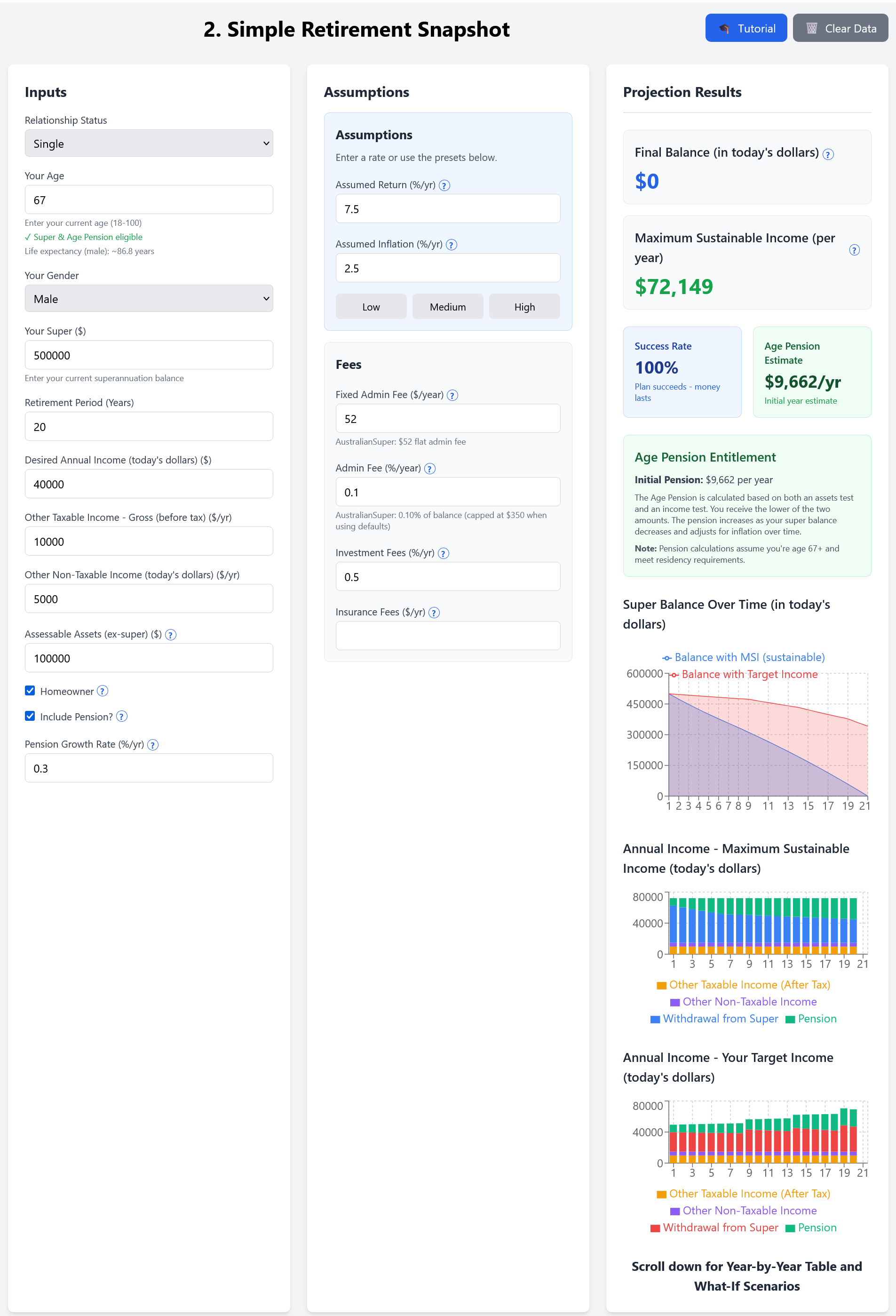
Instead of picking a single withdrawal percentage, the engine binary-searches the maximum sustainable real income per path: the highest fixed annual amount in today's dollars that path could have sustained. That is a different question from the tables ("does $X pass?" vs "what is the ceiling?") but the same spending rule as above. For the same $500,000, age 67, balanced preset, pension on, across all 71 starts:
- 10th percentile (stress case among paths): about $50,098 / year
- Median: about $59,839 / year
- 90th percentile: about $69,287 / year
The hardest single start year in this run was 1969 (maximum sustainable income about $46,143). The most forgiving was 1932 (about $85,913). Those bookends matter. A "safe" rule that ignores the 1969-style outcome is not describing worst-case history. It is describing comfort.
For context at other balances (same age and methodology): $400,000 shows median maximum sustainable income about $56,953 and 10th percentile about $48,164; $800,000 shows median about $71,484 and 10th percentile about $60,938. The median rises only modestly from $500k to $800k largely because Age Pension tapers with assets: more super means less pension in the model, so extra capital partly replaces government income rather than stacking one-for-one on top.
Minimum drawdown rules vs what you need
Account-based pensions in Australia have minimum drawdown percentages by age. Meeting the minimum is not the same as meeting living costs. On $500,000, a 5% minimum (the common band for ages 65-74 under current rules. Verify annually) implies $25,000 withdrawn, not spent. Cash flow can go back to accumulation or sit in cash. Our pension-inclusive success table suggests $25,000 total lifestyle spend is historically unproblematic at this balance in the model. Real life adds tax, aged care, and one-off costs. See minimum drawdown rates by age for the schedule and super drawdown strategy Australia for how spending rules interact with behaviour.
Why Monte Carlo and historical answers differ
This article is entirely historical path based. Monte Carlo retirement simulation discusses random draws and when they misrepresent clustering of bad years. For the separate question of what forward return to assume before you trust any projection, see regression to the mean and future returns. The Advanced Calculator offers historical and Monte Carlo views so you can compare methodology, not just branding.
Model a safe withdrawal rate on your balance
Enter your age, super, spending, and pension settings. See historical success bands and Monte Carlo output side by side.
Open Advanced CalculatorBottom line
There is no single "Australian safe withdrawal rate" that fits every household. Under transparent assumptions, 4% of $500,000 without pension delivered about 92% historical success over 28 years across the full 71-start panel. With pension modelled, much higher fixed spending still clears many paths because Centrelink shares the load. The useful output is not a meme. It is a distribution of outcomes keyed to your balance, age, fees, allocation, and entitlements. Stress-test those, then decide what "safe" means for you.
Disclaimer: Past performance does not predict future results. Rules, tax, and pension parameters change. These statistics are reproducible from the stated open assumptions in the SuperCalc Pro codebase as at generation; your results in the live app may differ if inputs differ.