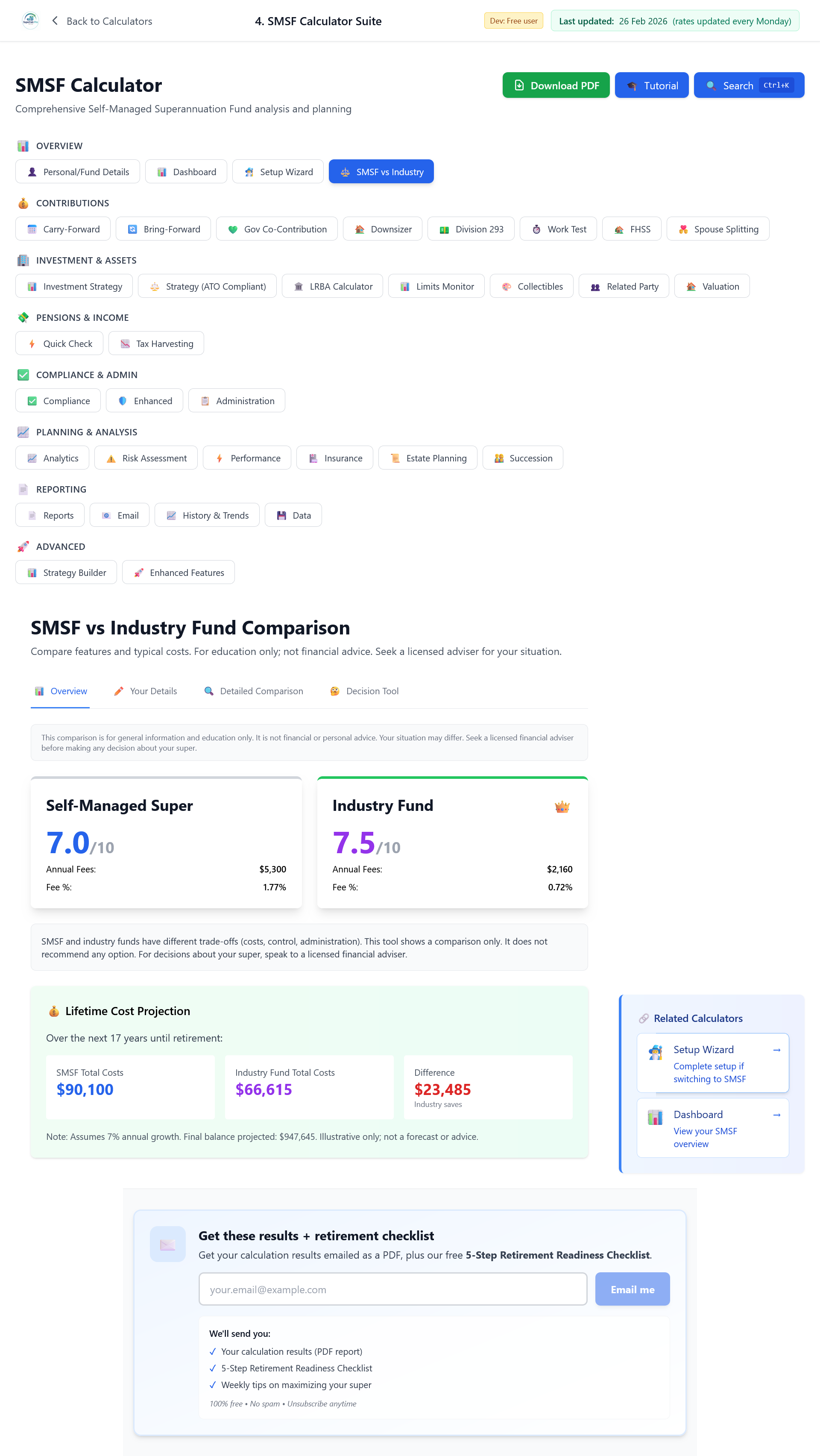
The standard pitch for SMSFs goes something like this: industry funds charge 1% a year, but SMSF running costs are fixed at $3,000 to $5,000. So once your balance reaches $300,000 or $400,000, you are paying less in percentage terms. The comparison sounds compelling. The problem is that it is not a complete comparison.
It leaves out the insurance you now need to buy separately. It leaves out a realistic value for your own time. It leaves out the costs of any mistakes. And it compares a partial SMSF cost against the all-in cost of an industry fund. Once you put the same items on both sides of the ledger, the picture changes considerably.
For a fund starting at $300,000, the additional annual cost of an SMSF compared to a competitive industry fund can exceed $5,000 in the early years. Compounded over 30 years, that difference grows to well over $200,000 in retirement savings. This does not mean SMSFs are the wrong choice for every trustee. For a fund with $1.5 million or more, and a trustee with genuine investment expertise and the time to manage the fund properly, the numbers can work. But for many trustees, the figures tell a different story to the marketing pitch.
The Full Cost of Running an SMSF
Below is a realistic breakdown of what an SMSF with a $300,000 balance actually costs to run each year. These are not worst-case figures. They are typical for a straightforward fund with a corporate trustee, managed by an accountant, with a single asset class.
| Cost item | Typical annual cost | Notes |
|---|---|---|
| Audit fee | $900 to $1,500 | Required by law every year. Simple funds at the low end; property-heavy funds at the high end. |
| Accountant / tax return | $1,500 to $2,500 | Financial statements, tax return, and member statements. Cost rises with complexity. |
| ASIC annual review fee (corporate trustee) | $59 | Fixed charge for a corporate trustee company. |
| ATO supervisory levy | $259 | Fixed charge collected with the annual return. |
| Insurance (life, TPD, income protection) | $2,000 to $4,000 | Industry funds include this in their fee. SMSF trustees must buy it separately. Many do not bother, leaving a significant gap. |
| Trustee time | $1,000 to $2,000 | Based on 20 to 40 hours per year at a conservative $50 per hour. This is a real cost even if you do not invoice yourself. |
| Total (mid-range estimate) | $6,500 to $8,000 | As a percentage of $300,000: roughly 2.2% to 2.7% in year one. |
Compare that to a competitive industry fund at 0.85% per year on $300,000, which comes to $2,550. The gap in year one is between $4,000 and $5,500. That is not a small difference. It is not money that disappears either. It is money that would otherwise have compounded inside your fund for the next 30 years.
How Those Costs Compound Over 30 Years
Annual costs matter less than people think in year one. They matter a great deal over 30 years, because every dollar paid in costs is a dollar that is no longer compounding inside your fund.
Take a $300,000 starting balance at an assumed gross return of 7% per year. The industry fund charges 0.85% per year, leaving a net return of roughly 6.15%. The SMSF incurs $7,000 per year in total costs, which in the early years represents roughly 2.3% of the fund. As the balance grows, the fixed costs become a smaller percentage, but the compounding damage from the early years does not reverse.
Industry Fund
$300,000 starting balance
0.85% annual fee
Net return: 6.15%/yr
30 years
Illustrative projection only. Past returns do not guarantee future results.
SMSF
$300,000 starting balance
$7,000/yr fixed costs
Gross return: 7%/yr
30 years
Illustrative projection only. Past returns do not guarantee future results.
The gap in this illustrative example is around $230,000. This is not a cherry-picked scenario. It reflects a realistic cost structure for a small SMSF. The $200,000 in the title is a conservative estimate of the long-run cost for this type of fund.
Two things would close the gap. A larger balance reduces the percentage impact of the fixed SMSF costs: at $1.5 million, $7,000 a year is 0.47%, which is below many industry fund fees. And higher investment returns on SMSF assets, if the trustee can genuinely add value through active management, could offset the higher costs. But most trustees do not consistently outperform diversified industry fund portfolios over 30 years. Academic research on self-directed investors generally suggests the opposite.
The Insurance Gap
The cost comparison above assumes you replace your insurance when you leave an industry fund. Many SMSF trustees do not. This creates a gap that does not show up as a fee but is one of the largest financial risks SMSF members carry.
Industry funds include group life cover, total and permanent disability insurance, and income protection as a standard part of membership, funded from the pool of members. When you move to an SMSF, that cover disappears. If you want equivalent protection, you need to buy it individually, and individual premiums are considerably higher than group rates. A 50-year-old seeking $500,000 in life cover plus TPD plus income protection can expect to pay $3,000 to $6,000 per year depending on occupation and health.
Many trustees decide not to replace the cover, on the reasoning that their fund balance is large enough to self-insure. That may be defensible at $2 million. At $400,000 it leaves a significant gap that the fund cannot fill if the worst happens. A surviving spouse or dependants inherit the fund balance, not the fund balance plus the insurance payout they would have received from an industry fund.
When an SMSF Makes Financial Sense
SMSFs are not inherently more expensive than industry funds. For the right trustee, in the right circumstances, they can be cost-competitive and may offer genuine benefits that industry funds cannot match. The question is whether those circumstances apply to you.
The first condition is balance. At $1.5 million or more, fixed SMSF costs of $7,000 to $10,000 per year represent less than 0.7% of assets, which is competitive with many industry funds. Below $500,000, the percentage impact of fixed costs is too high to overcome without an investment return advantage that most trustees cannot sustain.
The second condition is genuine investment expertise. The only way to justify higher SMSF costs is to earn returns that exceed what a diversified industry fund would deliver. Some trustees do achieve this, particularly those with specific knowledge of direct property, private credit, or specialist asset classes. But it requires real expertise, not just interest, and the evidence is that most retail investors underperform, not outperform, professional managers over the long run.
The third condition is time. Running a compliant SMSF well takes at least 20 to 40 hours per year for a straightforward fund, and considerably more for a complex one. That time has a cost. If you are running a business, raising a family, or working full time, the time burden of trustee obligations is not trivial and needs to be factored into the comparison honestly.
There are also genuine reasons to choose an SMSF that go beyond the pure cost comparison. Direct investment in property, business real property, collectibles under the rules, private placements, and greater control over tax timing and estate planning are all features that industry funds cannot replicate. For trustees who value those things and are prepared to manage the compliance burden, the total proposition can stack up even when the raw cost comparison does not.
⚠️ The breakeven point is not fixed: The balance at which an SMSF becomes cost-competitive depends on your specific fees, the industry fund you are comparing against, whether you replace your insurance, and how you value your time. ASIC has previously suggested $500,000 as a rough guideline, but this was based on older fee structures. With industry fund fees having fallen significantly in the past decade, a higher balance may now be needed before the comparison genuinely favours a self-managed structure.
Running the Numbers Before You Decide
The decision to set up or continue with an SMSF is worth modelling with your actual numbers rather than rules of thumb. That means putting your real balance, your real SMSF costs, and your insurance position into a comparison that shows you the projected outcome over your actual retirement timeframe.
It also means being honest about the return assumption. If you are going to claim that your SMSF will outperform an industry fund, you need a clear reason why, and that reason needs to be more than "I will manage it better." Most trustees who expect to outperform do not, and the cost of that expectation comes out of retirement savings over 30 years.
There is no universally right answer here. Some trustees are genuinely better served by a self-managed fund. Many are not. The only way to know is to do the comparison properly, with all the costs included.
Model the cost comparison with your actual numbers
The Advanced Calculator lets you enter your balance, your fee structure, and your return assumption, then run Monte Carlo and historical simulations to project your retirement outcome. Change the fee input to see the compounding impact of a 1% cost difference over 30 years. The SMSF Suite also includes a cost and compliance toolkit so you can track what your fund actually costs to run year by year.
Run the comparisonWhat it costs to keep modelling
Try the SMSF Suite free first. Unlimited SMSF tools plus Advanced Retirement are All Access at $399 a year, or $39.99 a month if you’d rather not commit upfront.
Open the SMSF Suite →Free SMSF suite runs first, no card required. Subscribe only if the tools are useful enough to keep using.
Disclaimer: This article contains general information only and does not constitute financial, tax or legal advice. SuperCalc Pro Pty Ltd does not hold an Australian Financial Services Licence (AFSL). The cost figures and projections in this article are illustrative only and do not represent any particular individual's circumstances. Past returns do not guarantee future performance. Before making decisions about superannuation structure, fees, or investment strategy, consult a licensed financial adviser or SMSF specialist who can assess your specific situation.