When your SMSF has members in both accumulation and pension phase, or even one member with interests in both phases, you face a question that directly affects how much tax the fund pays: how do you calculate the exempt current pension income (ECPI)? Investment earnings on assets supporting pensions are tax-free, while earnings on accumulation assets are taxed at 15%. But how do you determine which earnings support which phase?
There are two methods: segregated and proportionate (also called unsegregated or actuarial). The choice between them isn't always yours to make, the law mandates proportionate in certain situations, but when you do have a choice, understanding the implications can save your fund thousands in tax.
Our SMSF Suite lets you see your members' account types (accumulation vs pension) and balances in one place on the Dashboard, useful for understanding the split that drives ECPI. The tool is educational only and does not recommend which method your fund should use; that's a decision for your accountant or actuary.
Understanding the Two Methods
The Segregated Method
Under the segregated method, you physically allocate specific assets to support specific interests. You might say "these $400,000 in shares support the pension, and this $200,000 term deposit supports the accumulation interest." The income from each pool is then treated accordingly: dividends from the shares are 100% tax-exempt (they support pension), while interest from the term deposit is taxed at 15% (it supports accumulation).
The appeal of segregation is its clarity. You know exactly which assets support which phase, and the tax treatment follows directly. There's no complex calculation, no actuarial certificate required, and no ambiguity. If you want to maximise tax-free earnings, you can strategically allocate your highest-growth assets to the pension pool.
But segregation requires discipline. You need to maintain clear records of which assets belong to which pool. If you sell a pension asset and buy a new investment, you need to document that the new investment also supports the pension. Mixing things up, using pension assets to fund an accumulation contribution, for example, can invalidate the segregation.
The Proportionate Method
Under the proportionate method, all fund assets are treated as supporting all interests proportionally. An actuary calculates the percentage of the fund that supports pension interests versus accumulation interests, based on the relative liabilities. If the actuary determines that 70% of the fund supports pension and 30% supports accumulation, then 70% of all investment income is tax-exempt and 30% is taxable.
The proportionate method is more flexible for investment management. You don't need to track which assets belong to which pool, you manage the fund as a single portfolio. When you buy or sell investments, you don't need to worry about which phase they're supporting. The actuary's calculation handles the tax split.
The downside is cost and complexity. You need an actuarial certificate each year, typically costing $200 to $500. The exempt percentage changes annually based on the actuary's calculation, so your tax position isn't fixed. And you lose the ability to strategically allocate high-growth assets to the tax-exempt pension pool.
When You Must Use Proportionate
Since 1 July 2017, the choice between methods isn't always available. You must use the proportionate method if any member of your fund has a total superannuation balance exceeding $1.6 million (now indexed to $2.1 million). The rationale is that members with large balances are more likely to have both accumulation and pension interests, and the government wanted to prevent strategic asset allocation that maximised tax-free earnings.
You also must use proportionate if your fund has "disregarded small fund assets", essentially, if you have segregated pension assets but also unsegregated assets. And of course, if you simply choose not to segregate (or can't maintain proper segregation records), proportionate is your only option.
Note: The 2017 change required many SMSFs to switch to proportionate when the $1.6M threshold was introduced. Trustees who haven't reviewed their fund's ECPI method since then may want to ask their accountant or actuary whether they're still eligible for segregation.
Comparing the Methods: A Practical Example
Consider an SMSF with $800,000 total: $600,000 supporting a pension and $200,000 in accumulation. Total investment income for the year is $40,000.
Under the segregated method, if the fund carefully allocated its assets, it might have $30,000 of income from pension assets (tax-exempt) and $10,000 from accumulation assets (taxed at 15%). Tax payable: $1,500.
Under the proportionate method, an actuary might determine that 75% of the fund supports pension (based on actuarial liabilities, which don't always match simple balance ratios). All $40,000 of income is then split: $30,000 exempt, $10,000 taxable. Tax payable: $1,500.
In this simple example, the results are similar. But consider what happens if the fund strategically allocated its highest-yielding assets to the pension pool under segregation. The share portfolio earning 8% supports pension; the term deposit earning 4% supports accumulation. Now the pension assets generate $36,000 in income (exempt) while accumulation assets generate only $4,000 (taxable). Tax drops to $600.
This strategic allocation isn't possible under proportionate, all income is split according to the actuarial percentage, regardless of which assets generated it.
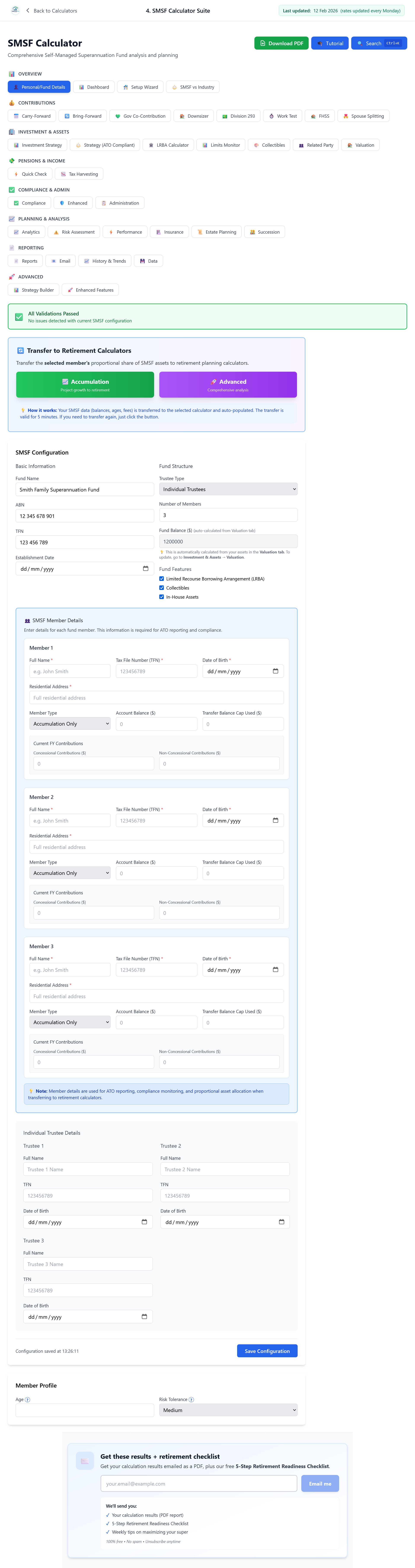
SMSF Suite: member types and account balances, the split that drives ECPI under either method. Illustration only; not advice.
Making the Choice
If you're eligible for segregation (no member over $2.1M total super balance), trustees and their advisers weigh several factors. We don't recommend one method over the other, that depends on your fund's circumstances and is a matter for your accountant or actuary.
Some funds use segregation when they have a clear split between pension and accumulation assets, when they wish to allocate higher-growth assets to the tax-exempt pension pool, and when they can maintain the records needed to support segregation. The potential tax savings from that allocation can be meaningful, especially for funds with significant accumulation balances alongside pensions.
Many funds use proportionate when they prefer simpler investment management without tracking asset pools, when the cost of an actuarial certificate is small relative to fund size, or when their structure makes maintaining segregation burdensome. The tax difference isn't always significant enough to justify the extra work of segregation.
If your fund is 100% in pension phase, all members fully retired, no accumulation interests, you don't need either method. All income is exempt, full stop. The question only arises when you have a mix of phases.
Practical note: Funds using the proportionate method often obtain their actuarial certificate early in the financial year rather than at year-end. Your accountant or actuary can advise on timing for your fund.
Changing Methods
You can change between methods from year to year, provided you're eligible for your chosen method. If you've been using proportionate and want to try segregation, you can, but you need to properly establish the segregated pools from the start of the financial year and maintain appropriate records throughout.
Going the other way (segregated to proportionate) is simpler: you just stop maintaining segregation and get an actuarial certificate instead. Many funds that were forced into proportionate by the 2017 changes have stayed there even if their balances have since dropped below the threshold, simply because it's easier.
See Your Fund's Pension vs Accumulation Split
In the SMSF Suite Dashboard you can view member types (accumulation or pension), balances, and TBC used, the same split that drives ECPI under segregated or proportionate method. Educational tool only; no advice.
Open SMSF SuiteWhat it costs to keep modelling
Try the SMSF Suite free first. Unlimited SMSF tools plus Advanced Retirement are All Access at $399 a year, or $39.99 a month if you’d rather not commit upfront.
Open the SMSF Suite →Free SMSF suite runs first, no card required. Subscribe only if the tools are useful enough to keep using.
Disclaimer: This article is general information only and does not constitute financial, tax or legal advice. SuperCalc Pro Pty Ltd does not hold an Australian Financial Services Licence (AFSL). SMSF taxation and ECPI are complex; consult a licensed SMSF specialist, accountant or tax agent for advice specific to your fund.