Walk into a new job and, unless you choose otherwise, your Super Guarantee usually lands in a MySuper product. That is deliberate. After the Cooper Review, Parliament wanted a simple, low-cost default for people who would never open their PDS. APRA’s 2026 Comprehensive Product Performance Package (CPPP) counts 50 MySuper products holding more than $1.3 trillion of member savings. Only about 7% of the product offerings in the CPPP, but the majority of the dollars.
Defaults did fix a real problem: expensive, scattered accounts for people who never engaged with their fund. A product built for that job still cannot know your retirement date, your partner’s age, your home equity, your Age Pension asset test position, or whether the next decade of markets looks like 1990 or 2000. Treating MySuper as a finished household plan is where the one-size story breaks.
What MySuper is built to do
MySuper is an accumulation default with legislated constraints on fees, insurance offerings, and a diversified investment strategy. Trustees report into APRA’s performance architecture: the annual performance test and the broader CPPP metrics on investment implementation and administration fees. In the 2026 Insights Paper, the MySuper BRAFE (the median of representative administration fees and expenses for MySuper products) fell 1.69 basis points to 0.2313%. APRA’s fee analysis in that paper is at a $50,000 balance. That figure is administration fees and costs only. It does not include investment fees, so it is not a total-cost number. Platform trustee-directed products sat at a BRAFE of 0.4675% on the same measure.
That fee pressure is the success story. It is also why so many members stay put. If the default is cheap enough and the performance test is not flashing red, inertia looks rational. The question for a 35-year-old with decades of SG ahead is different from the question for a 62-year-old five years from drawing down. The product still uses the same regulatory template for both.
| APRA CPPP 2026 snapshot | Figure |
|---|---|
| MySuper products in scope | 50 |
| Member assets in MySuper (order of magnitude) | >$1.3 trillion |
| MySuper BRAFE (admin fees and costs, $50k analysis) | 0.2313% |
| Product design focus | Disengaged accumulation members |
Single-strategy versus lifecycle MySuper
Trustees can authorise a MySuper with one diversified mix for everyone, or a lifecycle strategy that moves members through identifiable stages as they age. Lifecycle usually cuts growth assets and lifts defensive assets in later stages. APRA is clear on one constraint that surprises people: members cannot choose their lifecycle stage. Age (and limited prescribed factors) decides which bucket you sit in. You cannot tell the trustee “keep me in the growth stage until I actually retire at 70.”
So the industry already admits that one static mix is imperfect. Lifecycle is the fix that still fits the MySuper mould: age in, stage out. It does not ask whether you have a younger spouse still working, a defined benefit residual, a rental property, or a plan to retire at 60 and bridge seven years before Age Pension age 67. Age is only a proxy for those household facts, and it misses the edges.
A single-strategy MySuper is even blunter. The same growth tilt that compounds nicely at 40 can leave a 64-year-old fully exposed to a sequence-of-returns hit in the years they start withdrawing. Sequence-of-returns risk is well documented in retirement research: the order of returns matters more than the long-run average once withdrawals have started, which is the point of the sequence risk piece. A glossy fund projection often skips that path. Many fund tools assume smooth returns on whatever mix you hold today and print a single retirement balance, which is the gap covered in why fund projections go wrong.
Who the default suits, and who it leaves awkward
For many mid-career employees with steady SG, no large outside portfolio, and retirement far enough away that a diversified growth mix is the main job, a competitive MySuper is often an adequate parking place. Low administration fees and fund scale are a large part of why. The performance test gives a floor under chronic underperformance, even if it is not a guarantee of household outcomes.
The awkward cases are not rare. Older workers who never switched out of a growth-heavy single strategy. People with interrupted careers and smaller balances who still carry default insurance premiums that punch a hole in a thin account. Dual-income couples with different retirement ages, where one partner’s default lifecycle stage has nothing to do with the household’s combined drawdown date. Homeowners near Age Pension thresholds, where a few years of market path changes both the balance and the pension. Renters who need the balance to do more work because the pension and housing story is harsher, a split already visible in the adequacy numbers.
Women as a cohort sit across several of those edges at once: more part-time years, more career breaks, and balances that make default insurance and fee drag more painful as a share of the account. That is a structural pattern, not a claim that every woman should leave MySuper. It is a reason “the default is fine for everyone” fails as a planning slogan.
Fees, insurance, and the quiet drains
MySuper compressed administration fees. That does not make every dollar on the statement harmless. Investment fees still differ across products and lifecycle stages. Flat dollar admin fees hurt small balances hardest as a percentage. Default death, TPD, and income-protection cover, often useful early in a career, can keep draining accounts that never reviewed the sum insured. The next article in this series digs into insurance inside super directly. For now, the planning point is simple: the default package is an investment option plus a fee schedule plus an insurance setting. Optimising only the first line while ignoring the other two is how balances quietly shrink.
The set-and-forget cost is not only behavioural laziness. It is the gap between a product that is good enough for compulsory saving and a plan that has to survive drawdown, Centrelink, and a partner’s timeline.
Performance tests measure products, not households
Your Future, Your Super and the CPPP ask whether a product’s returns and fees look acceptable against benchmarks built for that product type. That is useful consumer protection. It is not the same as asking whether your sustainable income survives a 2000 or 2008 start with Age Pension and minimum drawdowns in the mix. A MySuper can pass its test and still leave a household short if the allocation, insurance, and retirement timing do not match the cash-flow problem.
Conversely, leaving a MySuper for a more expensive choice menu is not automatically “engagement.” Plenty of choice pathways charge more for features a member never uses. APRA’s own fee charts keep showing platform products sitting well above MySuper administration levels. Switching for the sake of switching is how people pay for complexity they do not need.
The useful question: not “is MySuper good or bad,” but “what does this default assume about me, and which of those assumptions is wrong for my household?” Age-based lifecycle answers one assumption. It leaves the rest on the table.
What a household model still has to show
Once retirement is within sight, the decision is less about the brand on the MySuper label and more about whether the path works. That means year-by-year income from super and Age Pension, fees and insurance drag if you model them, partner phasing if you have a spouse, and stress under ugly historical starts rather than a single long-run average. MoneySmart and many fund calculators answer a thinner question. The gap is exactly why an Australian retirement calculator has to show more than a default product name and a projected balance at 67.
None of that requires declaring MySuper unfit for purpose. It requires refusing to stretch a default investment vehicle into a complete retirement plan it was never designed to be.
Official sources
Run the path your default never modelled
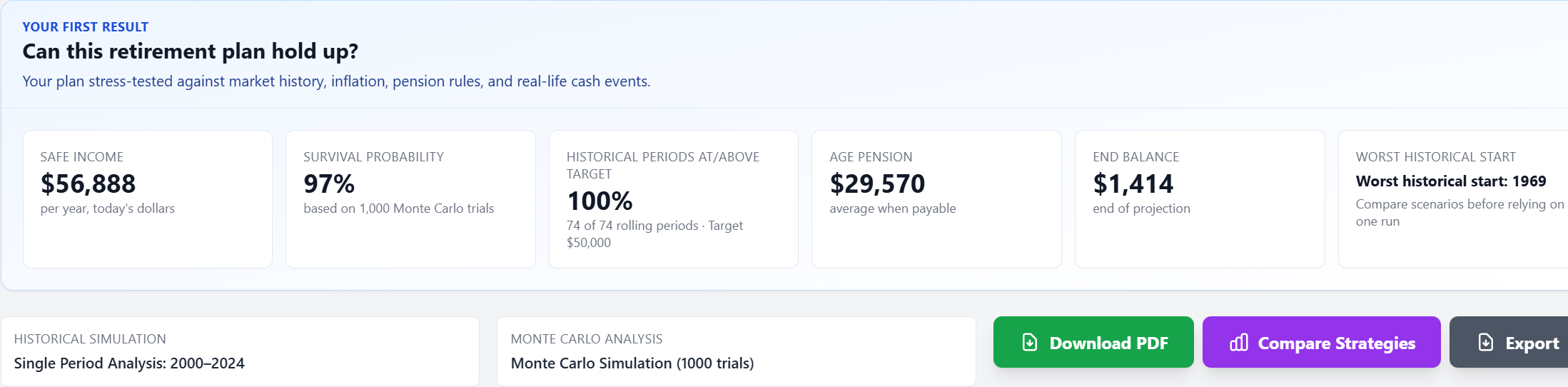
MySuper answers the default-investment problem. The Advanced Calculator answers the household one: Age Pension year by year, allocation you choose, and income under harsh historical starts. Start from the near-retirement growth scenario above, then change the mix and retirement age. The first Advanced runs are free. Unlimited historical runs and PDF exports are $149 a year, or $14.99 a month if you would rather not commit upfront.
Run the near-retirement growth scenario →No card required for the first run. Subscribe only if you keep using the full model.
General information only. This article is educational and does not consider your objectives, financial situation, or needs. It does not recommend that you stay in, leave, or switch any MySuper or choice product, change insurance inside super, or alter your investment mix. SuperCalc Pro Pty Ltd does not hold an Australian Financial Services Licence (AFSL). MySuper rules, APRA performance metrics, and fund offerings change. Seek advice from a licensed financial adviser when personal recommendations are required, and verify current product details with your fund, APRA, ASIC MoneySmart, and the Federal Register of Legislation.