What is the difference between the Age Pension income test and assets test?
The Age Pension income test reduces pension based on assessable income, while the assets test reduces pension based on assessable assets above the relevant threshold. Services Australia applies both tests and pays the lower pension result, so the test that matters can change as your super balance, work income, or deemed income changes.
If you are on a part Age Pension, you have probably heard about the assets test. You may also know that deeming and other income affect the income test. What catches people out is this: Services Australia works out your pension under both tests every time. You get paid based on whichever test produces the lower pension. So the test that actually limits your payment is the one that bites first, and it can change as your super balance, work income, or interest rates move. This article explains that logic in plain language. It is general information only, not personal advice. For year-by-year modelling with both tests, use the Advanced Retirement Simulator in the app (Advanced tab). That is not the basic snapshot calculator: full ongoing use sits behind a subscription after any included free runs. For official entitlement, speak with Services Australia or a licensed financial adviser.
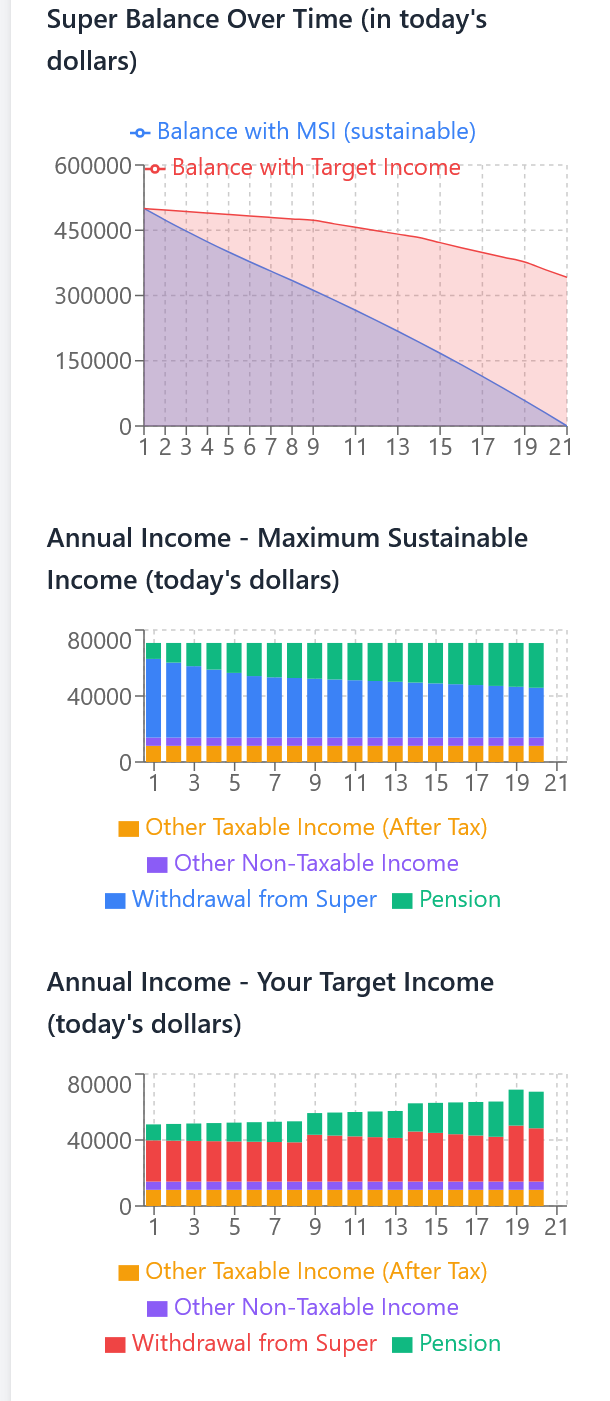
Advanced Retirement Simulator: income and pension components over time (not the basic snapshot screen).
Two tests, one payment
Think of it as two separate calculations:
- Income test: adds up assessable income (including deemed income on many financial assets, wages, rent, and some super drawdowns, subject to rules).
- Assets test: adds up assessable assets (your home is usually exempt; other property, money in the bank, and investments count, with rules and thresholds). For superannuation: money in accumulation is generally assessable once you have reached Age Pension age. Money in a super pension or income stream is treated under the asset rules for those products regardless of whether you have reached pension age, subject to how Services Australia defines the fund or stream.
Each test has free areas and taper rates set in legislation and indexed over time. The details change with government policy; always check Services Australia for current thresholds. The point for planning is structural: you are not paid the better of the two outcomes. You are paid the worse.
Why "under the asset cutoff" is not the whole story
You might hear someone say their assets are below the relevant limit, so they expect the full pension. If their assessable income is still high enough, the income test can still produce a part pension or nil payment. Deeming is a common reason: Centrelink applies assumed returns to financial assets rather than your actual bank interest. After a deeming rate change, the same balance can produce more deemed income overnight. Our article on deeming rate changes covers how that flows through to part-pensioners.
Work income interacts with the income test through ordinary rules and, where relevant, the Work Bonus for employment income. Rental income and account-based pension payments can also count, depending on how they are assessed. None of that replaces the assets test; it runs in parallel.
Which test "cuts first" in a simple story
Picture two dials. One dial is your assets. The other is your income (including deemed income). Centrelink turns both and reads off two different pension amounts. You get the smaller amount. So the test that "cuts first" is whichever dial hits your payment first in dollar terms, not whichever one you think about more often.
For couples, both tests use combined figures in the usual way. When one partner is under Age Pension age, their accumulation super may not be assessable as an asset in the same way as yours until they also reach pension age, while pension-phase super can still count under the usual rules. Income and deeming for the household still need to be worked through as a couple. Our couples vs singles article touches on how household structure changes the picture.
Tapers and part pensions
Once you are above the relevant free area, the assets taper and the income taper reduce your pension at set rates. Because both tests apply, improving one side of your position does not always increase your payment. If you are asset-tested, gifting within rules or spending down assessable assets might help until you cross into income-test territory. If you are income-tested, the lever is often assessable income (including deeming), not another dollar of unused asset room.
See both tests on your own numbers
Reading about free areas and tapers is useful; seeing them on your balance sheet is clearer. The Advanced Retirement Simulator is built to show pension under both tests over time as your super and income change. It lives under the Advanced tab, not the simple snapshot. We do not tell you to change funds or products. We show the mechanics so you can compare scenarios or take questions to a professional.
Run income and assets together
Run the Advanced Calculator, enter your situation, and see which test binds and how your pension moves year by year. Free Advanced runs first.
Run the Advanced CalculatorWhat it costs to keep modelling
See which test binds free first. Unlimited runs, year-by-year projections, and PDF exports are $149 a year, or $14.99 a month if you’d rather not commit upfront, typically less than one hour of paid advice for the same Centrelink interaction work.
Run the Advanced Calculator →No card required to try it. Pair with the pension asset test calculator for today’s assets-test snapshot.
Disclaimer: This article is general information only. It is not financial product advice or personal advice under the Corporations Act 2001. SuperCalc Pro Pty Ltd does not hold an Australian Financial Services Licence (AFSL). We do not recommend that you open, close, or change any super fund or product. Age Pension rules, thresholds, and deeming rates are set by the Australian Government and change over time. For current rules and advice tailored to your circumstances, contact Services Australia or a licensed financial adviser.