Important: This article is general educational information only. It is not personal advice, not financial product advice, and not a recommendation. SuperCalc Pro Pty Ltd does not hold an Australian Financial Services License (AFSL). Rules and thresholds can change. If you need advice for your situation, speak to a licensed financial adviser.
The Age Pension treats couples and singles differently. The differences are significant and affect both asset test thresholds and payment rates.
Couples get higher asset test thresholds. But they get lower per-person pension rates. Singles get lower thresholds but higher per-person rates.
Understanding these differences helps you plan for retirement. Here is how couples and singles are treated differently.
If you're modelling Age Pension and super together, the taper can force you to spend down principal unless returns beat 7.8%. We explain the maths in The 7.8% Taper Trap. You can see your own numbers in our Advanced Calculator below.
Maximum pension rates
The maximum Age Pension rates differ for couples and singles.
| Status | Maximum Pension (Annual) | Maximum Pension (Per Fortnight) | Per Person (Couples) |
|---|---|---|---|
| Single | $28,504.40 | $1,096.30 | N/A |
| Couple (Combined) | $42,504.40 | $1,636.30 | $21,252.20 each |
Singles receive $28,504.40 per year. Couples receive $42,504.40 per year combined, which is $21,252.20 per person.
This means singles get about 34% more per person than couples. A single person gets $1,096.30 per fortnight. Each person in a couple gets $818.15 per fortnight.
The difference exists because couples are assumed to share living costs. Housing, utilities, and other expenses are shared between two people.
Single or couple, which gets you more? Singles get 34% more per person but face lower thresholds. Couples share costs but get less individually. Calculate your exact entitlement. See your pension amount →
Asset test thresholds
Couples get higher asset test thresholds than singles. This reflects that couples typically have higher combined assets.
For homeowners in 2026-27:
| Status | Full Pension Threshold | Cutoff (Zero Pension) |
|---|---|---|
| Single Homeowner | $333,000 | $745,750 |
| Couple Homeowner (Combined) | $499,000 | $1,121,000 |
For non-homeowners in 2026-27:
| Status | Full Pension Threshold | Cutoff (Zero Pension) |
|---|---|---|
| Single Non-Homeowner | $600,000 | $1,012,750 |
| Couple Non-Homeowner (Combined) | $766,000 | $1,388,000 |
Couples get about 50% higher thresholds than singles. A single homeowner can have $333,000 before the asset test reduces their pension. A couple can have $499,000 combined.
But the couple threshold is not double the single threshold. It is about 1.5 times higher. This reflects shared living costs.
How couples are assessed
Centrelink assesses couples as a combined unit. Your assets and income are combined for the asset test and income test.
If you are a couple, Centrelink adds both partners' assets together. If one partner has $200,000 in super and the other has $300,000, your combined assessable assets are $500,000.
The same applies to income. Both partners' income is combined for the income test.
This means couples cannot split assets to get better outcomes. You cannot put all assets in one partner's name to reduce the other partner's assessable assets. Centrelink combines everything.
Key point: Couples are assessed as a combined unit. Both partners' assets and income are added together for the asset test and income test.
Per-person comparison
When you compare per-person outcomes, singles generally do better than couples at lower asset levels.
Consider a homeowner with $400,000 in assets:
- Single: Assets are $67,000 above the $333,000 threshold. Pension reduces by about $5,226 per year ($201/fortnight). Maximum pension is about $32,180 so they receive about $25,997 per year.
- Couple (combined $400,000): Assets are below the $499,000 threshold. They receive full pension of $42,504 per year combined, which is $21,252 per person.
At this asset level, the single person receives slightly more per person than each person in the couple.
But at higher asset levels, couples can do better because they have higher thresholds. A couple with $800,000 in assets might still receive part pension, while a single with $400,000 might receive less.
Assets, thresholds, rates, they all interact. At $400K singles get $22,810, couples get $21,252 each. But at $600K? $800K? The math changes. See your exact numbers. Calculate your pension now →
Income test differences
The income test also differs for couples and singles.
| Status | Income-Free Threshold (Annual) | Cutoff (Zero Pension) |
|---|---|---|
| Single | $5,876 | $70,236.40 |
| Couple (Combined) | $10,296 | $107,328.00 |
Couples get higher income thresholds, but again, not double. The income-free threshold for couples is about 74% higher than for singles, not 100% higher.
This reflects shared living costs. Two people can live on less than double what one person needs.
Strategic implications
Understanding the differences between couples and singles helps with retirement planning.
If you are a couple, you have higher combined thresholds. This means you can hold more assets before your pension reduces. But you receive less per person than a single person would.
If you are single, you receive more per person, but you have lower thresholds. This means your pension reduces sooner as your assets increase.
For couples, balancing assets between partners does not help with Age Pension. Centrelink combines everything. But balancing assets can help with other strategies, like Transfer Balance Cap optimization.
For singles, you have less flexibility. You cannot split assets with a partner. But you receive higher per-person rates if you qualify for pension.
Quick Comparison
Singles: Higher per-person rates, lower thresholds, less flexibility
Couples: Lower per-person rates, higher thresholds, assessed as combined unit
Bottom line: Singles get more per person, but couples can hold more assets before pension reduces.
What counts as a couple
Centrelink defines a couple as two people who are married, in a de facto relationship, or in a registered relationship.
You are considered a couple if you live together and are in a relationship. You do not need to be married. De facto relationships count.
If you are separated but still living together, you might still be assessed as a couple. Centrelink looks at the nature of your relationship, not just your living arrangements.
If you are genuinely separated and living apart, you are assessed as singles. This can sometimes improve your pension entitlement if you have significant assets.
Planning considerations
If you are planning for retirement as a couple, remember that you are assessed as a combined unit. You cannot split assets to improve your Age Pension outcome.
But you can still optimize other aspects of your retirement. Transfer Balance Cap optimization, for example, benefits from balanced super balances between partners.
If you are single, you have less flexibility but receive higher per-person rates. Your thresholds are lower, so you need to be more careful about asset levels.
The right strategy depends on your specific assets, income, and circumstances. There is no one-size-fits-all answer.
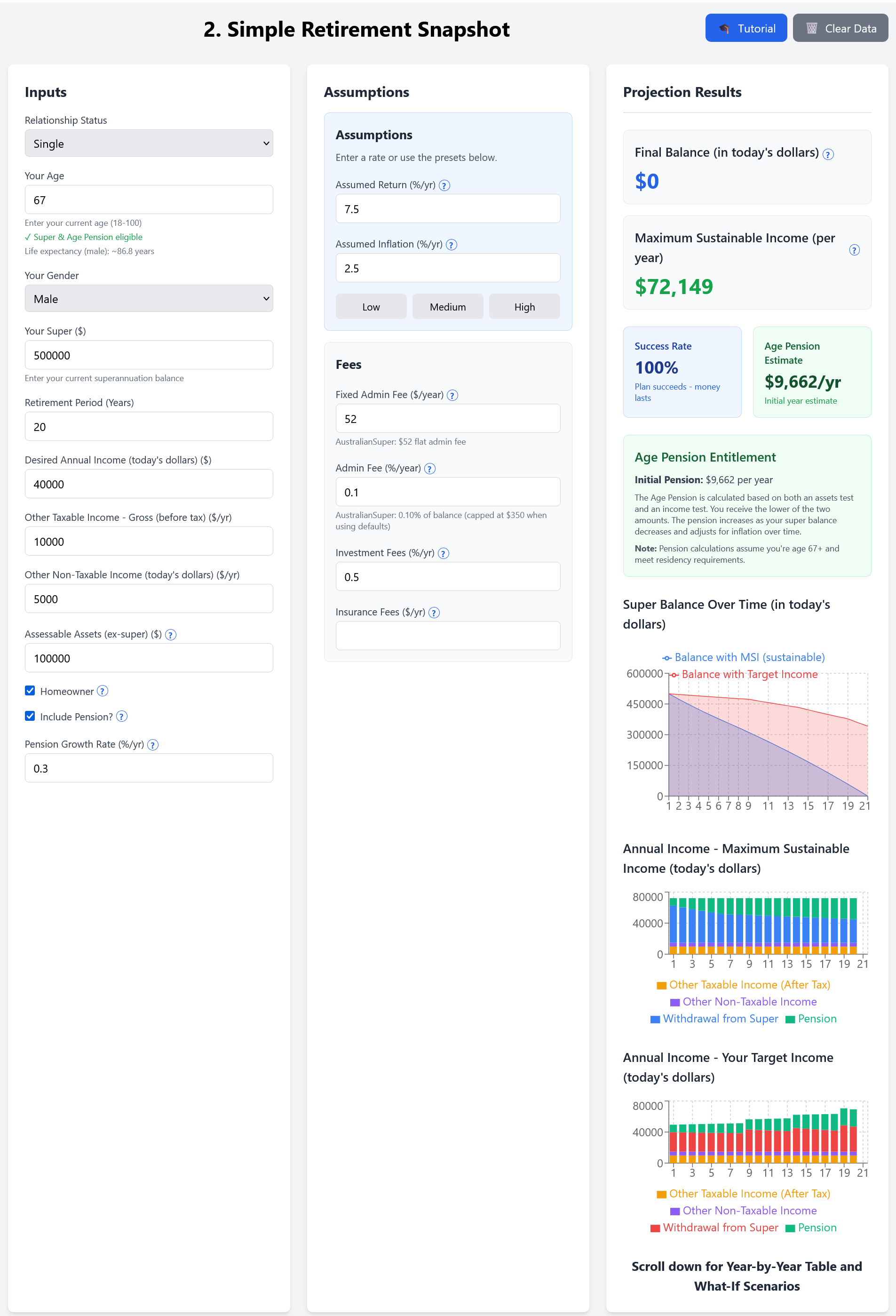
Compare your pension entitlement as a couple vs single
Put numbers around it: Choose couple or single, enter your combined assets and super balance, and the app applies the correct thresholds, the couple's higher asset test cutoffs, the combined income test, and projects your exact pension entitlement plus combined super drawdown year-by-year from retirement to 90. Run the Advanced Calculator → Free Advanced runs first.
What it costs to keep modelling
Run couple vs single thresholds free first. Unlimited household runs, historical stress tests, and PDF exports are $149 a year, or $14.99 a month if you’d rather not commit upfront, typically less than one hour of paid advice for the same Centrelink interaction work.
Run the couples vs singles scenario →No card required to try it. Pair with the pension asset test calculator for today’s entitlement snapshot.