Some free Australian retirement calculators ask for one retirement age; others provide stronger couple inputs. But running a single-person tool twice and adding the outputs is wrong for the household that actually faces joint Centrelink and super access rules.
I built the Advanced Calculator partly because that second path kept showing up in practice: people would run a free planner twice, add the incomes, and then wonder why Centrelink’s answer looked nothing like their spreadsheet. The mismatch appears the moment partners stop work years apart. One reaches preservation age and starts drawing. The other still earns wages and receives employer Super Guarantee (SG) contributions. Age Pension may start for one at 67 while the other is still under pension age. Centrelink does not care that the free tool only offered one calendar. It assesses you as a couple from day one, which is why the rules for a younger partner still under Age Pension age trip people who thought they had already checked the numbers online.
What MoneySmart and fund tools usually ask for
ASIC’s MoneySmart retirement planner is a useful public-interest orientation tool and includes broad retirement inputs. In our September 2026 review, its projection remained deterministic and did not expose SuperCalc Pro’s combination of rolling historical household MSI and phased-couple modelling. Other audited fund tools varied; this article should not be read as saying every competitor has the same interface.
Those interfaces are not malicious. They are designed for the modal user: one person, one job end date, one balance trajectory. When a couple shares a mortgage, a home, and a Centrelink claim, that template is the wrong shape. You need each partner’s age, each retirement age, each super balance, and any ongoing salary on the same year-by-year timeline.
Services Australia estimators answer a different question again. They estimate entitlement at a point in time. They do not tell you whether the household plan survives a weak market in the first five years of the older partner’s retirement, or what happens when the younger partner’s wage finally stops and the couple rate and asset test shift again.
Why two single runs do not add up
People try to fix the gap by running MoneySmart twice, once for each partner, then adding the incomes. That produces a comforting spreadsheet cell and a false sense of precision.
Couple Age Pension rates are not twice the single rate. From 20 March 2026 the maximum full rate (including supplements) is $1,200.90 a fortnight for a single person and $1,810.40 combined for a couple, about 1.5 times the single payment rather than double ($2,401.80). Asset test free areas are not double either. From 1 July 2026, a homeowner can hold about $333,000 in assessable assets and still sit on a full pension if single, versus about $499,000 combined if a couple. Twice the single figure would be $666,000. The real couple line is roughly $167,000 lower than that naive sum. Deeming thresholds sit at the couple level too: about $66,800 single versus about $110,600 combined for a couple where at least one partner is on a pension, again not a clean double. The income-free area is a combined amount. The younger partner’s wages feed the income test that can cut the older partner’s pension hard even though the older partner has already retired. None of that appears if you stack two single-person outputs.
There is a second failure mode. Even tools that let you tick “couple” often still force one shared retirement age. That erases the years when only one person can access super, when employer Super Guarantee is still landing on one account, and when Age Pension applies to only half the household. Those years are exactly where sequence risk and cash-flow mistakes hide. The longer walkthrough on how to model phased retirement for couples shows how those phases line up in practice.
If a model cannot set two retirement ages and keep both partners on one combined Centrelink and asset base, it is not modelling an Australian couple. It is modelling two singles who happen to live together.
What breaks in the middle years
Take a familiar pattern. Older partner is 67 and retired. Younger partner is 62, still earning, and not yet Age Pension age. The older partner claims Age Pension at the couple rate. The younger partner’s salary counts in the household income test. Assessable assets are joint. Super that is still preserved for the younger partner may sit outside the assets test until it becomes accessible, while the older partner’s account-based pension is already in play. In scenarios I have run through the calculator, lifting the younger partner’s wage by about $10,000 a year can move the older partner’s Age Pension by several thousand dollars over the same year, sometimes enough to change whether the income test or the assets test is binding. A single-exit-date calculator never asks that question.
Drawdowns compound the error. Minimum drawdown percentages apply per account, not to a blended household pot. If the retired partner starts drawing heavily while markets are weak, and the working partner’s contributions are modest next to that drawdown, capital can shrink in the years that matter most. A smooth 7% average return assumption papers over that. Historical paths do not.
Couples who try to average ages to feed a one-person tool create a third fiction. Averaging 67 and 62 into 64.5 does not create a person who qualifies for Age Pension halfway. Eligibility is binary by birth date: the household either has one pensioner or two.
Run one household, not two singles
Advanced Retirement pre-filled: older partner 67 retired, younger 62 still earning $72k, combined supers. Same inputs a free single-person planner cannot hold as one Centrelink household across phases.
Run the phased couple scenario →Free Advanced runs first, no card required. Change ages and wages; watch pension and drawdowns move together.
What a household model has to show
A useful Australian couples calculator has to do several jobs at once. Set each partner’s current age and retirement age. Keep wages and employer Super Guarantee on until each person stops. Apply couple Age Pension thresholds, taper, and deeming on the shared asset base. Move through the phases: both working, one retired, both retired under pension age, one on Age Pension, then both. Stress the same plan against weak historical start years, not only a median path.
That is the gap between a Centrelink form estimate and a retirement plan. The form asks what you might get this fortnight. The plan asks whether the household income path lasts.
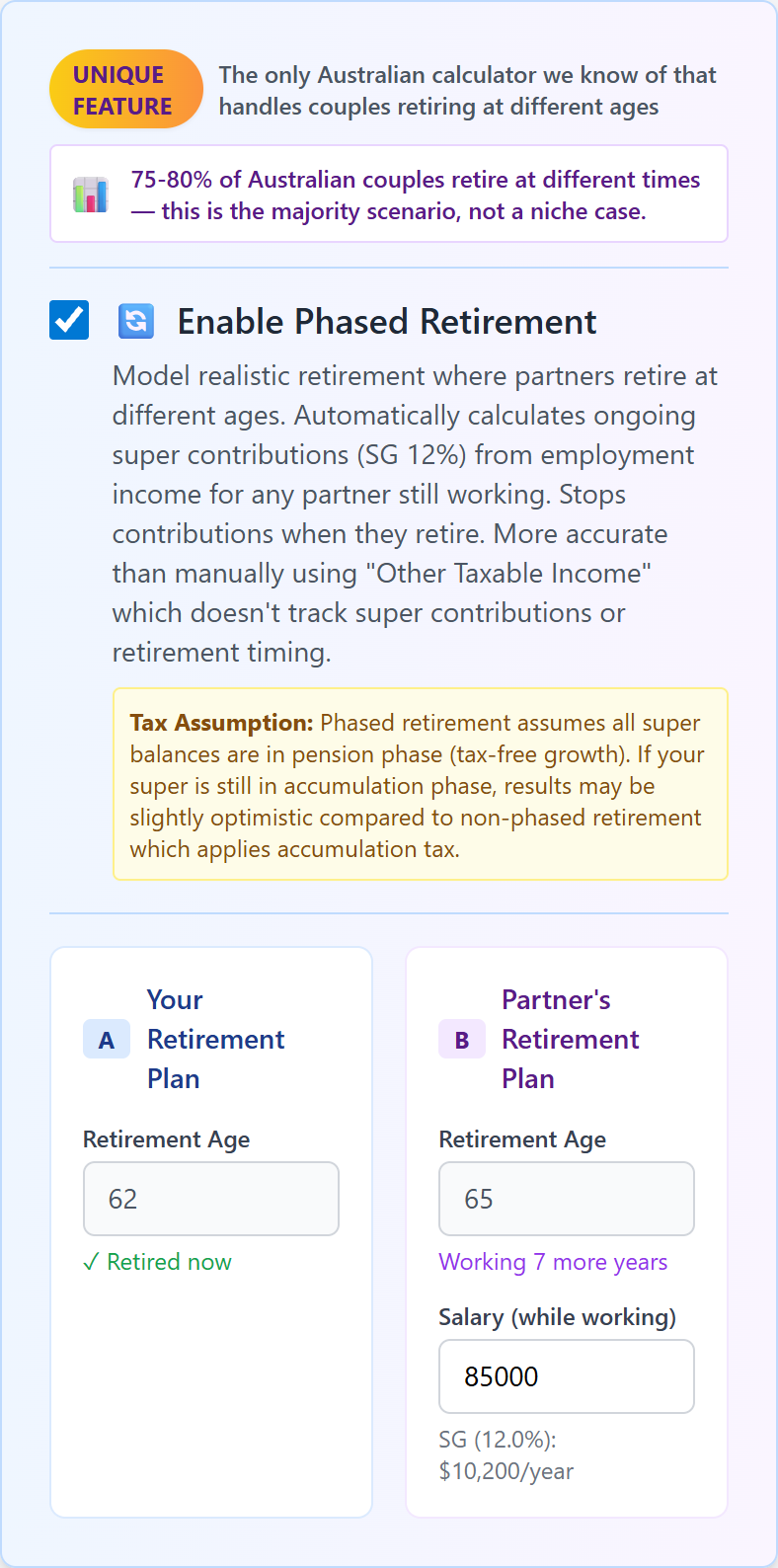
Advanced Retirement: one household timeline with different retirement ages, not two stacked single runs.
When a free tool is still enough
If both partners will stop work in the same year, have similar balances, and mainly want a rough sense of whether a spending target is in the ballpark, MoneySmart or a fund planner can be a sensible first pass. Use them for orientation. Do not treat the output as a household stress test.
When one partner keeps earning for several years, or one claims Age Pension while the other is still under 67, a tool that cannot represent those facts can diverge from the Centrelink result. That is also when one retired, one still working cash flow becomes the planning problem, not a footnote.
How to check your own numbers without treating the output as advice
Enter each partner separately: age, super, intended retirement age, and any salary that continues. Turn Age Pension on. Compare the year the older partner retires against the year the younger partner stops. Look at household income in the gap years, not only the final “both retired” plateau. Then replay a poor historical start for the first partner’s exit. If the plan only works on a smooth average return, it is not robust yet.
Keep current thresholds beside the model using our super and Age Pension rates hub. Those lines index through the year, so a spreadsheet from last March is already stale.
Official sources
What it costs to keep modelling
Run the pre-filled couple scenario free first. When you want unlimited household runs, historical stress tests, and PDF exports, Advanced Retirement is $149 a year, or $14.99 a month if you’d rather not commit upfront, typically less than one hour of paid advice for the same Centrelink interaction work.
Run the phased couple scenario →No card required to try the scenario. Subscribe only if the household model is useful enough to keep using.
General information only. This article is educational and does not consider your objectives, financial situation, or needs. It does not recommend that you open, close, or change any super fund or product. SuperCalc Pro Pty Ltd does not hold an Australian Financial Services Licence (AFSL). Consider licensed financial advice, and confirm current rules with Services Australia and the ATO, before making retirement decisions.