Most SMSF trustees believe they are better investors than the average. They are wrong, and the data is reasonably clear about it. This is not an insult. Overestimating your own investment ability is one of the most well-documented findings in behavioural finance, and it applies to everyone from retail investors to professional fund managers. The difference for SMSF trustees is that they pay the cost directly out of their own retirement savings.
APRA data has consistently shown that smaller SMSFs (those under $500,000, which represent the majority of funds) have delivered net returns that lag APRA-regulated funds over rolling five-year and ten-year periods. The gap narrows significantly as balances rise, which tells you something important: the problem is not self-management per se. It is the combination of higher proportional costs and behavioural mistakes that most small-balance trustees make without realising it.
The behavioural side of the equation is what this article is about. Understanding the specific mistakes that drive underperformance is the first step to correcting them, and in a retirement fund, correcting them is worth a great deal of money.
The Overconfidence Problem
Overconfidence is the tendency to overestimate the accuracy of your own judgements. In investing, it manifests as believing you can identify which stocks will outperform, which timing decisions are correct, or which sectors are about to move. Research by Barber and Odean, the most cited work in individual investor behaviour, found that the most active retail traders underperformed the market by around 6.5 percentage points per year on a gross basis, and by about 1.9 percentage points after accounting for the fact that active trading at least means you are paying attention. The more confident they were, the worse they did.
SMSF trustees are particularly exposed to overconfidence for a specific reason: career expertise. A trustee who has been a successful engineer, accountant, or business owner has genuine expertise in their field. That expertise often feels transferable to investing. It is not. Pattern recognition, decisiveness, and confidence in your own judgement are the skills that make you effective in your profession. They are also the skills that lead to overtrading, ignoring diversification, and doubling down on losing positions in a portfolio context.
The tell for overconfidence is turnover. If your SMSF buys and sells individual securities more than once or twice a year without a systematic rebalancing rationale, you are almost certainly incurring costs that exceed the value added by those decisions. Brokerage, market impact, and tax on realised gains are all frictions that compound against you over time.
Concentration Risk: The Australian SMSF Signature Problem
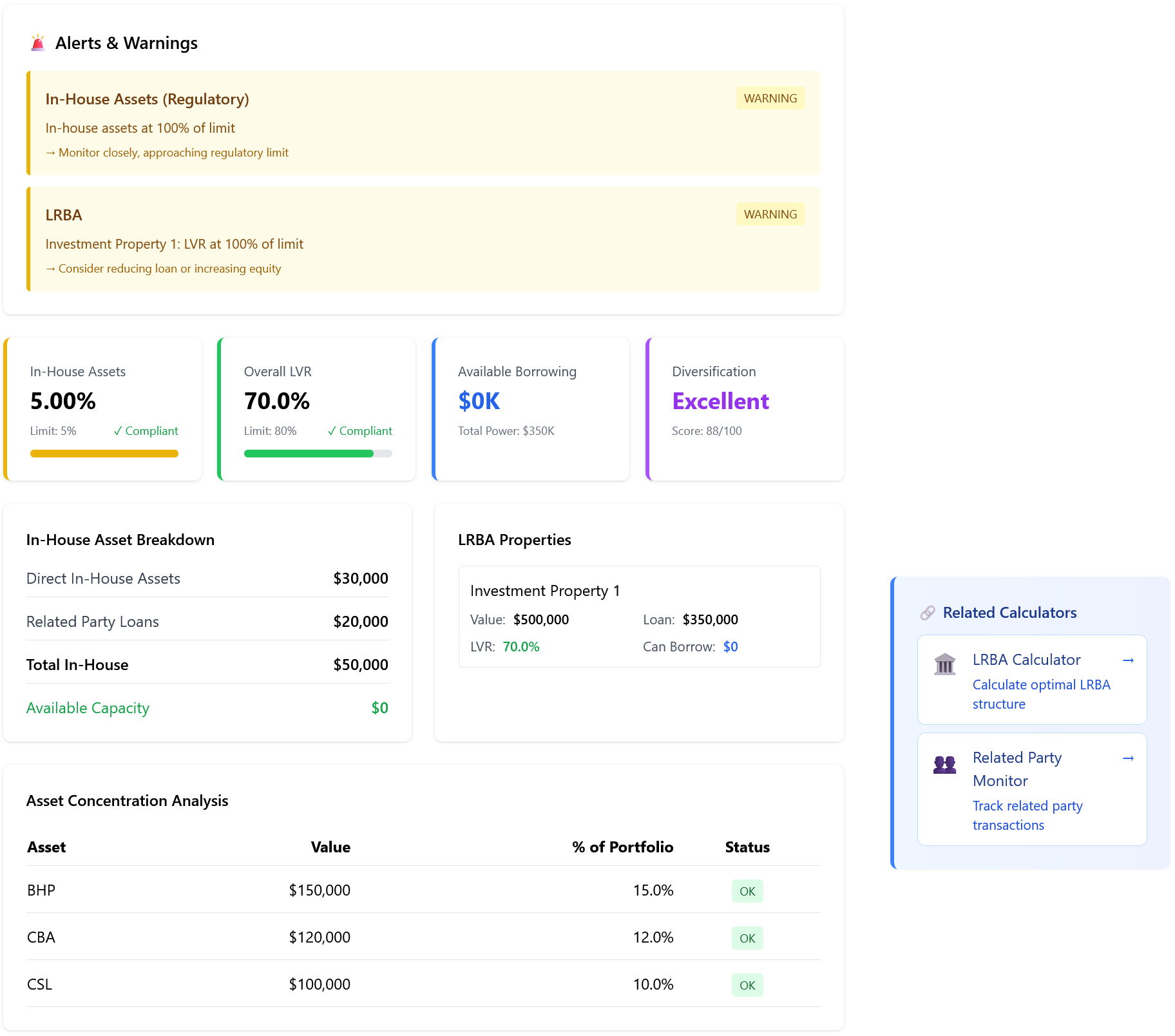
ATO statistics show that a significant proportion of SMSFs hold the majority of their assets in a single investment. For many funds, that investment is residential or commercial property. For others, it is a small number of shares, often in an industry the trustee knows well from their working life. Miners run mining-heavy SMSFs. Property developers hold direct property. IT professionals concentrate in tech stocks.
The intuition behind concentration is not irrational: you invest where you have the most knowledge and confidence. The problem is that concentration dramatically increases volatility without increasing expected return in proportion. A portfolio that holds ten uncorrelated assets has roughly one-third the volatility of a single-asset portfolio with the same expected return. That is not a theoretical abstraction. It means that during a GFC, a mining downturn, or a residential property correction, a concentrated SMSF suffers multiples of the loss that a diversified fund of the same size would take.
For a fund approaching pension phase, that distinction matters enormously. Sequence-of-returns risk, the damage done by large losses early in retirement, hits concentrated portfolios far harder than diversified ones. A 30% loss in year one of retirement on a $1 million fund means drawing down on a base of $700,000 for the remainder of your retirement, even if the market recovers in year two. You have already sold assets at the bottom to fund living expenses.
Timing Mistakes: Buying High and Selling Low
Dalbar's annual Quantitative Analysis of Investor Behaviour has tracked the gap between what markets return and what individual investors actually receive for over 30 years. The consistent finding is that individual investors underperform the index by 1.5 to 3 percentage points per year, and the primary cause is timing decisions: investors pour money in after periods of strong performance (when assets are expensive) and withdraw after periods of poor performance (when assets are cheap).
This pattern is not driven by stupidity. It is driven by the emotional experience of watching your portfolio fall. The instinct to act, to do something, when markets are declining is almost universal and almost always wrong. SMSF trustees act on that instinct with their own money, with no fund manager, trustee board, or investment committee to slow the decision down. An industry fund trustee cannot liquidate their portfolio on a Tuesday afternoon because the ASX has fallen 4%. An SMSF trustee can.
The worst timing decisions tend to cluster around the same events: the GFC, the COVID crash in March 2020, the 2022 rate-rise correction. In each case the pattern was the same: significant redemptions at the bottom, slow re-entry as markets recovered, and net underperformance relative to a trustee who simply did nothing.
Home Bias: Missing 98% of the Investment Universe
Australia represents approximately 2% of global equity market capitalisation. A portfolio invested entirely in Australian shares is by definition ignoring 98% of the world's publicly listed companies. Yet APRA data shows that the average SMSF has a far higher allocation to Australian assets than any benchmark portfolio would suggest is rational.
Home bias is reinforced by familiarity. Trustees invest in companies they recognise, industries they understand, and assets they can physically observe. Commonwealth Bank, BHP, and a house in a suburb they know well feel safer than international shares or global ETFs. That feeling of familiarity is not correlated with actual safety. Australian equities are heavily concentrated in financials and resources, two sectors with relatively high correlation to each other and to Australian economic conditions. A globally diversified portfolio reduces that correlation and provides exposure to sectors such as technology, healthcare, and consumer discretionary that are underrepresented in the Australian market.
The cost of home bias has been particularly visible since 2010. Australian equities have materially underperformed global equities over the past decade, and SMSF trustees with heavily domestic portfolios have paid that cost in reduced retirement balances relative to what a simple globally diversified allocation would have produced.
Recency Bias: The Rear-View Mirror Problem
Recency bias is the tendency to overweight recent experience when making forward-looking decisions. Property has returned 8% annually for the past decade, so trustees assume property will continue to return 8%. US technology stocks performed extraordinarily well from 2015 to 2021, so trustees loaded up on them in 2021 and 2022, just before the correction. Australian listed infrastructure performed well in the low-rate environment and attracted SMSF capital as rates began to rise.
The pattern is consistent: capital flows into yesterday's winner and away from today's underperformer. This is the inverse of what a rational return-maximising strategy would do. Assets with recent strong performance are typically more expensive and have lower forward-looking expected returns than assets that have recently underperformed.
Recency bias also distorts risk perception. After a long bull market in property, trustees tend to underestimate property risk. After a sustained period of low equity volatility, trustees underestimate equity risk. The risk feels lower because nothing bad has happened recently. The actual risk has not changed.
What the Performance Gap Actually Costs
When you aggregate the impact of overconfident trading, concentration, timing errors, home bias, and recency bias, the evidence suggests that the average self-directed SMSF trustee underperforms a simple diversified benchmark by 1.5 to 2.5 percentage points per year. At the midpoint, 2% per year, that is a conservative estimate for a trustee who makes the common mistakes described above without making catastrophic individual ones.
| Behavioural bias | Mechanism | Estimated annual drag |
|---|---|---|
| Overconfidence / overtrading | Excess brokerage, tax on gains, buying high after conviction | 0.3% – 0.8% |
| Concentration risk | Higher volatility, sequence-of-returns exposure, sector correlation | 0.3% – 0.7% |
| Market timing errors | Selling during drawdowns, slow re-entry, cash drag | 0.5% – 1.0% |
| Home bias | Underexposure to global equities, concentration in AU sectors | 0.2% – 0.5% |
| Recency bias | Chasing recent performers at peak prices | 0.2% – 0.5% |
| Estimated total drag (mid-range) | Not all biases apply to all trustees; overlaps exist | ~1.5% – 2.5%/yr |
On a $600,000 SMSF balance with a 30-year retirement horizon, a 2% annual underperformance compounds to roughly $700,000 in lost retirement savings against a diversified benchmark returning 7% gross. That is not a theoretical loss. It is the difference between a comfortable retirement and a constrained one.
When SMSFs Can Overcome These Biases
None of the above means that SMSFs cannot outperform, or that self-management is inherently a bad choice. The biases described are tendencies, not laws. Some trustees genuinely overcome them, and some SMSFs deliver excellent risk-adjusted returns over the long run. The question is whether you are one of them.
The trustees who tend to outperform share a few characteristics. They have genuine, specific investment expertise: not just interest or experience, but demonstrable edge in a particular asset class or strategy. They have a written investment strategy and they follow it mechanically, not emotionally. They rebalance on a schedule, not in response to market movements. They benchmark their own performance honestly against a relevant index and adjust when the evidence suggests their approach is not adding value. And they are honest about the difference between skill and a bull market: outperforming in 2020 and 2021 does not prove investment skill; it may prove that your asset class happened to benefit from an unusual macro environment.
The practical implication for trustees who suspect they may be subject to these biases is not necessarily to wind up the fund. It may be to change the approach: shift from active stock selection to low-cost diversified ETFs held within the SMSF structure, rebalance annually, and stop making tactical decisions in response to market news. The SMSF structure provides genuine benefits in investment flexibility, estate planning control, and transparency. But those benefits do not require you to trade actively, concentrate in a single asset, or make market timing calls.
⚠️ The hardest part is recognising it in yourself: Almost every trustee who is subject to overconfidence, concentration, or timing bias believes they are the exception. If reading this article has prompted you to think "yes, but my SMSF is different," that reaction is itself one of the diagnostic signals. The discipline required to honestly benchmark your own performance, acknowledge when your approach is not working, and change it rather than find reasons to persist, is the genuine differentiator between trustees who add value and those who do not.
Benchmark your SMSF against 98 years of history
The Advanced Calculator's Monte Carlo and historical backtesting tools let you enter your asset allocation and see the realistic range of retirement outcomes across thousands of scenarios, not a single projected number. Run a simple diversified portfolio alongside your current allocation and see the difference in projected outcomes over your retirement horizon.
Run the backtesting tool2 free Advanced runs, no signup. See Pro pricing for unlimited scenarios and SMSF suite.
What it costs to keep modelling
Try the SMSF Suite free first. Unlimited SMSF tools plus Advanced Retirement are All Access at $399 a year, or $39.99 a month if you’d rather not commit upfront.
Open the SMSF Suite →Free SMSF suite runs first, no card required. Subscribe only if the tools are useful enough to keep using.
Disclaimer: This article contains general information only and does not constitute financial, tax or legal advice. SuperCalc Pro Pty Ltd does not hold an Australian Financial Services Licence (AFSL). Performance figures and behavioural finance estimates cited are drawn from published academic and regulatory research and are illustrative of general tendencies; they do not represent any specific fund's past or future performance. Past returns do not guarantee future performance. Before making decisions about your SMSF's investment strategy, consult a licensed financial adviser or SMSF specialist who can assess your specific situation.