For years, many Australians met their first financial adviser through a bank. The pitch was convenient: mortgage, everyday banking, and super or investment advice under one roof. The Hayne Royal Commission tore into that model. Conflicts of interest, sales culture dressed as advice, and remediation bills followed. One by one, the major banks sold advice arms, closed networks, or retreated to high-net-worth corners. That history is well documented. What gets less airtime is the quieter consequence for households with mid-sized super who still need someone to talk through retirement timing, Age Pension, and drawdown risk.
This is not a sermon against advisers. Good advice remains scarce and valuable. It is an observation about supply. When the largest distribution channel for mass-market advice withdrew, middle Australia did not get a replacement channel of equal scale.
What “banks exited advice” actually meant
Between the late 2010s and early 2020s, Commonwealth, Westpac, ANZ, and NAB each exited or radically shrunk vertically integrated advice. Some businesses were sold to licensees. Some books of clients were transferred. Many relationships simply ended with a letter and a referral list. Branch staff who once booked advice appointments stopped doing so because the product no longer existed behind the counter.
The drivers were not mysterious. Remediation for fees for no service and related failures ran into the billions across the industry. Ongoing compliance under a tougher advice regime raised the cost of every file. Bank boards decided retail advice was a capital and reputation problem, not a growth engine. Wealthy clients with complex structures still found paths inside private banks and specialist firms. A couple with $450,000 combined super and a paid-off home often did not.
ASIC and Treasury have kept publishing papers on the advice gap ever since. The policy debate continues. The household experience is simpler: fewer places to walk in and ask for help without hitting a fee or a minimum that stops the conversation cold.
Who is left for ordinary balances
Independent and boutique practices still take clients. So do dealer groups, some accountants with advice pathways, and limited-scope services inside industry funds (often contribution, insurance, or retirement-income information rather than full personal advice). Digital and scaled-advice products have grown, with narrower questions and standardised outputs. None of that rebuilds the old bank footprint overnight.
Full personal advice usually means a Statement of Advice, fact-finds, and ongoing compliance. Practices price that work with retainers, hourly fees, or asset-based fees. Many set informal or formal minimums on investable assets because a $3,000 to $5,000 advice engagement on a $180,000 balance is hard for both sides to justify. That is not greed in every case. It is unit economics. The result for middle Australia is a thin market: too much complexity for free MoneySmart pages alone, not enough balance to look attractive on a traditional advice panel.
Middle Australia here means households that are not destitute and not private-bank clients: typically several hundred thousand in super, maybe an owner-occupied home, maybe a bit of cash, facing real decisions about when to retire, how much to draw, and how Age Pension interacts with the rest. They are the cohort banks used to funnel into advice, and the cohort most exposed when that funnel closed.
Fees, minimums, and what people actually do
Ask around any suburb and you hear the same patterns. Some households pay for a one-off plan and then self-manage for years. Some stay with an adviser on a retainer they can barely explain. Some use industry-fund phone lines for discrete questions and never get a household model. Some open a spreadsheet, copy a rule of thumb from a podcast, and hope sequence risk never shows up. A few find a good local adviser who still works with ordinary balances and never leave.
None of those paths is inherently foolish. Each carries a different risk. The dangerous path is the one that assumes the bank exit was temporary theatre and that someone else will call when it is time to retire. No one is calling. The system now assumes you either pay for advice, accept limited-scope help, or DIY with public tools and your own judgement.
That is why fee transparency matters, and why ASIC keeps pushing it. It is also why educational modelling has a role that is not “advice lite.” A model that shows how a couple retiring at different ages behaves under bad market starts does not tell you which product to buy. It tells you whether your gut feeling about “we will be fine” survives contact with history.
What modelling can and cannot replace
A retirement calculator will not write a Statement of Advice. It will not review your insurance, negotiate a binding death benefit nomination, or decide whether to keep the mortgage. Those tasks belong with licensed people when your situation warrants it. What modelling does well is expose assumptions that sound reasonable in conversation and fail under stress: retiring into 1969 or 1973, drawing a fixed spending path while minimum pensions force cash out in good years, ignoring deeming on a large cash buffer.
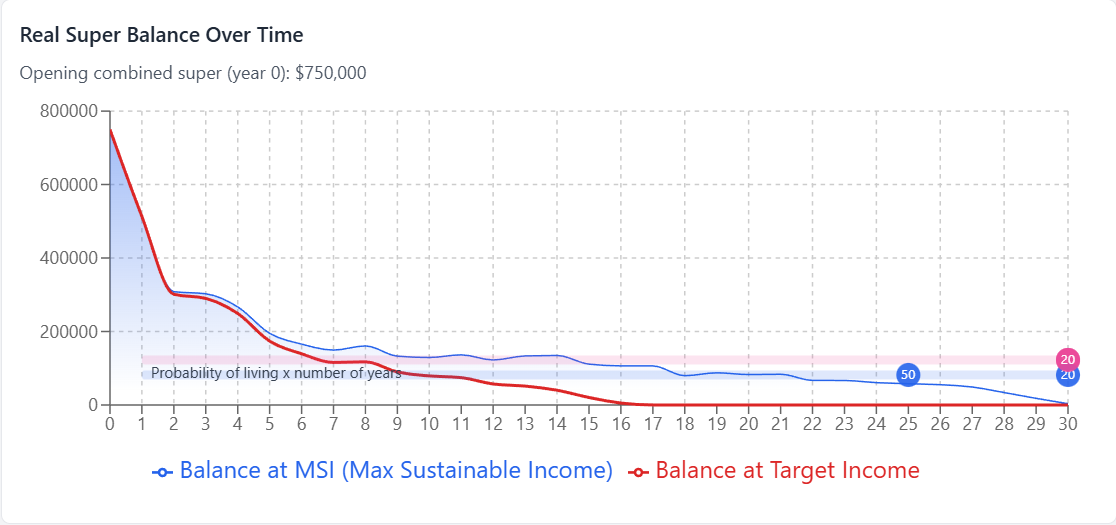
Bring that kind of printout to an adviser and the conversation changes. You spend less time arguing about whether markets can be bad and more time on insurance, estate, and tax elections. Bring nothing and you pay for the discovery phase either way.
Practical paths people use after the bank exit
Households that still want personal advice usually start with referrals, professional association finders, or accountant introductions, then ask about scope and fee structure before any fact-find. Industry-fund limited advice can answer narrow questions cheaply. Scaled digital advice can suit simple, single-topic decisions. For everything else, many people combine public education (ASIC MoneySmart, ATO guidance, Services Australia pages) with their own modelling and, when the stakes are high enough, a paid engagement.
The unfinished policy problem is scale. Australia still has millions of people approaching retirement with balances that deserve careful thought and fees that make traditional advice awkward. Until that gap narrows, DIY literacy is not a lifestyle choice. It is the default for a large slice of the population.
Official sources
Model the household before you pay for advice
Run the middle-Australia couple scenario free. See Age Pension, sequence risk, and drawdown in one path. Unlimited historical runs and PDF exports are $149 a year, or $14.99 a month if you would rather not commit upfront. Calculators do not replace licensed advice.
Run the middle-Australia scenario →No card required for the first run. Subscribe only if you keep using the full model.
General information only. This article is educational and does not consider your objectives, financial situation, or needs. It does not recommend that you engage or dismiss any adviser, open or close any product, or take any particular course of action. SuperCalc Pro Pty Ltd does not hold an Australian Financial Services Licence (AFSL). Advice laws, fees, and licensee arrangements change. Seek advice from a licensed financial adviser when personal recommendations are required, and verify current guidance with ASIC MoneySmart and the ATO.