Every year someone forwards me a fund letter that reads like a scolding. The balance went up. The minimum pension payment went up with it. They live comfortably on the Age Pension plus a modest draw from super. They would rather leave the extra inside the tax-free pension account. The answer from the fund, correctly, is that the minimum still has to be paid.
That surprise sits at the centre of a narrow planning problem, even if fund calculators rarely spell it out. Most retirees spend at or above the minimum anyway. The clash shows up for a smaller group: asset-tested part-pensioners with large pension balances, genuinely fixed low spending, and a run of good returns that pushes the dollar minimum well above what they planned to take. Fund calculators show a smooth spending line. Adviser conversations often start from “how much do you need to live?” The minimum drawdown table by age is a compliance floor climbing from 4% under 65 to 14% from age 95. For households on the Age Pension asset test, surplus cash from a forced payment can change next year’s entitlement in ways a static spreadsheet never shows.
What mandatory drawdown actually means
Each financial year, a percentage of the 1 July balance (or pro-rated in the first year) must leave the pension account as a pension payment. You may take more. You may not take less, except in the narrow product-specific cases the ATO recognises.
The percentages are set in tax law. They stepped up over the decades so older retirees pull a larger share of the balance each year. The age-by-age percentages are the ATO minimum drawdown rates. This page is about the rule those percentages enforce: there is no box on the form that says “I do not need the money this year.”
Governments have temporarily halved these percentages before. The legislated relief ran from 2019-20 through 2022-23 as part of the broader COVID stimulus package, not as an open-ended health measure. For any given year, use the rate that applies that financial year. The ATO and your fund remain the source of truth.
The good-year trap frugal retirees hit
Picture a homeowner aged 72 with $900,000 in pension phase and another $120,000 in cash outside super. Living costs sit around $45,000 a year. Age Pension fills part of that. Super tops up the rest. On paper the plan is stable.
Then markets run hot for three years. The pension balance rises to $1.1 million. By age 75 the minimum rate has stepped up to 6%. Six per cent of $1.1 million is $66,000 from super alone, well above the $45,000 total spending target. The surplus lands in the bank. Next July the balance is still elevated. Centrelink counts those bank dollars as assessable assets. The Age Pension can shrink even though nothing about daily spending changed.
That sequence is uncommon but real. It is why a drawdown strategy built only on living costs can look flat on a PowerPoint slide and jagged once minimums and market years are both in the model. Mandatory percentages turn balance growth into cash the law requires you to take.
Tax, Age Pension, and where the money sits after it leaves super
From age 60, pension payments from a taxed source are generally tax-free in your hands. The compliance pain is not an extra income tax bill on the minimum itself. The pain is what you do with money you did not plan to spend. Cash outside super counts for deeming. Term deposits count. Money gifted within Centrelink limits still has timing rules. Each forced withdrawal reshapes the balance sheet the Age Pension tests next fortnight.
For most account-based pensions that started after 1 January 2015, the Age Pension income test does not count your actual pension payment at all. Centrelink applies deeming rates to the account balance instead. Drawing more or less than the minimum does not, by itself, change that deemed income figure. What mandatory drawdowns can still shift is the assets test: surplus cash sitting in the bank after a large payment counts as assessable assets. A couple sitting just above the homeowner free area can lose pension faster when mandatory drawdowns refill the offset account. Grandfathered pensions that started before 2015 follow different income-test rules, so confirm which regime applies to your product. Modelling only the spending target misses that feedback loop between forced withdrawals and assessable assets outside super.
Transition-to-retirement pensions carry their own minimum and maximum bands while you are still working. Once a standard account-based pension starts, the age table above typically applies. The TTR trap articles cover a different product; the compliance floor idea is the same.
Why policy works this way
Super tax concessions were sold as support for retirement income, not indefinite wealth storage. Minimum drawdowns are the mechanism that pushes balances out over a lifetime. The 2020 Retirement Income Review discussed bequest motives and how minimum drawdown rules help turn pension-phase balances into income streams rather than open-ended tax-free storage. Whether you agree with that trade-off is a political question. For planning purposes the rule is simply live law.
Parliament also raises the percentages as age bands climb so very old retirees cannot keep enormous balances untouched while drawing a thin pension. By the time someone reaches their late 80s, the minimum percentage is high enough that even a falling balance can still produce a large dollar withdrawal. Longevity and aged care conversations sit downstream of that maths.
None of this tells you how to invest surplus cash, whether to pay down debt, or how much to gift to family. Those are personal decisions that need licensed advice. Mandatory drawdowns are a structural feature of the system. They bite hardest on the asset-tested households this article opened with, not on every retiree with an account-based pension.
What breaks in simplified calculators
Fund projection tools often assume you withdraw exactly your target income every year. Some ignore minimums until you are deep into retirement. Spreadsheet models built on a constant percentage spend the same nominal amount forever and never ask whether that amount cleared the statutory floor after a good decade in markets.
Fixed-dollar strategies in the Advanced Retirement Simulator show the clash explicitly. You set a sustainable income target. The engine still applies minimum drawdown rules by age. In strong return years the model pays the higher of the two. The yearly income chart jumps. The red dotted line averages total income across every year of the projection, including those mandatory spikes, so you see the gap between the plan on paper and the plan the law allows.
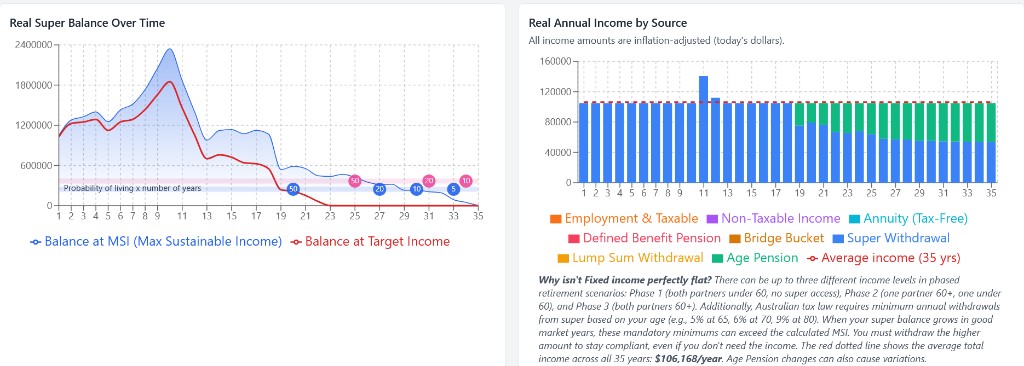
Actual Advanced Calculator output (fictional couple, ages 67/65, $700,000 super each, $150,000 other assets, 1990–2024, fixed sustainable income). Engine-computed MSI with mandatory spike years in the income chart and the red dotted all-years average. Not a real household.
If your tool never produces those spikes, check whether it is applying minimum drawdown rules at all. For households that always spend above the floor, the gap may never appear. For the fixed-spending, asset-tested cases described above, the gap is the whole point of running the model. Open the same fictional couple spike-year case in Advanced to stress the same rules on a larger combined balance.
Practical planning moves people discuss with advisers
Households respond in different ways. Some spend more in the years when minimums rise. Members with an account-based pension sometimes discuss a partial commutation back to their own accumulation account once the year’s minimum has been paid, because that transfer does not count toward the minimum itself and it debits their transfer balance cap while keeping the surplus inside super. Earnings in accumulation are taxed at up to 15%, the balance remains subject to deeming for Age Pension, and contribution rules still apply if they move money again later. Some households instead move surplus to a partner still in accumulation phase. Some pay down a mortgage, accept the lost pension on the cash that remains, and compare the after-pension cost. Others recontribute within caps in a later year. Each path has tax, cap, and Centrelink edges that belong in professional advice, not a blog post.
What you can do without advice is quantify the size of the forced withdrawals before they arrive, if your household sits in the segment where the minimum can exceed planned spending. Run the balance forward with minimums turned on. Stress the first decade of returns. See whether Age Pension rises or falls when surplus cash stacks up. Compare that path with a strategy that spends a percentage of the portfolio instead of a fixed dollar amount. The lump sum versus pension discussion is a separate decision; once you are in pension phase, the age table above still governs compliance regardless of which spending strategy you prefer.
Official sources
See the mandatory years before they arrive
Start with the free super drawdown calculator for ATO minimums by age. Then try the fictional couple spike-year scenario free (1990 start, fixed sustainable income, minimum drawdowns on). Unlimited historical runs and PDF exports are $149 a year, or $14.99 a month if you would rather not commit upfront.
Run the spike-year scenario →No card required for the first run. Subscribe only if you keep using the full model.
General information only. This article is educational and does not consider your objectives, financial situation, or needs. It does not recommend that you open, close, or change any super fund or product. SuperCalc Pro Pty Ltd does not hold an Australian Financial Services Licence (AFSL). Minimum drawdown rates, Age Pension rules, and contribution caps change. Consider licensed financial advice, and confirm current rules with the ATO and Services Australia, before making retirement decisions.