Once you reach preservation age, you do not have to wait until full retirement to touch your super. A transition to retirement (TTR) income stream, sometimes called a TRIS, is an account-based pension you can start while you are still employed. It sits between accumulation phase and a full retirement pension: you receive regular payments from super, you can keep working, and you can still make contributions subject to the usual caps.
Financial planners have talked about TTR for years because of a simple tax idea. If you are aged 60 or over, pension payments from super are generally tax-free in your hands. Concessional contributions, including salary sacrifice, are taxed at 15% inside the fund instead of at your marginal rate. Pair a TTR drawdown with extra salary sacrifice and your take-home pay can stay roughly flat while less tax is paid overall. That story is real for some people, but it is not automatic. Several structural limits can shrink or reverse the benefit.
What a TTR pension actually allows
You can usually start a TTR pension from preservation age. That age is 60 for anyone born on or after 1 July 1964. In 2026, anyone still working and considering TTR is in that group, so preservation age is effectively 60 for current planning. You do not need to have left your job. Many people use TTR to work fewer hours without a big drop in spending money, or to run the salary-sacrifice strategy while they are still on full-time wages.
While you remain in transition phase, the pension has both a floor and a ceiling on withdrawals each financial year. The minimum is commonly 4% of the account balance (using the fund's valuation date). The maximum is commonly 10%. Those percentages apply to the balance under the fund's rules, often measured at 1 July or when the pension starts. If you start mid-year, the first year's minimum is usually pro-rated. Full retirement-phase account-based pensions follow different minimum drawdown tables and do not have the 10% cap.
Payments from a TTR pension are taxed differently depending on your age. From age 60, the taxable component is generally tax-free in your hands. Between preservation age and 59, taxable amounts are assessable but you may receive a 15% tax offset. Earnings on the assets supporting the pension are another matter, and that is where the first major trap appears.
Trap one: earnings tax since 2017
Until mid-2017, investment earnings in a TTR pension were often tax-free, like a full account-based pension. The law changed. While you are still in transition phase, fund earnings on the TTR account are generally taxed at 15%, the same rate as accumulation phase. You only move to the 0% earnings tax rate once you meet a full condition of release, such as reaching age 65 or permanently retiring under the super rules.
That change cut the headline benefit for people who expected pension-phase tax treatment from day one. The personal tax saving on salary sacrifice can still matter, especially for someone on a 32.5% or 37% marginal rate. But the fund is no longer compounding those TTR assets entirely tax-free. Over several years on a large balance, 15% tax on earnings is a meaningful drag compared with leaving money in accumulation until you genuinely retire, or compared with what the same strategy looked like before 2017.
Trap two: the 10% withdrawal ceiling
The salary-sacrifice pairing only works smoothly when the amount you want to redirect into super is no more than the amount you can legally draw from the TTR pension. The cap is 10% of the balance per year, not unlimited access.
Suppose your super in the TTR account is $400,000. The maximum annual pension payment is about $40,000. If you earn $140,000 and wanted to salary sacrifice $50,000 while replacing that cash from super, the maths hits the ceiling. You can only draw up to $40,000 from the pension, so you cannot fully replace a $50,000 sacrifice from super alone unless you find the extra $10,000 from elsewhere. Many articles illustrate TTR with round numbers like $30,000 sacrifice on a $600,000 balance, where the cap is not binding. On smaller balances or higher incomes, the cap binds first.
The minimum drawdown can also surprise people who start TTR purely for tax arbitrage and do not want extra cash flow. You must take at least the minimum payment even if you do not need the money. That cash lands in your bank account unless you reinvest it outside super, which may not have been the plan.
Trap three: concessional contributions still have a single cap
Salary sacrifice under a TTR strategy uses the same concessional contributions cap as any other employer or personal deductible contribution. Employer super guarantee, salary sacrifice, and personal contributions you claim as a deduction all count toward one annual limit. For 2025-26 the standard cap is $30,000, with carry-forward unused cap space available for some people who meet the eligibility rules.
People often forget that employer SG already consumes part of the cap. On a $150,000 salary, 12% employer contributions are $18,000, leaving roughly $12,000 of headroom for sacrifice before you breach the cap. Excess concessional contributions trigger tax and paperwork you do not want. Payroll and your fund will not always stop you in time, so tracking the running total through the year is your responsibility, or your adviser's.
Trap four: Division 293 on higher incomes
If your income for Division 293 purposes plus concessional super contributions exceeds the threshold (currently $250,000), an extra 15% tax can apply to some or all of those contributions inside super. That lifts the effective contributions tax rate toward 30% for affected amounts. TTR can still produce a saving compared with a 37% or 45% marginal rate, but the gap narrows. Some high earners find the admin and pension fees hard to justify once Division 293 is included in the comparison.
Trap five: drawing more than you put back in
The classic boost strategy assumes pension withdrawals and salary sacrifice are matched, or that sacrifice exceeds withdrawals so the balance still grows. If you draw $35,000 from the TTR pension but only salary sacrifice $15,000, super is leaking. Your take-home pay may rise, which might be intentional if you wanted more spending money while working part-time, but it is not the tax-minimisation strategy people read about. Many trustees discover this only when the balance falls faster than they expected.
Investment returns add another layer. The 4% to 10% payment bands are recalculated on the balance at the relevant date. If markets rise, the dollar maximum and minimum rise with it. If you keep paying the same dollar amount year after year without checking the percentages, you can drift below the minimum or leave tax-saving headroom unused.
Trap six: Age Pension and partner income tests
TTR is usually discussed as a tax strategy for people still working, but it interacts with Centrelink when a partner is already on or near the Age Pension. The main lever for most couples in the 60 to 67 band is the income test, not the assets test. Payments from a TTR income stream generally count as income for the person receiving them, and in a couple that income is combined when Services Australia assesses the household.
The assets test is easy to overstate. If the younger partner has not yet reached Age Pension age, their super balance is generally not counted in the couple assets test, whether it sits in accumulation or is paying a TTR pension. What usually bites is the cash flowing out: TTR pension payments plus wages from part-time work can push combined income above the couple income-free area and reduce the older partner's pension. Once the younger partner reaches Age Pension age, their super typically moves into the assets test and the picture changes again.
In a couple where one partner has reached Age Pension age and the other is still working with a TTR, the tax benefit on super contributions has to be weighed against that household income impact. Scenarios like this are common and rarely appear in generic TTR examples. See also younger partner Age Pension rules for how staggered ages play out. Centrelink rules are complex and can change; confirm your situation with Services Australia or a licensed adviser.
What changes at age 65
From age 65 you generally have unrestricted access to super regardless of employment status. A TTR pension usually converts to a standard account-based pension in retirement phase. The 10% maximum falls away, earnings tax on the pension account drops to 0%, and the age-based minimum drawdown percentages for full pensions apply instead. For many people the strategy looks different after 65 even if they keep working, because the binding constraint shifts from the TTR cap to minimum drawdown rules and how much they want in pension phase versus accumulation.
That conversion also matters for the transfer balance cap. While a TTR pension remains in transition phase, the amount in that income stream generally does not count toward your personal transfer balance cap. Once it converts to a full retirement-phase pension (commonly at 65, or when you permanently retire under the super rules), the value of assets moved into retirement phase typically becomes a credit against the cap at that point. If you have a large TTR balance and are already using much of the cap elsewhere, the conversion can leave little room for further pension-phase transfers. Product rules and timing vary by fund; check your transfer balance account and cap position with your fund or adviser before assuming you can simply roll everything into a tax-free pension at 65.
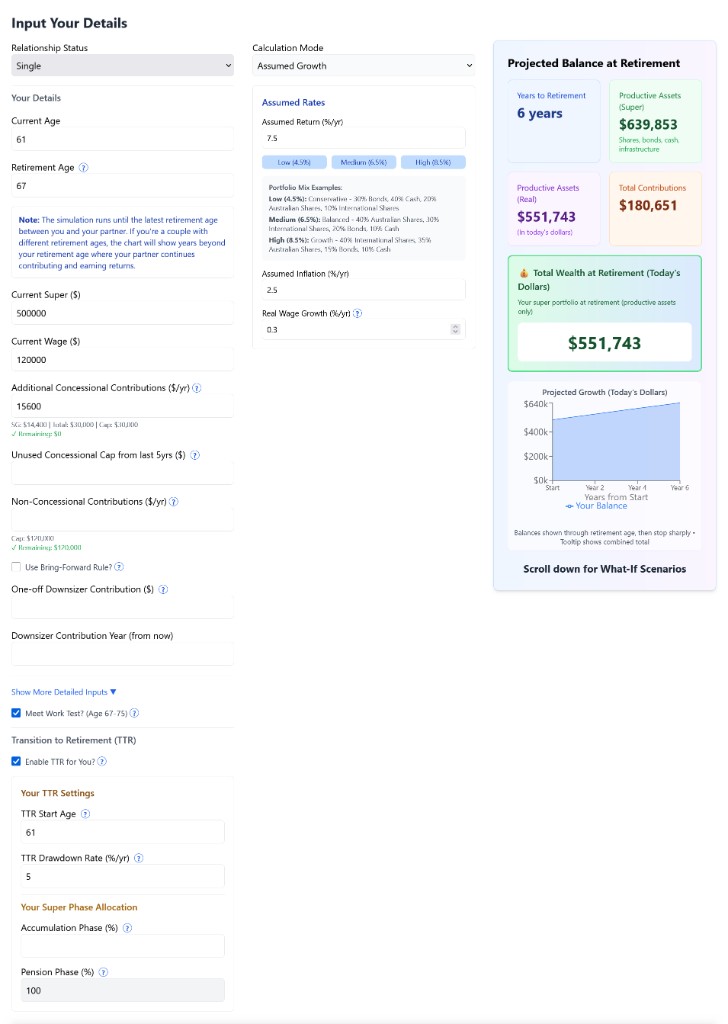
Accumulation Calculator example: age 61, $500k super, TTR drawdown 5%, salary sacrifice at the concessional cap ($30,000 including SG). Drawdowns apply only to the pension-phase portion of the balance you specify.
When the setup may not be worth the effort
TTR products carry administration fees and often require advice to set up cleanly with payroll. On a balance of $150,000, a tax saving of a few thousand dollars can be partly absorbed by pension fees and the time cost of coordinating HR, the fund, and the ATO. People close to 65 sometimes find it simpler to wait for unrestricted access rather than open a pension that will convert within a year or two anyway.
TTR also does not solve cash-flow problems on its own if the balance is modest and you still need full-time wages to meet mortgage or living costs. It is a structure for accessing super within limits, not a guarantee that your super is large enough for partial retirement. Modelling several years with realistic sacrifice amounts, fees, and drawdown limits usually clarifies whether the benefit is material. The educational guide at transition to retirement walks through product rules in more detail; this article focuses on where people stumble in practice.
Before opening a TTR pension, it helps to run through the binding constraints in order. Confirm preservation age and employment status with your fund. Work out the maximum drawdown on your actual balance and compare it to the sacrifice amount you have in mind. Include employer SG when calculating cap room. Ask whether Division 293 applies. If a partner receives Age Pension, model household income, not just personal tax. Compare pension fees and the post-2017 earnings tax against the number of years you expect to stay in transition phase.
Model TTR with salary sacrifice
See whether the 10% cap, contribution limits, and drawdowns still leave a worthwhile projected balance for your age and wage.
Open the Accumulation CalculatorWhat it costs to keep modelling
Run Advanced Retirement free first. Unlimited scenarios, historical stress tests, and PDF exports are $149 a year, or $14.99 a month if you’d rather not commit upfront, typically less than one hour of paid advice for the same modelling work.
Run the Advanced Calculator →No card required to try it. Subscribe only if the model is useful enough to keep using.
Disclaimer: This article is general information only. It is not financial product advice or personal advice. SuperCalc Pro Pty Ltd does not hold an Australian Financial Services Licence (AFSL). We do not recommend that you open, close, or change any super fund or product. TTR rules, tax rates, contribution caps, and Centrelink treatment can change. For advice tailored to your situation, see the ATO, your super fund, Services Australia, or a licensed financial adviser.