The premium comes out of the account
Take a woman aged 45, on a salary of $80,000, who changed jobs and told the old fund to keep the insurance. Both funds can still be deducting a default premium for death cover, total and permanent disability cover, and perhaps income protection. Nothing on the payslip shows it. The statement shows a smaller balance than contributions and earnings alone would have produced.
For her I use $800 a year as the total deducted. That is 1% of her salary, held from age 45 until 65, when total and permanent disability cover in super usually ends. It is one combined figure, not $800 from each fund. If both funds charged at that line, the cost would be higher than the sum below.
At 6% that $800 is worth $29,428 at 65. Two more years of compounding, to retirement at 67, take it to $33,065. That is about 5.5% of a $600,000 balance. Across her age band a substantial share of premiums comes back as claims, so the expected net cost is lower. A person who does not claim still pays the full premium.
ASIC says you are paying for that cover from the account, and that it reduces the retirement savings. If there is more than one fund, ASIC says you are likely paying more than one premium. MoneySmart adds the other half. Group cover can be cheaper than a policy bought outside super, and a default amount often needs no medical check. Both of those can be real advantages. The premium is still a deduction.
Report 760 (March 2023) counts people for the first two figures and accounts for the third, all from June 2022. About 15 million Australians had an accumulation account, and about 8 million of those people had insurance through super. Those two counts are ATO figures drawn from member account reporting. About 71% of insured accounts, a separate APRA count, were on the trustee's default. Default means the fund chose the sum insured. That sum may or may not match a mortgage, a partner, or the absence of either.
Two limits on automatic cover
From 1 April 2020, a new member under 25 does not receive automatic insurance, and neither does a member whose balance is under $6,000, unless they opt in in writing. A fund can still attach cover automatically for a dangerous occupation. If you already hold cover and the balance later drops under $6,000, you usually keep it. The rule is aimed at new, small accounts, not at stripping cover from someone who has already elected to hold it.
From 1 July 2019, an account that has had no contribution or rollover for 16 months loses its insurance unless the member tells the fund to keep it. That election is why the old fund in the example is still charging. Without it, and with nothing still being paid in, the cover would have stopped once the 16 months had passed.
Those two laws, Putting Members' Interests First and Protecting Your Super, were a response to automatic cover consuming accounts that were too small, or too quiet, to carry it. The laws restrict when that default can start, and when it must stop. They do not ban the cover.
The 14% was a different case
ASIC, citing the Productivity Commission's superannuation inquiry, said that for many low-income members the balance at retirement could be 14% lower because of inappropriate insurance premiums. The 14% comes from that model. It is the scale the Commission put on the concern for many low-income members. It is not this household, and it is not a tally of what ASIC observed in every account.
Identical members, different premiums
In Report 675, published on 14 December 2020, ASIC compared default cover across 20 large MySuper products. The like-for-like comparison is the price per $1,000 of death and TPD cover. For a 30-year-old woman, the dearest product charged more than 12 times the cheapest. For a 50-year-old man, almost 5 times. Age, sex and cover type were the same. The total premium, which mixes different types and amounts of cover, ranged more widely: $29 to $732 a year for that woman, and $40 to $1,480 for that man. ASIC said part of that wider spread is simply different cover, including income protection in some products and not others. Occupation and the risk of the membership still affect price. The 12 times is the unit-price range, not a finding that risk is irrelevant.
Trustees sometimes test affordability by asking whether the premium is above or below 1% of salary. One fund in ASIC's later review used 1% of estimated salary as the line at which it would warn a member. On an $80,000 salary, 1% is $800 a year. I use that as a stress test, held flat. MoneySmart says TPD cover in super usually ends at 65, and life cover usually ends at 70. For the 45-year-old above, 65 is 20 years away. Premiums also usually step up with age, so a flat $800 is not the shape of a real premium schedule.
What $800 a year becomes
$800 at the end of each year from age 45 to 65, at 6%, is worth $29,428 at 65. She retires at 67, so I compound that sum for two more years. It is then $33,065. Only the first year's premium has the full 20 years before 65. The last has one year. Life cover can continue after 65, usually to 70, and those later premiums are not in this sum.
Two things that sum leaves out. A fund can generally claim a tax deduction for insurance premiums it pays for members. Some of that saving may come back as a lower charge on the account. How much is passed through depends on the fund, so I have left the $800 untouched. The premium is also the price of a benefit. ASIC's release on Report 675 said insurers estimated that members with default insurance, as a group, would be paid up to 79 cents in claims for each dollar of premiums over the six years to 2019. In the report the average was 87% for total and permanent disability, 80% for death cover, and 61% for income protection, including claims estimated but not yet paid. That is a pooled average. A member who does not claim pays the full premium. The same report found systematic differences by age. Members under 30 received much lower value than older members. For ages 30 to 49, the group this woman sits in, Table 19 gives accrual ratios of 82% for death, 100% for total and permanent disability, and 61% for income protection. The 100% means that cohort's claims matched its premiums. It does not mean each member was paid back.
A second fund with its own default is a second premium. Death and total and permanent disability are usually lump sums, and two policies can both pay, though the terms differ. Income protection generally does not stack. The benefit is reduced by other income, including sick leave, workers' compensation, and often another policy. MoneySmart says you may not be able to claim the full amount from more than one policy, and that it depends on the terms. In a 2021 review, ASIC found that five trustees, each with a significant number of members on default income protection, could not show they had sought reliable data on those offsets and reviewed whether the default was still appropriate. In the 2022 follow-up, almost all of the trustees ASIC asked said they were receiving, or about to receive, granular data on the offsets from the insurer on a regular basis. Consolidating an idle account is partly an insurance decision, which is why the lost-super cleanup belongs in the same conversation as the premium.
The pension narrows the income gap
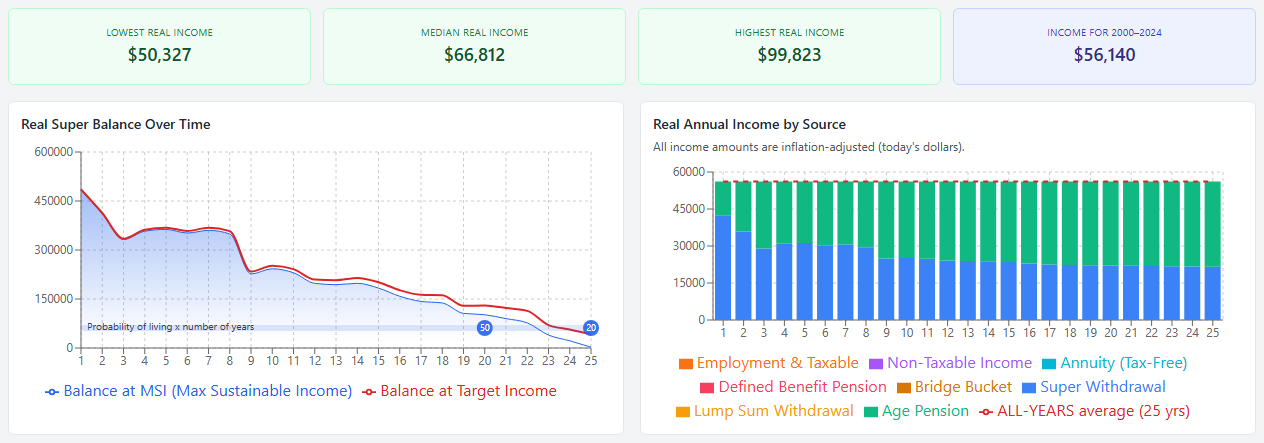
I ran a single homeowner, aged 67, with $40,000 outside super, through 2000 to 2024 on today's Age Pension rules, using the calculator's default fees. A $600,000 balance supports $57,041 a year on that path. Subtract the $33,065 and the start is $566,935, which supports $56,140. The difference is about $900 a year, on one historical window, before tax and claims.
At the start, $600,000 of super plus $40,000 of other assets is $640,000. For a single homeowner, from 20 September 2026, the asset-test free area is $333,000 and the cut-off is $745,750, so this household is above the free area and under the cut-off. Only a part pension is payable while the balance is still large. Turn the pension off and the same two starts support $28,652 and $26,990. The difference between those, about $1,700 a year, is what the missing capital costs when there is no pension. On the $600,000 start, the pension's average contribution over the 25 years is $28,389, which is $57,041 minus $28,652. That is an average after the balance has been drawn down, not the pension in the first year. Someone who stays above the cut-off for longer is closer to the no-pension result.
The fees are the calculator's own defaults, which is what produced the table. Administration is $52 plus 0.10% of the balance, and that piece stops at $350 a year. The investment fee is set at 0.5%, with a separate default cap of $350 a year. On $600,000, 0.5% would be $3,000, so the model charges $350. This cap is a setting in the calculator, and the link below runs with it on, so the table and the chart stay on that setting. It changes the income level. On the $600,000 start it lifts income from $56,250 to $57,041, about $800 a year. The premium effect is the gap between the two starts, and that gap barely moves. With the cap off, the same two balances support $56,250 and $55,392 with the pension, still about $900 apart, and $27,422 and $25,911 without it, about $1,500 apart rather than about $1,700. Transaction costs add 0.08%. Franking is 80%, and the pension is allowed to rise 0.3% a year above prices.
| Starting super | Income with the pension | Income without it |
|---|---|---|
| $600,000 | $57,041 | $28,652 |
| $566,935 | $56,140 | $26,990 |
The smaller row is $600,000 minus the compounded premiums. The $800 is the 1% line on an $80,000 salary, held flat, not a premium copied from a product disclosure statement.
Check the statement
The useful line on the annual statement is the premium in dollars, next to the type of cover and the sum insured, and the same line on the other fund if it is still open. None of this is a reason to cancel the cover from an article. Default cover is the only life insurance many households hold. Cancelling it to fatten a projection is how people arrive at retirement uninsured, and a projection that ignores the premium makes the opposite mistake. A licensed adviser, or the fund's own insurance line, is the place to change the cover. The sum on this page is what a flat warning-line premium costs the balance if it keeps being charged, before tax pass-through and before any claim.
The bottom line
In this case the premium is a real cost, and a modest one, before tax and claims. Change the cover, the number of years it runs, or whether anything is paid out, and the result changes with them. A calculator that starts from today's balance has already netted off the premiums deducted so far. What it leaves out, unless you put them in, is the premiums still to come.
Official sources
- MoneySmart: Insurance through super
- ASIC: Insurance through super
- ASIC 19-095MR: Protecting Your Super, including the 14% erosion finding
- ASIC 19-296MR: Putting Members' Interests First
- ASIC Report 675: Default insurance in superannuation, member value for money (14 December 2020). The $29 to $732 and $40 to $1,480 premium ranges, the unit-price gap, and Table 19 age-cohort claims ratios.
- ASIC 20-323MR: the release on Report 675, including the "up to 79 cents" claims estimate
- ASIC Report 760: Insurance in superannuation (March 2023). The 15 million and 8 million are people, from ATO data for June 2022. The 71% is a share of insured accounts, from APRA data for June 2022.
Run the same start
The chart is that smaller start. On the 2000 to 2024 path, income with the pension is about $900 a year below the $600,000 case. The first Advanced runs are free. Unlimited historical runs and PDF exports are $149 a year, or $14.99 a month ($179.88 over twelve months).
Open the calculator →No card required for the first run. Subscribe only if you keep using the full model.