Redundancy often arrives at the worst possible time to make neat financial decisions. There is a final pay, a tax statement, maybe a payout figure large enough to feel reassuring, and a very practical question: what can go into super? Before that question can be answered, the payment has to be split into the right boxes.
The split matters because 2026-27 super contribution caps, employment termination payment caps, unused leave tax rules, and retirement timing all interact. A person made redundant at 60 may be deciding whether to preserve cash, contribute after-tax money, or bring retirement forward. Someone at 45 has a different problem: rebuilding employment income without locking too much cash away. Get the label wrong and you misread what cash is actually available for super.
One payslip, several tax buckets
The ATO separates termination payments into categories. Ordinary salary and wages are still ordinary income. Unused annual leave and long service leave sit under unused leave rules. A genuine redundancy payment can have a tax-free part. The excess over that tax-free limit becomes an employment termination payment, usually called an ETP. Other termination payments, such as payment in lieu of notice, a golden handshake, unused sick leave, or compensation for loss of job, can also be ETPs.
Same headline payout, different tax outcomes. One person may receive mostly tax-free genuine redundancy; another may see most of the cheque eaten by unused leave and non-excluded ETPs. Payroll software usually withholds correctly, but the employee still needs to know what landed in the bank before treating any of it as spare capital for super.
For 2026-27: the genuine redundancy tax-free limit is $13,598 plus $6,801 for each completed year of service. The life benefit ETP cap is $270,000. The whole-of-income cap remains $180,000, and it is not indexed.
Genuine redundancy and the tax-free amount
A genuine redundancy has strict conditions. The job must be abolished, the employee dismissed because that role no longer exists, and the employee must generally be under Age Pension age (67 from 1 July 2023). That last gate is easy to confuse with preservation age (60 for anyone born after 1 July 1964), which governs when you can access super. Two different ages, both relevant if you are made redundant in your early 60s. Voluntary resignation, planned retirement, and dismissal for poor performance follow different tax rules no matter what the termination letter calls them.
The tax-free part is mechanical. In 2026-27 it is $13,598 plus $6,801 for each completed year of service with that employer. A worker with 10 completed years has a tax-free limit of $81,608. If the genuine redundancy payment is $75,000, the whole genuine redundancy amount is within the tax-free limit. If it is $100,000, the first $81,608 is tax-free and the remaining $18,392 is treated as an ETP.
Employers report the tax-free genuine redundancy amount separately from any ETP. It is not assessable income. Amounts above the formula cross into ETP territory. People often assume the whole payout shares one tax label, which is where the arithmetic trips them up.
Employment termination payments and caps
An ETP has a taxable component after any tax-free component, such as invalidity or pre-July 1983 service. For many employees, the practical question is whether the taxable component stays below the relevant cap. Amounts above the cap are taxed at the top marginal rate plus Medicare levy.
The 2026-27 ETP cap is $270,000. Some payments only use the ETP cap. These include the amount of a genuine redundancy payment above the tax-free limit, invalidity payments, and certain compensation payments. Other payments use the smaller of the ETP cap and the whole-of-income cap. This second group includes golden handshakes, payment in lieu of notice, unused sick leave, and non-genuine redundancy payments. The whole-of-income cap is $180,000 reduced by other taxable income for the year. If your last six months of wages, unused leave, and a golden handshake all land in the same financial year, the cap can shrink to almost nothing. Worth running the numbers before you assume concessional ETP tax rates apply to the full amount.
| Payment type | Usually treated as | Common trap |
|---|---|---|
| Salary, wages, bonuses already earned | Ordinary income | Not an ETP and not a redundancy concession. |
| Unused annual leave and long service leave | Unused leave payment | Taxed under separate leave rules, not ETP rules. |
| Genuine redundancy up to the formula | Tax-free amount | Only completed years of service count. |
| Genuine redundancy above the formula | ETP | Generally concessionally taxed up to the ETP cap. |
| Payment in lieu of notice or golden handshake | ETP | Whole-of-income cap may reduce concessional treatment. |
What can go into super?
The redundancy payment itself is paid to the employee first. It does not usually roll straight into super as an employer contribution. Once you want it in super, you contribute after tax, subject to eligibility and cap space. Once the cash has landed, contribution caps take over.
For 2026-27, the general concessional contributions cap is $32,500. Personal deductible contributions and salary sacrifice count toward that cap. A person who has unused concessional cap amounts from the previous five years may be able to use carry-forward concessional contributions if their total super balance was below $500,000 at the prior 30 June, but the deduction still needs paperwork and timing. See the separate guide to salary sacrifice versus personal deductible contributions.
The non-concessional cap is $130,000 in 2026-27. Bring-forward rules may allow up to $390,000 over three years for people below the relevant total super balance threshold. If total super balance was at least the general transfer balance cap at the previous 30 June, the non-concessional cap is nil. From 1 July 2026, the general transfer balance cap is $2.1 million, and the bring-forward thresholds move with it. The non-concessional bring-forward rule can absorb a large after-tax redundancy amount in one move, but only if you pass the total super balance tests first.
Redundancy close to retirement
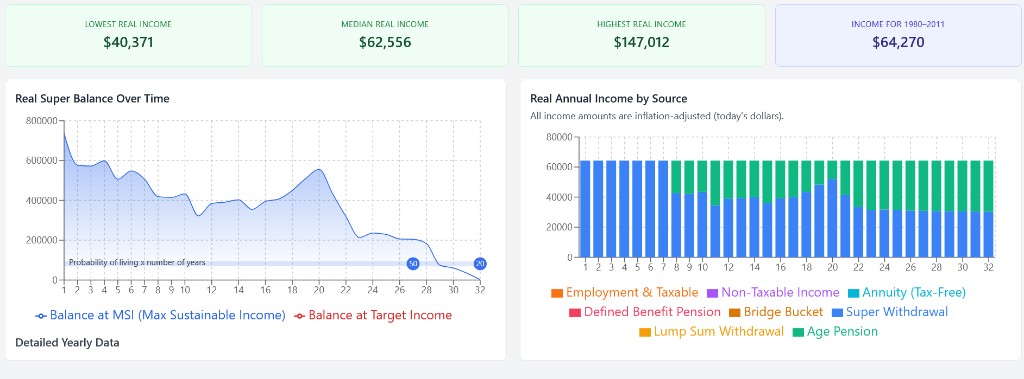
Redundancy near preservation age is where the numbers become personal quickly. A person aged 60 may satisfy a condition of release and legally draw super, but drawing and deciding are different problems. Taking a payout, retiring earlier than expected, and shuffling money into or out of super can shift Age Pension timing, investment risk, and how long your cash reserves last. Sometimes the best move is to keep $80,000 outside super as a buffer rather than trigger a bring-forward contribution you cannot unwind if contract work dries up.
Between 60 and 67 you carry the same seven-year gap as in any early-retirement plan: preservation age lets you access super, Age Pension age does not arrive until 67. The redundancy cheque can feel large on day one and thin after mortgage repayments, tax, and two years of living costs. Transition to retirement can help cash flow if you pick up part-time or contract work, but TTR was designed for people choosing to wind down, not everyone handed a termination letter on a Friday afternoon.
Redundancy well before retirement
For workers in their 40s or early 50s, the super instinct can be expensive if it absorbs too much liquidity. Contributing after-tax money may improve the retirement balance, but super is still preserved until a condition of release. A person out of work for six months may need cash more than a larger balance they cannot touch.
Super still matters when emergency cash is sorted, debt pressure is low, and cap room exists. The order of operations: classify the payment, reconcile what payroll withheld, count what you need outside super, then ask about concessional or non-concessional contributions. The common mistake is committing to a contribution before the household knows what it needs for the next twelve months of job hunting.
Official sources
For current rules, start with the ATO pages on genuine redundancy payments, employment termination payments for employees, payments that are ETPs, and the contribution caps. The ATO tax tables for ETPs and unused leave are the source payroll teams use for withholding.
What it costs to keep modelling
Run Advanced Retirement free first. Unlimited scenarios, historical stress tests, and PDF exports are $149 a year, or $14.99 a month if you’d rather not commit upfront, typically less than one hour of paid advice for the same modelling work.
Run the Advanced Calculator →No card required to try it. Subscribe only if the model is useful enough to keep using.
Disclaimer: This article is general information only. It is not financial product advice, legal advice, tax advice, or personal advice. SuperCalc Pro Pty Ltd does not hold an Australian Financial Services Licence (AFSL). We do not recommend that you open, close, change, or contribute to any super fund or product. Redundancy, ETP, contribution, and tax rules depend on personal circumstances and change over time. For advice tailored to your situation, consult the ATO, your employer's payroll team, a registered tax agent, solicitor, or licensed financial adviser.