
Same deeming rates, different test
The Age Pension asset test exempts the home, uses a free area of a few hundred thousand dollars, and deems income on bank accounts and account-based pensions. The aged care means assessment, run by Services Australia under the Aged Care Act 2024, uses the same deeming rates (1.75% and 3.75% from 20 September 2026) and the same gifting limits, but a single person's asset free area is only $66,500 and the income free area is $36,454.60.
Three differences catch people out. The former home is counted at up to $219,858.40 unless a partner or other protected person still lives there. A refundable accommodation deposit, which the Age Pension ignores entirely, is counted in full. And the Age Pension you receive is assessable income for aged care purposes. A full pensioner with a modest bank balance can sit below every threshold. A part pensioner with $350,000 in super and a house usually does not.
See the real balance at 85 across historical starts. Open a single homeowner retiring at 67 in the Advanced Retirement Calculator. Pre-filled, free to run, no signup.
Open in the Advanced Calculator →What a new resident pays from 20 September 2026
Anyone entering permanent residential care since 1 November 2025 is generally on the new fee arrangements. Everyone pays the basic daily fee, which is set at 85% of the single basic Age Pension and is currently $68.93 a day, a little over $25,000 a year. Clinical care, the nursing side, is now fully government funded for new residents. Everything else depends on the means assessment.
Above a certain level of means you pay the room price you agreed with the home, a hotelling contribution of up to $22.15 a day toward meals, cleaning and laundry, and then a non-clinical care contribution of up to $109.45 a day toward personal care such as bathing and mobility help. The non-clinical contribution stops for good once you have paid $140,652.80 in total, or after four years of paying it in residential care, whichever comes first. Contributions paid earlier under Support at Home count toward the dollar cap, but not toward the four-year residential limit. The hotelling contribution has no lifetime cap at all, and neither does the basic daily fee or the room.
The room is priced by the provider. Homes can charge up to $789,686 as a refundable accommodation deposit (RAD) without special approval (that ceiling appears on the July 2026 residential care schedule), or the daily equivalent, a daily accommodation payment (DAP), worked out at the maximum permissible interest rate. That rate is 8.51% for room prices agreed between 1 October and 31 December 2026, so a $550,000 room costs $128.23 a day if paid entirely by DAP. New residents who pay a RAD lose 2% of the balance each year to retention, for up to five years.
Not everyone is on these rules. People already in care on 31 October 2025 keep their old arrangements unless they opt in, and anyone who held or was approved for a Home Care Package on or before 12 September 2024 is protected by the no-worse-off principle and pays under the 2014 arrangements with the old means tested care fee. Check the fee advice letter before assuming which set of numbers applies.
How Services Australia turns income and assets into one daily number
The assessment produces a single figure, the daily means tested amount. Income is counted at 50% above the free area, in alternating bands. Assets are counted at 17.5% between $66,500 and $219,858.40, then at 7.8% between $266,000 and $369,366.66, and again at 7.8% above $552,858.40, with nothing counted in the gaps between. The income and asset amounts are added and divided by 364. The 7.8% will look familiar to anyone who has fought the Age Pension taper: it is the same annual rate.
The bands look arbitrary until you do the arithmetic. The first asset band, filled completely, produces exactly $73.73 a day, which is the maximum accommodation supplement, so a resident at that point is fully paying for their own room. The second band, filled completely, adds exactly $22.15, the hotelling cap. The income bands are tuned to the same two figures. Below $73.73 a day you have low means and the government helps with the room. Between $73.73 and $95.88 you pay the room and part of the hotelling contribution. Above $95.88 the excess becomes non-clinical care contribution, up to the daily cap. Somebody with income under the free area and assets anywhere between $369,367 and $552,858 lands on precisely $95.88 a day, which is the full hotelling contribution and nothing for non-clinical care.
Those figures match to the cent, which suggests the bands were built backwards from the two caps. I haven't seen a fee letter that explains it.
The home is counted, but only up to $219,858.40
If a partner, a dependent child, or a carer or close relative who qualifies as a protected person still lives in the home, it is not counted at all. If nobody protected lives there, it counts at its net value or $219,858.40, whichever is lower. A $1.4 million house in Mosman and a $480,000 house in Mandurah are assessed identically. The cap applies separately to each member of a couple, and couples are assessed on half their combined income and assets regardless of whose name is on what.
The Age Pension runs on a different clock. A former home is exempt from the pension assets test for two years after you enter care. After that it counts at full market value and you are assessed as a non-homeowner. Sell the house and the proceeds become financial assets for both tests: uncapped for aged care, deemed for income, and counted for the pension except for any part paid as a RAD, which the pension disregards. Aged care counts the RAD anyway.
That combination, a capped home on one side and a fully counted RAD on the other, is why keep-or-sell is the argument families have when the fee letter arrives.
Worked example: keep the house or sell it
Margaret is 86, single, and moving into permanent care. She owns a $950,000 house that nobody else lives in, has $300,000 left in an account-based pension, $40,000 in the bank and $10,000 of contents. The home she has chosen has a $550,000 room price. All figures below use 20 September 2026 rates and the October to December 2026 interest rate, and her Age Pension is worked out from the current pension tests.
If she keeps the house and pays the room by DAP, the home is counted at the $219,858.40 cap. Her assessable assets are $569,858 and her assessable income is about $40,825: an Age Pension of about $29,411 (the house is still exempt for the pension) plus $11,414 of deemed income. That gives a means tested amount of $105.53 a day. She pays the full hotelling contribution and $9.65 a day of non-clinical care contribution.
If she sells and puts $550,000 of the proceeds into a RAD, her aged care assets jump to about $1.3 million, because the RAD and the remaining $740,000 of financial assets all count. Her pension falls to about $20,480 under the non-homeowner assets test, but her deemed income rises to $26,414. Her means tested amount is $270.32 a day, and the non-clinical care contribution hits its $109.45 daily cap.
| Per day, first two years | Keep home, pay DAP | Sell home, pay RAD |
|---|---|---|
| Basic daily fee | $68.93 | $68.93 |
| Hotelling contribution | $22.15 | $22.15 |
| Non-clinical care contribution | $9.65 | $109.45 |
| Room (DAP, or RAD retention at 2%) | $128.23 | $30.14 |
| Total per day | $228.96 | $230.67 |
Less than $2 a day apart. The usual advice, keep the house because it is capped, is right about the care fees and wrong about the total, because the money saved on the non-clinical contribution goes straight into a non-refundable room payment.
The two paths differ in what stops and what comes back. If Margaret sells, her non-clinical contribution stops once she has paid $140,652.80, roughly three and a half years at the daily cap, and RAD retention stops after five years, having taken at most about $55,000. The rest of the $550,000 is refunded to her estate when she leaves. If she keeps the house, the DAP never stops and is indexed twice a year, and none of it is refunded. Her house may keep growing in value, or may cost rates, insurance and upkeep while it sits empty; rent from it would count as income.
Then the two-year pension exemption ends. With a $950,000 house now counted for the pension, Margaret's Age Pension falls to nil and roughly $29,000 a year of income disappears. Her care fees drop a little because the pension no longer counts as income, but she is now drawing the whole bill from what is left of her super. On these numbers, by the third year in care her financial assets are around $230,000. That $230,000 is after about $93,600 of non-refundable room fees in the first two years ($128.23 a day, before indexation).
Super decides which choices she has
Keep-or-sell and how she pays for the room change the shape of the bill, and what is refundable, more than the leftover super does. About $100 a day shifts between the non-clinical contribution and the room cost; the daily total barely moves. Non-clinical care is capped at $109.45 a day, so the balance only drives that fee between roughly $550,000 and $1.1 million of assessable assets, where each extra $100,000 adds about $21 a day (7.8% divided by 364). The "roughly" matters because her income shifts the edges. What the balance still decides is which choices she can fund (including keeping the house through the pension exemption), and how much cash she has left when Services Australia updates the means assessment after her income or assets change (including when the Age Pension falls away).
Look back at her starting point. The house value is capped. The pension is set by the rules. The $340,000 of super and cash she still had at 86 was not knowable at 67, and it sits above the median outcome in the next paragraph. It depended on what she spent, what the markets did along the way, and how much Age Pension she received. For an illustrative Advanced Calculator run (single homeowner, retire at 67 with $500,000, $50,000 other assets, Fixed Sustainable Income, 30-year runs, no annuity or defined benefit), the real balance at 85 across historical start years ranges from about $101,000 to about $504,000, with a median near $233,000. That is the spread of those historical sequences for this generic scenario, not a forecast of what any one person will have. One 1990 path (the screenshot below) shows $295,255 at 84 and $185,574 at 85 after the 2008 crash in year 19: move into care a year earlier and that path is assessed on a balance about 59% higher.
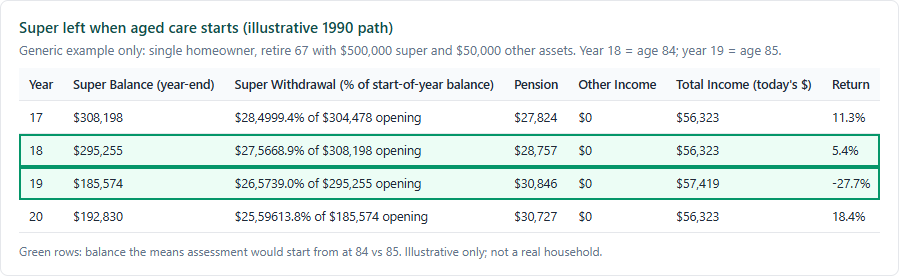
Generic example as of November 2026. Educational projection; it does not include aged care fees.
Support at Home draws on the same cap
Many people receive care at home for years before they move into a home, and since 1 November 2025 that runs through Support at Home. Clinical services such as nursing are free. Independence services and everyday living services attract a contribution: 5% and 17.5% of the service price for a full pensioner, up to 50% and 80% for a self-funded retiree, with part pensioners and Commonwealth Seniors Health Card holders in between on a sliding scale set by their income and assets. Those home care contributions count toward the same $140,652.80 lifetime dollar cap as the non-clinical care contribution in residential care. They do not count toward the four-year residential time limit. Someone who paid heavily for help at home in their early eighties can arrive in residential care with much of the dollar cap already used, and still face up to four years of residential non-clinical contributions if the dollar cap has not been reached.
The Financial Information Service at Services Australia (132 300) explains how these rules apply to a particular situation at no cost, and the My Aged Care fee estimator gives a quick figure. Both are worth using before choosing a room.
Official sources
- Department of Health, Disability and Ageing: Schedule of fees and charges for residential care (from 20 September 2026)
- My Aged Care: Aged care home costs and fees
- My Aged Care: Understanding aged care home accommodation costs
- Department of Health, Disability and Ageing: Means assessment for residential aged care
- Federal Register of Legislation: Aged Care Act 2024 (section 319, daily means tested amount)
- Services Australia: Real estate assets and the two-year exemption when entering care
- Social Security Guide: Refundable deposits and the Age Pension assets test
Find out what you will bring to the means test
The first assessment starts from the balance you walk in with, and everything after builds on it. Put in your own balance, spending, partner and home status and the Advanced Calculator shows that balance at every age, in today's dollars, through historical market starts, with Age Pension included year by year. Your first Advanced runs are free. Unlimited runs and PDF exports are $149 a year, or $14.99 a month.
Run the projection →Subscribe only if you keep using the full Advanced model.