The pitch that made TTR famous
Before mid-2017, a transition to retirement income stream (TRIS, usually called a TTR pension) was sold as something close to a retirement-phase account while you were still on the payroll. You could start one from preservation age, draw a limited pension, keep working, and often enjoy tax-free investment earnings on the assets supporting that pension. Advisers packaged it with salary sacrifice. Take-home pay could look flat while more dollars sat inside super.
Tax-free payments from age 60 helped. The compounding story inside the fund is what made TTR a product category of its own. Once earnings looked like a full account-based pension, keeping the job became a feature.
Then see whether the balance lasts in retirement. Open the scenario from this article in the Advanced Retirement Calculator. It is pre-filled, free to run, and needs no signup.
Open in the Advanced Calculator →What 1 July 2017 actually removed
Parliament left the product standing and removed that earnings treatment. While a TRIS is not in retirement phase, the ATO is plain: earnings on supporting assets are taxable, and the fund cannot claim exempt current pension income on those assets. The headline rate on taxable fund income is 15%, the same as accumulation. Retirement phase starts when you turn 65 (automatically), or when you notify the fund that you have met a nil-cashing condition of release such as retirement, permanent incapacity, or a terminal medical condition.
Under the retirement condition of release, someone aged 60 or over who ceases an employment arrangement can satisfy retirement for that purpose. The cessation must be genuine, not a paper resignation designed to unlock benefits. Reducing hours with the same employer does not count. Ceasing one job can be enough even if another arrangement continues, and intention to work again later does not undo the condition once it is met. In that one-job case the ATO lets you cash benefits accumulated up to the cessation; amounts that accrue from a continuing job afterwards stay preserved until a fresh condition of release is met. The fund still needs to be notified before a TRIS moves into retirement phase. You do not always have to wait until 65 or until you have left the workforce for good.
Until that switch, a TTR account sits under the same earnings-tax regime as accumulation. You have added pension paperwork, a 4% to 10% payment band, and often an advice or admin fee, without buying the tax-free earnings that once justified the complexity. MoneySmart still describes TTR as a way to top up income or pair with contributions.
On a $500,000 TTR balance, say $30,000 of taxable earnings in a year. Fifteen per cent of that slice is $4,500. That is the flat-rate cost on that taxable base, not a typical bill. Relative to the old exempt regime, the lost benefit is 15% of taxable earnings in the fund. Real portfolios can land lower (CGT discount on assets held more than 12 months, deferred unrealised gains, deductible fund expenses) or higher (heavily franked dividends are grossed up, so taxable income can exceed cash yield). Over five years of transition before age 65, the simple flat-rate sum is about $22,500 before compounding on dollars that never stayed. Fees and return paths change the figure.
| TTR balance (illustrative) | Taxable earnings at 6% | Flat-rate cost at 15% |
|---|---|---|
| $250,000 | $15,000 | $2,250 |
| $500,000 | $30,000 | $4,500 |
| $800,000 | $48,000 | $7,200 |
Those rows are arithmetic on a flat taxable-earnings rate with no CGT discount and no expense deductions. They show the scale of the thing that used to be zero.
What still works
TTR remains a legal way to access super while employed once you have reached preservation age. For anyone born on or after 1 July 1964, that age is 60. Everyone born before that date has already passed the older stepped preservation ages, so no current member sits between preservation age and 59. The old under-60 payment tax offset has no live cohort left for planning today. Payments sit between a floor (commonly 4%) and a ceiling (commonly 10%) of the account each financial year. From age 60 those payments are generally tax-free in your hands. You can draw cash within that band while you keep working. Lump-sum access stays blocked until a nil-cashing condition of release.
Cutting hours with the same employer is still the cleanest cash-flow use of TTR, and it does not by itself move the income stream into retirement phase. If wages fall and you need income until you leave that job, drawing up to 10% of a large enough balance can replace part of the lost pay. You are spending super earlier. MoneySmart puts the same downside next to the hours-reduction case: draw now and you have less later. The relic label targets the old tax-product pitch. Plenty of people still need cash while easing out of work.
The classic salary-sacrifice pairing also still exists in a thinner form, and for someone in the 30% band or above who keeps the same job it can still save real personal tax. From 60, you can sometimes redirect more concessional contributions into the fund (taxed at 15% inside, subject to the cap and Division 293) while replacing take-home pay with tax-free pension payments. From 1 July 2026 the general concessional cap is $32,500, and employer Super Guarantee eats that room first. Unused concessional carry-forward can reopen space if your total super balance on the prior 30 June was under $500,000. The worked $500,000 starting balance in this article sits exactly on that cutoff, so carry-forward is closed for that case. The 10% drawdown ceiling still caps how much sacrifice you can replace from the pension alone. Our companion piece on TTR traps walks those binding constraints. Even when the pairing still saves personal tax, it no longer buys tax-free earnings on the TTR account.
Where the relic label fits hardest is any leftover pitch that TTR still delivers pension-phase tax inside the fund while you stay employed. Leaving money in accumulation until you meet a nil-cashing condition of release, notifying the fund after you cease a job at 60 or over, or waiting until 65 when a TRIS flips into retirement phase automatically, often matches the earnings-tax outcome without years of TTR paperwork. People a year or two from 65 who are sold a multi-year TTR strategy for earnings reasons are buying admin for a benefit that arrives on their birthday anyway.
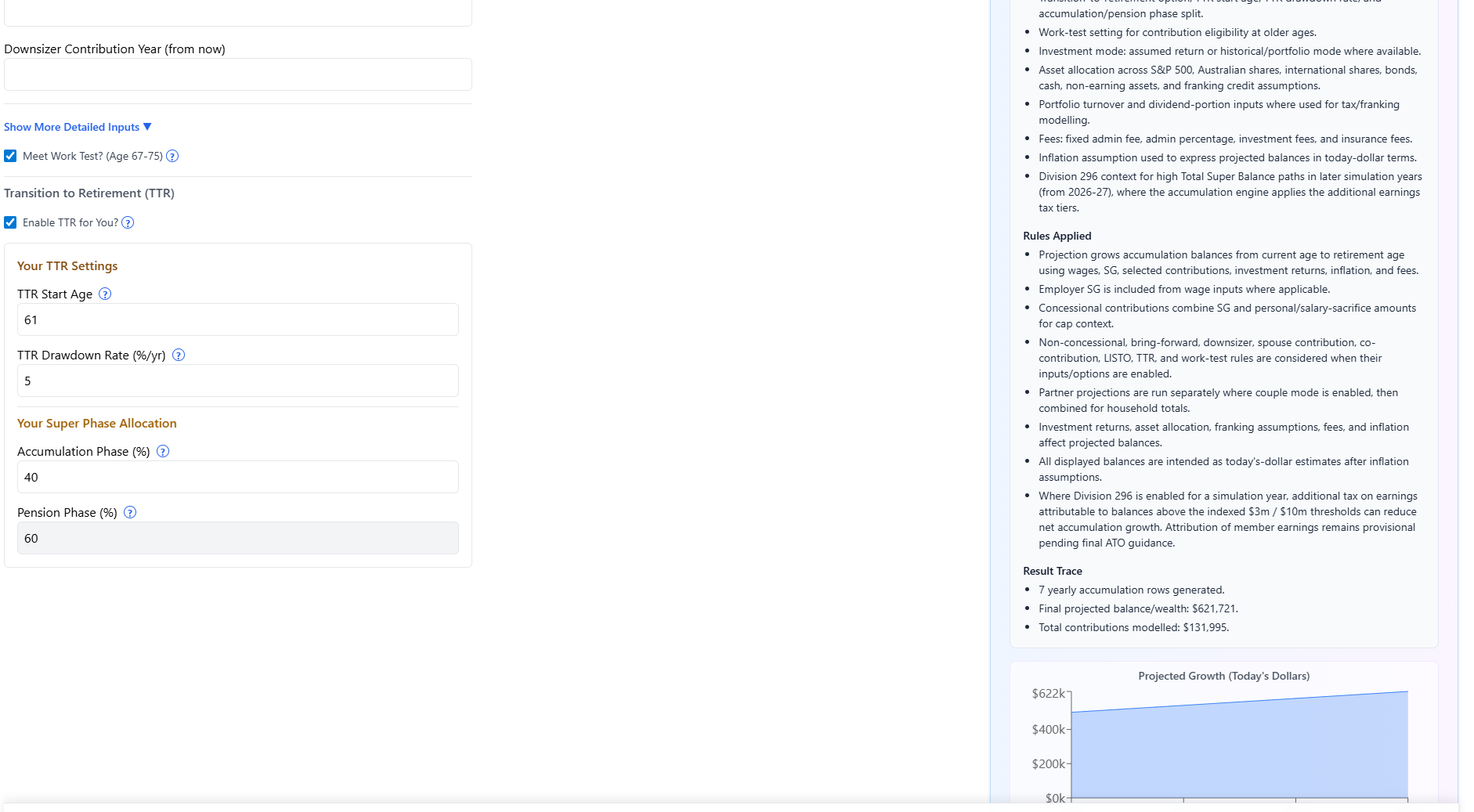
Assumptions (tool defaults as of November 2026): age 61 to 67; $500,000 start; $90,000 wage; 0.3% real wage growth; $15,000 extra concessional; 5% drawdown on the TTR pension slice (60% of balance, about 3% of total); 40/60 accumulation/TTR split; 6.5% assumed return; 2.5% inflation; fees about $52 admin, 0.10% admin percentage, 0.50% investment, and 0.08% transaction costs; 15% contributions tax; accumulation earnings tax with portfolio turnover and the CGT discount (not a flat 15% on every dollar of return); balances reported in today's dollars. Educational projection.
Who still has a live case
Someone aged 60 or over who is deliberately cutting hours, has a balance large enough that 10% covers the wage gap they care about, and accepts that they are spending nest egg to buy time, still has a structural use for TTR. So does a higher earner whose concessional room after SG is real (or whose carry-forward is open because last June’s total super balance sat under $500,000), whose Division 293 position is understood, and who treats the salary-sacrifice pairing as a personal-tax exercise while staying in the same job. Those are live uses. They are narrower than the mid-2010s product pitch.
If you need the cash while you wind down work, and you know what you are giving up, the product can still earn its keep. If the reason for opening it is a memory of tax-free earnings while employed, that reason is gone. For traps, caps, and Centrelink interactions in detail, use the traps article. For whether salary sacrifice itself is bending at low brackets and in the taper, see where the salary sacrifice pitch bends.
Official sources
See what the draws cost your balance
Match the ages, balance, wage, sacrifice, return, and TTR settings in the caption, then turn TTR off and keep the same wage and sacrifice. The higher end balance is mostly the cash you did not draw, which is useful for sizing what the draws cost your balance. That comparison does not hold take-home pay equal: with TTR off you still sacrifice into super, but you no longer replace cash with pension payments. This screen does not isolate a fund-earnings tax penalty: the same draws from accumulation would show the same earnings-tax regime. Accumulation is free to run. Unlimited Advanced historical runs and PDF exports are $149 a year, or $14.99 a month ($179.88 over twelve months).
Open Accumulation →Already near retirement? See how the balance holds up in the Advanced Calculator →
Subscribe only if you keep using the full Advanced model.