Running a pension from your SMSF means investment earnings on the assets supporting that pension are tax-free, and payments to you (once you're 60 or over) are tax-free. The trade-off is strict rules. The main one: every account-based pension must pay out at least a minimum percentage of its balance each financial year. Miss that minimum by 30 June and the ATO treats the pension as having ceased from 1 July of that year. All earnings for the year then become taxable at 15%, and you have to restart a new pension, which uses Transfer Balance Cap space again.
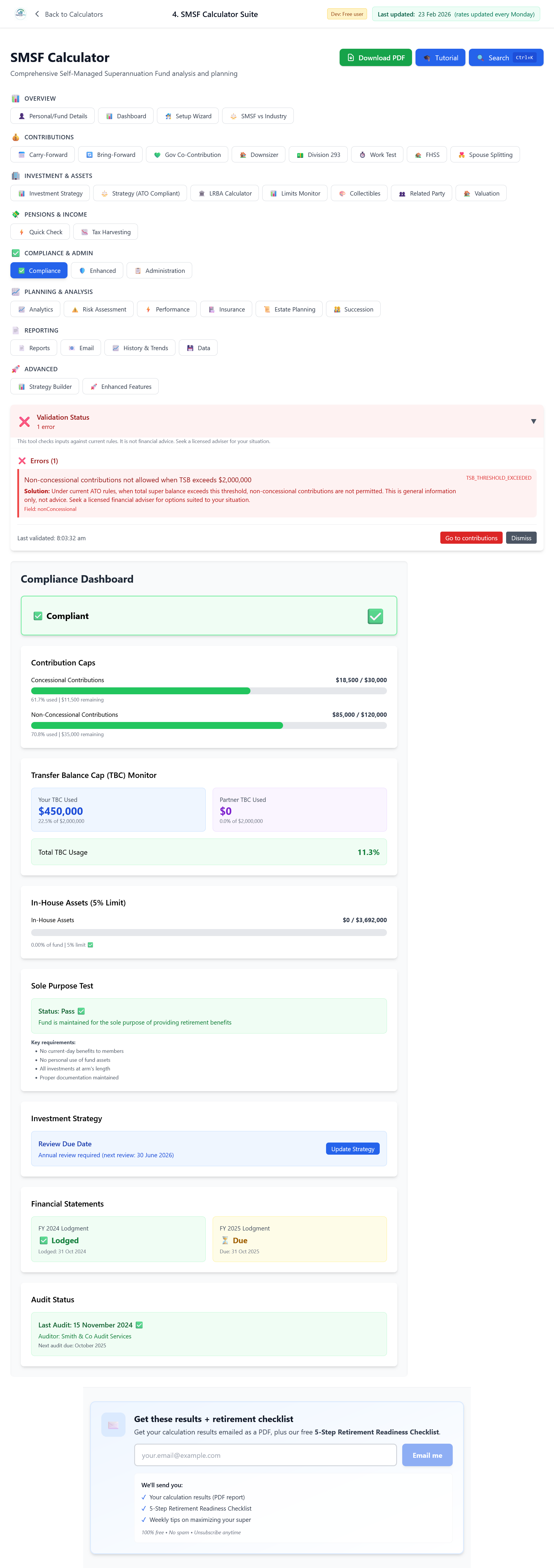
SMSF Calculator: compliance dashboard view with TBC monitoring and pension administration context.
Minimum drawdown: the percentages
The minimum is a percentage of the pension account balance at 1 July. The percentage rises with age. The rates are set by the government and have been reduced in some years (e.g. for COVID); the table below reflects the standard rates.
| Age (at 1 July) | Minimum % | Example ($500K balance) |
|---|---|---|
| Under 65 | 4% | $20,000 |
| 65–74 | 5% | $25,000 |
| 75–79 | 6% | $30,000 |
| 80–84 | 7% | $35,000 |
| 85–89 | 9% | $45,000 |
| 90–94 | 11% | $55,000 |
| 95+ | 14% | $70,000 |
These are minimums only. You can take more; there's no maximum drawdown for account-based pensions. The payment has to be made by 30 June. The ATO does not grant extensions or grace periods.
Want to see how minimum drawdowns and pension phase work in practice? Our SMSF Suite models minimums by age and balance using your own fund data.
The deadline: Minimum payments must be made by 30 June. If they're not, the pension is deemed to have ceased from 1 July of that financial year. That backdating is what triggers tax on the year's earnings and the need to report the cessation and potentially start a new pension.
What happens when a pension is deemed to have ceased
When the ATO treats the pension as having ceased, it's as if it stopped on 1 July, not on the day you missed the payment. So the whole year's investment earnings lose their tax-free status and are taxed at 15%. On $50,000 of earnings, that's $7,500 in tax. You also have to report the cessation on a Transfer Balance Account Report (TBAR). To get back into pension phase you have to start a new pension, which uses Transfer Balance Cap space again. If you've already used your cap, you may not have room to restart.
Pro-rata for new pensions
If you start a pension part-way through the year, the minimum is pro-rated. The calculation is based on the number of days in the financial year from commencement. In practice, many administrators use a quarterly shorthand: start in Jul-Sep, full minimum; Oct-Dec, 75%; Jan-Mar, 50%; Apr-Jun, 25%. So a $500,000 pension started in February at age 67 would have a minimum for that year of $500,000 x 5% x (days from Feb to 30 Jun) / 365, often approximated as 50% of the full minimum, i.e. $12,500. A practical exception also applies: if the pension starts on or after 1 June, there is generally no minimum payment required in that first financial year.
How the minimum is calculated
Two things trustees sometimes get wrong: the percentage is based on your age at 1 July, not your age when you make the payment. If you turn 75 on 15 July, the rate for that year is still the 65-74 rate (5%); the 75-79 rate (6%) applies from the next 1 July. But if you are already 75 on 1 July, the 6% rate applies for that year. And the minimum is based on the pension balance at 1 July, not the balance at payment time. If the balance was $500,000 at 1 July and is now $450,000, the minimum is still calculated on $500,000.
Documentation
When you start a pension you need a written application from the member and a trustee resolution that records the commencement date, starting balance, payment frequency, and whether the pension is reversionary. You also need a Product Disclosure Statement for the pension, even when you're both trustee and member. Ongoing: records of each payment (date, amount, from the pension account) and, at year-end, minutes confirming the minimum was met. Auditors look for this.
Commutations and TBAR
A commutation turns pension money back into accumulation, or takes it out of super. It has to be minuted: amount, date, reason. If you're commuting to stay under the Transfer Balance Cap, the commutation has to happen before you exceed the cap. Partial commutations are common. For annual minimum pension purposes, the current year's minimum is generally based on the 1 July account balance and does not automatically reset because of a mid-year commutation.
SMSFs report pension events to the ATO on the Transfer Balance Account Report. New pensions, commutations, cessations. The deadline is 28 days after the end of the quarter in which the event occurred. So a pension started on 15 August must be reported by 28 October; a commutation on 10 January, by 28 April. TBAR is separate from the annual return. Late reporting can attract penalties.
What it costs to keep modelling
Try the SMSF Suite free first. Unlimited SMSF tools plus Advanced Retirement are All Access at $399 a year, or $39.99 a month if you’d rather not commit upfront.
Open the SMSF Suite →Free SMSF suite runs first, no card required. Subscribe only if the tools are useful enough to keep using.