Most retirement calculators assume you retire on the same day. But reality is messier. One partner might retire at 60 due to health or redundancy, while the other works until 65. Or there's a 5-10 year age gap. These "phased retirement" scenarios are incredibly common, and incredibly poorly planned for.
The Statistics: Research shows that only 20-25% of Australian couples coordinate their retirement timing, meaning they retire within the same timeframe. This means 75-80% of couples experience phased retirement, where partners retire at different times, whether it's a gap of 2 years, 5 years, or more. Despite being the majority scenario, most retirement calculators don't properly model this reality.
75-80% of couples retire at different times. Standard calculators assume you retire together. If one partner retires at 60 and the other at 65, that's 5 years of single income—and standard calculators get it wrong. Model your phased retirement scenario →
Why Standard Calculators Fail
A typical calculator asks: "When do you retire?" and "How much super do you have?" But for couples with different timelines, you need to model years when one partner works and one doesn't, creating complex income transitions that standard calculators can't handle. You need to account for different preservation ages for super access, one partner might be able to access their super at 60 while the other can't until later. You must model changing income and spending through phases, as your household income structure shifts dramatically when one partner retires. Age Pension eligibility occurs at different times for each partner, creating periods where one qualifies and the other doesn't, which affects your total household income. Finally, you need to decide whose super to draw first, a strategic decision that can significantly impact your long-term financial security.
The Cost of Using Standard Calculators for Phased Retirement
Here's what happens when you use a standard calculator for a phased retirement scenario:
Real Example: The 5-Year Gap
Couple: Partner A (60, retiring now, $500K super), Partner B (55, retiring at 60, $300K super, $80K salary)
Standard Calculator Result:
- Assumes both retire at 60
- Combined super: $800K
- Sustainable income: $40K/year
- Problem: Doesn't account for Partner B working 5 more years
Phased Retirement Result:
- Years 1-5: Partner A draws $30K/year, Partner B works and contributes
- At Year 6: Combined super = $850K (Partner B contributed $50K)
- Sustainable income: $52K/year
- Benefit: +$12K/year = +$360K over 30 years
The gap: Using a standard calculator for phased retirement can potentially underestimate your sustainable income by 15-30%. That could be $10K-20K per year you're missing, or $300K-600K over a 30-year retirement.
Why this happens: Standard calculators can't model the complex income transitions, different preservation ages, and changing pension eligibility that occur during phased retirement. They assume you retire together, which misses the optimization opportunities.
Free calculators are even worse: MoneySmart, industry fund calculators, and basic online tools don't even attempt phased retirement. They assume both partners retire at the same age with the same super balance. If you and your partner have different retirement ages, which approximately 40% of couples do, these calculators may give you incomplete calculations.
Try Our Phased Retirement Calculator
See how phased retirement affects your income. Our Advanced Calculator models different retirement ages, ongoing contributions, and Age Pension timing.
Run the Couples Stress-Test (free)Common Phased Retirement Scenarios
Scenario 1: Age Gap Couple
John (62) and Sarah (55) want to retire together. John can access super now, but Sarah can't until 60. For the next 5 years, they'll rely primarily on John's super while Sarah continues working part-time.
Planning challenge: How fast can John draw down without running out before Sarah's super kicks in?
Scenario 2: Staggered Retirement
Mike (58) and Lisa (56) are the same age, but Mike wants to retire at 60 while Lisa loves her job and will work until 67. For 7 years, Lisa's salary covers expenses while Mike's super grows untouched.
Planning challenge: Should Mike start a TTR pension? When should they start drawing his super?
Scenario 3: Health-Driven Early Retirement
David (57) has health issues and needs to stop work. His wife Emma (54) will work until 65. They need David's super to supplement Emma's income for 8 years before both are fully retired.
Planning challenge: Can David access super early? How do they bridge the gap?
Key Considerations for Phased Retirement
1. Preservation Age Matters
Each partner can only access their own super when they reach preservation age (60 for most). If one partner is 58 and the other is 62, only the older partner's super is accessible.
2. Whose Super to Draw First?
Generally, draw from the older partner's super first because they have access earlier, allowing you to start withdrawals as soon as possible. The younger partner's super has more time to grow if left untouched, potentially generating significant additional returns over the years before it's needed. Drawing from the older partner's super first may also help with Age Pension timing, as it can help equalise balances and optimise your pension entitlement when both partners eventually qualify.
3. Age Pension Timing
You can't get Age Pension until 67. If one partner reaches 67 while the other is still working, the working partner's income affects the pension. This creates complex interactions.
4. Income Phases
Your income will change through distinct phases that require different planning approaches. Phase 1 is when both partners are working, providing maximum income and super contributions. Phase 2 begins when one partner retires while the other continues working, this creates a transition period where you're drawing from one super balance while the other is still growing. Phase 3 occurs when both partners are retired but neither has reached Age Pension age yet, meaning you're entirely reliant on super withdrawals. Phase 4 starts when one partner reaches 67 and qualifies for Age Pension while the other doesn't, creating a mixed income structure. Phase 5 is the final phase when both partners are on Age Pension, providing a stable base income supplemented by any remaining super withdrawals.
The key insight: Phased retirement isn't just about when you stop work. It's about coordinating two people's super access, income needs, and pension eligibility across multiple phases.
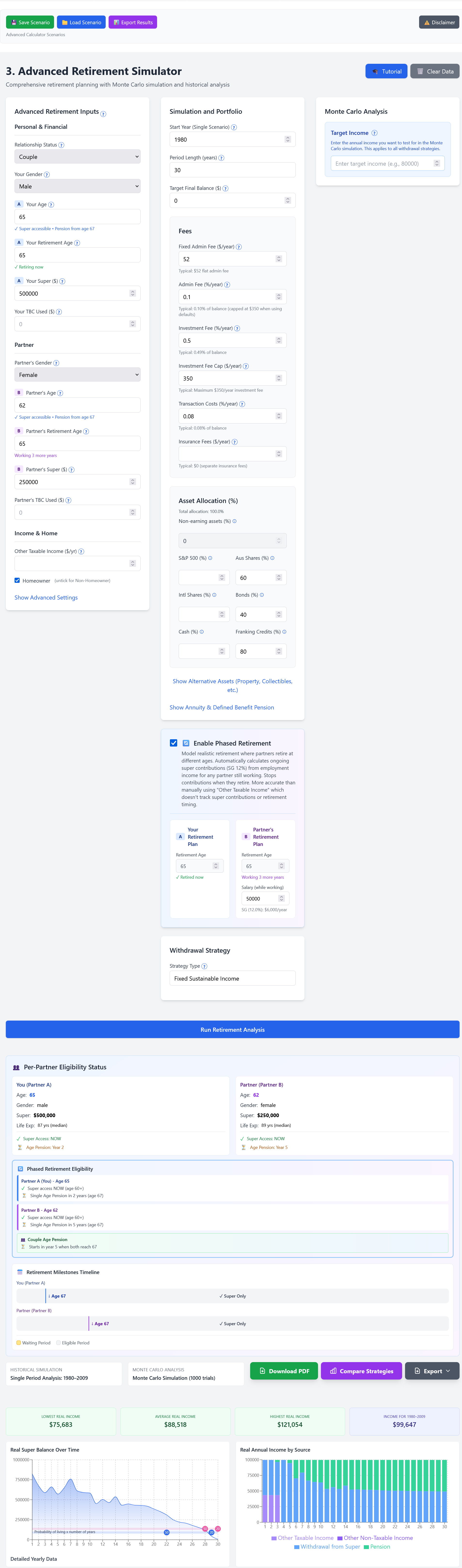
Show the advanced calculator with couple inputs and different retirement ages
The Value of Phased Retirement Planning
Phased retirement isn't just about timing, it's about optimization. When you model it correctly, you can potentially:
How it works: When one partner works while the other is retired, the working partner continues contributing to super. This increases your final balance. When you coordinate retirement timing, you can optimize Age Pension eligibility. When you model different preservation ages, you can optimize withdrawal timing.
Real-World Impact
Scenario: A couple where Partner A retires at 60 and Partner B works to 65.
- Standard calculator: "You can spend $45K/year" (assumes both retire at 60)
- Phased retirement calculator: "You can spend $58K/year because Partner B's contributions during those 5 years increase your final balance"
Result: That could be $13K more per year, or $390K over 30 years. Standard calculators may miss this entirely.
Bottom line: If you and your partner are retiring at different ages, you may need phased retirement planning. Standard calculators could underestimate your income, sometimes by hundreds of thousands of dollars over your retirement.
Planning Tips
Effective phased retirement planning requires several strategic considerations that go beyond simple retirement calculators.
Start by modelling each phase separately. Your income needs will change dramatically depending on whether one partner is working or both are retired. When one partner works while the other is retired, you need to calculate what income you need from the retired partner's super to supplement the working partner's salary. When neither partner works but both are under Age Pension age, you're entirely reliant on super withdrawals. When one partner reaches 67 and qualifies for Age Pension while the other doesn't, you have a mixed income structure. Each phase has different expenses, different income sources, and different tax implications. Calculating what you need in each phase helps you understand how much super you need and when you need it.
Consider a Transition to Retirement (TTR) pension for the working partner. This can provide significant tax benefits while allowing them to access some super while still contributing. A TTR pension allows you to draw between 4% and 10% of your super balance each year while still working, which can help you reduce your taxable income and potentially access some super earlier than you otherwise could. This is particularly useful when one partner has retired and needs income, but the other partner is still working and could benefit from the tax advantages of a TTR pension.
Equalise balances if one partner has much more super than the other. If one partner has $1.5 million and the other has $300,000, you're missing opportunities for better Age Pension eligibility and more flexible withdrawal strategies. Consider spouse contributions or contribution splitting to balance the accounts. Spouse contributions allow you to contribute to your partner's super and potentially claim a tax offset. Contribution splitting allows you to transfer some of your concessional contributions to your spouse's account. These strategies can help equalise balances, which can improve your Age Pension eligibility and give you more flexibility in deciding whose super to draw from first.
Finally, plan for the surviving spouse scenario. What happens if one partner dies early? This is a difficult question, but it's essential for proper planning. You need to understand how super death benefits work, typically, the super balance passes to the surviving spouse tax-free, but the income structure changes dramatically. Age Pension rates change for singles, which can significantly impact the surviving partner's income. A couple might receive $1,810.40 per fortnight in Age Pension, but a single person receives only $1,200.90. This reduction, combined with the loss of one partner's super income, could create a significant income gap. Ensuring the surviving partner has sufficient income to maintain their lifestyle requires careful planning, including potentially taking out life insurance, ensuring super death benefit nominations are up to date, and understanding how the surviving partner's income will change.
Model Your Phased Retirement Scenario
Standard calculators assume you retire together. Our Advanced Calculator models phased retirement.
See how your plan works when partners retire at different ages:
- Different retirement ages - Model each partner's retirement separately
- Ongoing salary and contributions - Account for working partner's income and super contributions
- Different preservation ages - Handle super access timing correctly
- Optimized withdrawal strategies - See how phased retirement may increase your income
- Age Pension timing - Model pension eligibility for each partner separately
Essential Plan: $14.99/month or $149/year
Less than a coffee per week. Cancel anytime.
Run the Couples Stress-Test (free)No credit card required for trial. See how phased retirement affects your income.
Disclaimer: This article is for informational and educational purposes only. It does not constitute financial advice. The projections and examples provided are illustrative only and may not reflect your actual circumstances. Past performance is not indicative of future results. Consult a licensed financial adviser for advice specific to your circumstances before making any financial decisions.