Important: This article contains factual educational information only. It is not financial
product advice, personal financial advice, or a recommendation. SuperCalc Pro does not hold an AFSL and
cannot provide advice. Always seek advice from a licensed financial adviser who can consider your
personal circumstances. This article describes what exists; it does not tell you what to do.
"Set and forget" has become common advice for superannuation. The phrase typically refers to selecting low-cost diversified investments and avoiding frequent changes based on market movements. This approach exists because constantly adjusting investments based on short-term market movements has historically correlated with lower returns.
However, "set and forget" as a phrase encompasses both investment selection and retirement planning more broadly. These are different topics. Investment strategy involves portfolio composition. Retirement planning involves concessional caps, asset allocation transitions, withdrawal strategies, and Age Pension interactions. These are separate domains.
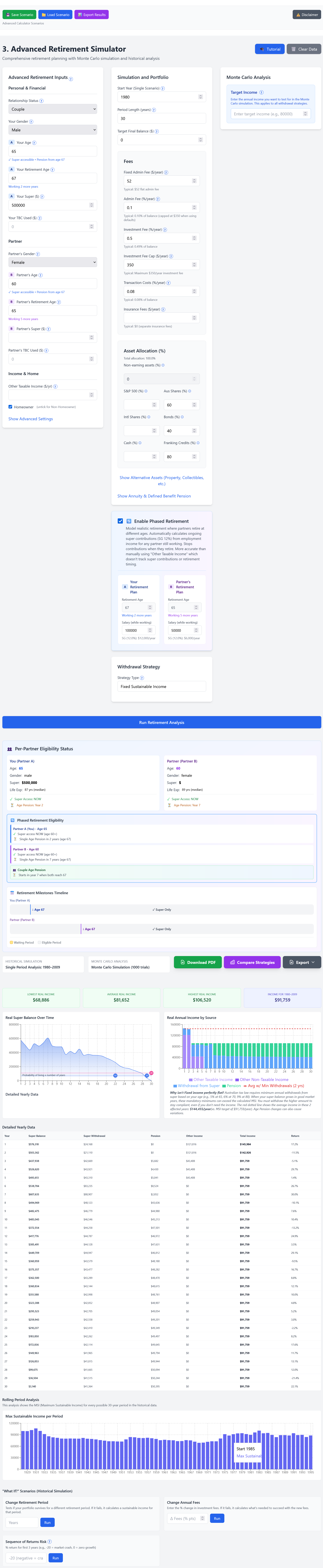
Model the household result: The app projects your retirement with contributions, drawdowns, and Age Pension. You can test different contribution levels and see how unused cap and sequence risk affect outcomes over 98 years of market data. Run the 60-Second Stress-Test.
Concessional Contribution Caps
The concessional contribution cap is currently $30,000 per year. This represents the limit on pre-tax contributions (employer contributions, salary sacrifice) that receive the 15% concessional tax treatment. Contributions above this cap are taxed at marginal rates plus an excess contributions charge.
Australia's superannuation system includes carry-forward provisions for unused concessional caps. Individuals with a total superannuation balance below $500,000 can access unused caps from the previous 5 years. This information is available via the ATO online portal.
Here's what happens when unused cap expires. Consider $20,000 in unused cap from 5 years ago. At a 37% marginal tax rate, that cap represents $7,400 in potential tax differential (37% marginal rate minus 15% concessional rate). If that $20,000 compounds at 7% real returns over 20 years, it becomes $77,000. When the cap expires unused, that potential accumulation doesn't occur.
The cap expires on a specific date whether used or not. The mathematics is arithmetic, not probabilistic.
$20K unused cap expiring = $77K lost over 20 years. Check your unused caps and model the exact compounding impact before they expire.
Calculate unused cap value →
Sequence of Returns Risk
Asset allocation in retirement accounts carries different mathematical properties than asset allocation during accumulation, because the cash-flow direction flips.
During accumulation, negative returns combined with ongoing contributions mean you are buying more units at lower prices (dollar-cost averaging). During decumulation, negative returns combined with ongoing withdrawals mean you are selling units at lower prices. Those two situations are not symmetric.
A simple year-one comparison makes the asymmetry concrete. Two households start with $1 million and both see a long-run average return near 7% a year, but the path differs immediately: one takes a 30% hit in year one, the other a 15% gain. Both still withdraw $50,000 that year.
After year one the first household is on about $650,000 ($700,000 after the fall, then the withdrawal). The second is on about $1.1 million. Same starting point, same average-return story on a brochure, same withdrawal amount, and already a $450,000 gap before year two begins. That gap is sequence of returns risk: the order of returns matters once cash is leaving the portfolio.
A 30-year-old who sees a 30% decline can keep contributing at lower prices. A 65-year-old who is withdrawing does not get that free ride. Capital sold to fund living costs is gone when markets recover.
So the allocation that felt comfortable while you were still feeding the fund needs a second look once the fund is feeding you.
A 30% crash at 65 is not the same problem as at 30. Test your asset allocation against every retirement start year since 1928 to see sequence risk.
Model sequence risk →
Super Balance Equalisation
For couples, superannuation balance distribution between partners affects multiple calculations. First, Age Pension eligibility. The Age Pension applies combined asset and income tests to couples. A household with $800,000 in one partner's name and $200,000 in the other's faces identical asset test results as $500,000/$500,000. However, contribution splitting and insurance costs differ.
Second, the Transfer Balance Cap. This cap ($2.0 million in 2025-26, rising to $2.1 million from 1 July 2026) applies per individual, not per couple. A couple with balances of $1.5M/$500K has combined pension phase capacity of one personal cap plus the second partner's used amount. A couple with $1M/$1M has different headroom again. Same total balance, different tax-free pension capacity.
The difference over 25 years, assuming 15% tax on accumulation phase earnings above the cap, varies by return assumptions. Historical calculations show differences of $20,000+ in some scenarios. This is purely structural, not performance-based.
Withdrawal Strategies
Multiple withdrawal strategies exist. Each produces different mathematical outcomes for income stability versus portfolio longevity.
Fixed real income: Withdraw a fixed dollar amount adjusted annually for inflation. If inflation is 3%, a $50,000 withdrawal in year one becomes $51,500 in year two. Provides stable purchasing power. Risk: portfolio may be exhausted if initial withdrawal rate exceeds sustainable level, particularly if markets decline early in retirement.
Dynamic withdrawal: Adjust withdrawal rate based on portfolio performance. If markets perform well, increase withdrawals. If poorly, decrease. Balances income stability with portfolio protection. Requires flexibility in spending.
Guardrail strategy: Set upper and lower bounds on withdrawal adjustments. If portfolio performs well, withdrawals can increase but only to an upper limit. If portfolio declines, withdrawals decrease but only to a floor. Combines elements of fixed and dynamic approaches.
Floor-ceiling: Guarantee minimum income (floor) via annuity or bonds, invest remainder in growth assets for potential upside (ceiling). Floor provides essential expenses, ceiling provides discretionary spending.
Each strategy produces different probability distributions for portfolio survival and income levels. Historical testing across all retirement periods since 1928 shows how each would have performed under actual market conditions. A couple starting with $800,000 using fixed real income at 6% initial rate faces different portfolio depletion risk than dynamic strategies that adjust to market performance.
The mathematics are deterministic given return sequences. The return sequences are probabilistic. Historical testing shows how each strategy would have performed across all historical retirement periods since 1928.
Age Pension Integration
The Age Pension applies both an asset test and an income test, using whichever produces a lower pension amount. The asset test reduces pension by $3 per fortnight for every $1,000 of assets above the threshold. That's $78 per year per $1,000, or 7.8% per annum.
For homeowners, the asset-free threshold is $333,000 for singles and $499,000 for couples. Assets above this reduce Age Pension entitlements. Superannuation in accumulation phase counts as an asset. Superannuation in pension phase counts as an asset (though income is assessed differently).
Small changes in superannuation balance can shift Age Pension entitlements by thousands of dollars per year. A couple with $495,000 in combined super receives more Age Pension than a couple with $505,000, assuming other factors remain constant. The difference relates purely to asset test application.
The income test applies deeming rates to financial assets. Below $66,800 (single) or $110,600 (couple), assets are deemed to earn 1.25%. Above that, 3.25% (from 20 March 2026 rates; thresholds from 1 July 2026). These rates apply regardless of actual earnings. The income test then reduces pension by $0.50 per dollar of income above the income-free threshold.
Which test applies (asset or income) depends on individual circumstances. Both tests exist. Both apply to everyone. The lower result determines the pension amount.
Historical Stress Testing
Historical backtesting involves running identical retirement scenarios across every historical period. If someone retires with $1 million withdrawing $50,000 annually, what happens if they retired in 1929? 1965? 1973? 2000? 2008?
The mathematics use actual historical returns for Australian equities, international equities, bonds, and cash. The returns include dividends, inflation-adjustment, and franking credits. Data spans 1928-2025 (98 years).
Results vary by retirement start year. Someone retiring in 1928 experienced the Great Depression in year one. Someone retiring in 1974 experienced the 1973-74 crash. Someone retiring in 1999 experienced the dot-com bubble burst. Each faced different sequence risk.
Testing all historical periods shows the range of outcomes. Best case, average case, worst case. The worst case matters because it represents what has actually happened, not theoretical scenarios. If a plan fails in 1973 or 2008, it failed in actual historical conditions, not hypotheticals.
This testing exists. It can be performed on any retirement scenario. The data is public. The calculations are arithmetic.
Phased Retirement Complexity
For couples with different retirement dates, household income management involves multiple phases. During the overlap period where one partner works and one doesn't, household income includes salary, superannuation withdrawals, and potentially partial Age Pension.
A couple where Partner A retires at 60 and Partner B works until 67 experiences 7 years of mixed income. Partner A can access super (preservation age), but Partner B is still contributing. Partner A's super balance counts toward the Age Pension asset test, but household income includes Partner B's salary, affecting income test results.
Tax implications differ. Partner B's salary is taxed at marginal rates. Partner A's super withdrawals (if over 60) are tax-free. But Partner A cannot claim spouse contribution offsets while Partner B earns above thresholds. The Tax-Free Threshold and Low Income Tax Offset calculations change.
This is phased retirement. It exists as a mathematical structure distinct from simultaneous retirement. The calculations differ.
Key distinction: Investment strategy (portfolio selection) operates under different mathematics than retirement planning (caps, allocation transitions, withdrawal design, pension integration). "Set and forget" as a phrase conflates these separate domains.
The Arithmetic
Unused concessional caps expiring: Potential differential of $50,000+ over time depending on marginal tax rate and compounding period.
Sequence risk from unchanged allocation: Portfolio longevity can differ by 10+ years depending on first-year returns. Sustainable income differs by $20,000+ annually in some scenarios.
Unequal balance distribution: Transfer Balance Cap utilization differs by up to $500,000 in tax-free pension capacity for couples with $2M+ combined.
Withdrawal strategy selection: Cumulative income over 25 years can differ by $100,000+ between optimal and suboptimal strategies, even with identical starting balance and returns.
These are calculable. They're arithmetic, not probabilistic. The only probabilistic element is future returns, but historical testing shows the range.
Total differential: $220,000+ across all factors in scenarios tested. This comes from structural decisions, not investment selection or market timing. Different domain entirely.
Historical analysis across 98 years of market data
Stop Setting and Forgetting. Start Modeling.
Unused caps, sequence risk, Age Pension, withdrawal strategies. Model ALL the variables most people ignore.
Run the 60-Second Stress-Test
What it costs to keep modelling
Run Advanced Retirement free first. Unlimited scenarios, historical stress tests, and PDF exports are $149 a year, or $14.99 a month if you’d rather not commit upfront, typically less than one hour of paid advice for the same modelling work.
Run the Advanced Calculator →
No card required to try it. Subscribe only if the model is useful enough to keep using.