You've spent decades accumulating super. Now you need to convert it into income. The main options are account-based pensions, annuities, and hybrid products. For drawdown strategies and minimums, see our guide; you can model your own numbers in the Advanced Calculator. Each has different trade-offs between flexibility, certainty, and longevity protection. There's no universal best choice. It depends on what you value and what keeps you awake at night.
Account-Based Pension: Flexibility at the Cost of Certainty
Account-based pensions are what most Australians choose, and for good reason. Your super stays invested in markets. You draw income from it each year, choosing how much above the legislated minimums. You keep full control over investments and withdrawals. If you want to take an extra $20,000 for a trip to Europe, you can. If markets crash and you want to reduce withdrawals temporarily, you can do that too.
The flexibility comes with risk. You bear full market risk and longevity risk. If markets crash early in your retirement, your balance might never recover, permanently reducing your income. If you live to 100, you might run out of money. There's no guarantee your income lasts your lifetime. Unlike an annuity, you need to make ongoing decisions about investments and withdrawal rates. Some people find this empowering. Others find it stressful.
The upside is that whatever's left when you die goes to your beneficiaries. If you die at 70 with $500,000 still in your account-based pension, your kids inherit it. This estate benefit is something annuities typically don't provide. Account-based pensions work best if you're comfortable with investment decisions, value flexibility over certainty, and have enough assets to weather market volatility without running out.
Lifetime Annuity: Certainty at the Cost of Flexibility
Lifetime annuities offer something account-based pensions can't. Guaranteed income for life, no matter how long you live or what happens to markets. You hand over a lump sum to an insurance company. They pay you a fixed income stream until you die. The income is typically indexed to inflation, so your purchasing power stays constant. The insurance company pools longevity risk across many people. Those who die early subsidise those who live longer, which is how they can guarantee lifetime payments.
The certainty comes at significant cost. Once you buy an annuity, you're locked in. You can't change your mind, increase income if you need more, or access a lump sum for emergencies. The income rate is set at purchase based on interest rates and your age. If you buy during low interest rates, you're stuck with that rate forever. Most annuities provide no estate benefit. When you die, payments stop and your beneficiaries get nothing. That's the trade for longevity protection.
Annuities work best if you're worried about outliving your savings, prioritise certainty over flexibility, and want to eliminate market risk from at least part of your income. They can also be relevant for Age Pension planning. Complying income streams may receive favourable asset test treatment, but the rules have changed over time and depend on the type of product and when it was purchased. You should check current Centrelink treatment or seek advice before relying on any particular percentage. If running out of money keeps you awake at night, or if you want to guarantee essential expenses are covered no matter what, an annuity provides that certainty.
Hybrid Products: Attempting the Middle Ground
The retirement income market has evolved beyond the simple choice of account-based pension or annuity. Various providers now offer hybrid products attempting to blend features of both. These products typically allow some access to capital, some ability to adjust income within limits, or temporary pauses in payments, while still providing some longevity protection or income guarantees.
These products are more complex than either pure option. They often have higher fees reflecting the additional guarantees. Not all super funds offer them. Eligibility requirements and minimum investment amounts vary. The complexity means you need to carefully read product disclosure statements and understand exactly what guarantees you're getting and what flexibility you're sacrificing. What sounds like "the best of both worlds" often turns out to be "some of each but not really enough of either."
This is not product advice or a recommendation of any specific product. These observations are educational only. If hybrid products interest you, speak to a licensed financial adviser who can assess whether specific products suit your circumstances. The added complexity and cost need to justify the benefits for your particular situation.
Account-based pension vs annuity vs hybrid? Each trades flexibility for certainty differently. Model your retirement income with all options and Age Pension interactions. Compare income strategies →
The Core Trade-Offs
Every retirement income product sits somewhere on a spectrum between flexibility and certainty. Account-based pensions offer maximum flexibility. Adjust withdrawals, change investments, access lump sums anytime. But you get low income certainty because your income depends on market performance, and there's no longevity protection. You can run out of money.
Lifetime annuities sit at the opposite end. Zero flexibility once purchased. You're locked in permanently. But maximum income certainty with guaranteed payments regardless of markets. Full longevity protection. You can't outlive your income. No market exposure means you avoid risk but also miss growth. Usually no estate benefit. When you die, it's over.
Hybrid products attempt middle ground with medium flexibility, medium certainty, and partial longevity protection. Estate benefits vary significantly by product. Age Pension treatment varies. Some get favourable asset test treatment like annuities, others are treated like account-based pensions. You can't have everything. High flexibility means lower certainty. High certainty means less flexibility. Full longevity protection typically means no estate benefit. The product you choose should reflect your priorities, risk tolerance, and what you're trying to achieve.
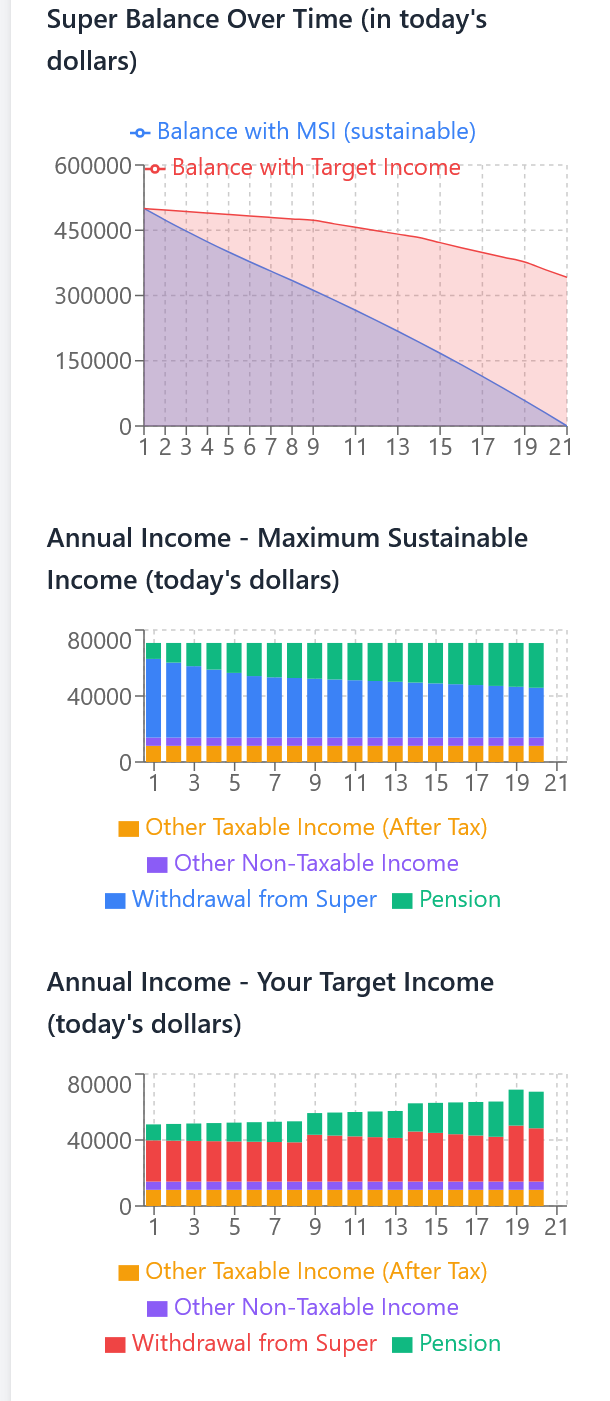
See how super withdrawals, Age Pension, and other income sources combine over your retirement.
The Bucket Strategy
Many financial planners recommend combining products rather than choosing just one. A common approach uses three buckets. First bucket is an annuity covering essential expenses like housing, food, and utilities. This provides a guaranteed floor for your most important costs. Second bucket is an account-based pension for discretionary spending and growth potential. This gives flexibility for lifestyle expenses while maintaining market exposure. Third bucket is a cash buffer for emergencies, ensuring immediate access to funds without selling investments or drawing from your pension.
This approach provides a guaranteed floor for essentials while maintaining upside for discretionary spending. It combines certainty for needs with flexibility for wants. The Age Pension acts as an additional safety net, increasing as your account-based pension balance declines. If this interests you, speak to a licensed adviser about how to structure it for your circumstances. This is not a recommendation to implement this strategy. It's an explanation of an approach some advisers use.
Age Pension Planning: Some complying income stream products receive favourable Age Pension asset test treatment. The applicable treatment depends on the type of product and when it was purchased; rules have changed since 2019. Check current Centrelink provisions or seek advice from a licensed adviser to see how a specific product is assessed.
Bucket strategy: $200K annuity + $300K pension = guaranteed floor + flexibility. Model your 3-bucket approach with Age Pension filling the gap. Calculate your bucket strategy →
Check the pension interaction: Enter your super balance, preferred annual income, and retirement age. The calculator projects your combined super drawdown plus Age Pension year-by-year, so you can see whether your income floor is funded by the pension as super gradually draws down, and whether a different income strategy leaves your balance lasting longer. Run the Advanced Calculator →
What This Means for Your Planning
If you value flexibility and want to maintain control over your investments and withdrawals, an account-based pension gives you that. If you're comfortable making ongoing decisions and have enough assets to weather market volatility, the flexibility might be worth the uncertainty. If running out of money terrifies you and you want guaranteed income no matter how long you live, an annuity provides that certainty. The cost is permanent loss of flexibility and typically no estate benefit.
Most retirees don't need to choose one or the other. You can combine products to get the features you need. Use an annuity to cover your essential expenses. The amount you absolutely need every month to survive. Use an account-based pension for discretionary spending and growth potential. Keep some cash accessible for emergencies. This gives you a guaranteed floor with upside potential, which addresses both the fear of running out and the desire for flexibility.
The Age Pension provides additional protection. As your super declines, your pension increases. For many Australians, this means you can be more aggressive with super withdrawals than you might think, because the pension fills the gap as your balance falls. Model your complete retirement income including Age Pension before making product decisions. The pension changes the calculus significantly.
What it costs to keep modelling
Run Advanced Retirement free first. Unlimited scenarios, historical stress tests, and PDF exports are $149 a year, or $14.99 a month if you’d rather not commit upfront, typically less than one hour of paid advice for the same modelling work.
Run the Advanced Calculator →No card required to try it. Subscribe only if the model is useful enough to keep using.