If your spouse earns under $40,000, you can contribute up to $3,000 to their super and claim an 18% tax offset. Maximum offset is $540.
The $540 is fine. But the real benefit is balance equalisation. Two $500,000 super balances beat one $1 million balance when it comes to Age Pension means testing, Transfer Balance Cap, and estate planning.
How the Tax Offset Works
You make an after-tax contribution to your spouse's super. Not salary sacrifice, not employer contributions. Your own after-tax money going into their account. At tax time, you claim an 18% offset on contributions up to $3,000. The offset caps at $540.
| Spouse's Income | Max Contribution for Offset | Max Tax Offset |
|---|---|---|
| $0 to $37,000 | $3,000 | $540 |
| $37,001 to $40,000 | Phases out | Phases out |
| $40,001+ | $0 | $0 |
The offset phases out between $37,000 and $40,000. If your spouse earns $38,000, you get a partial offset. If they earn $40,000 or more, you get nothing.
Example
Michael earns $120,000. Sarah works part-time earning $30,000. Michael contributes $3,000 to Sarah's super account.
Result: Michael claims $540 tax offset at tax time. Sarah's super increases by $3,000. The contribution counts toward Sarah's $120,000 non-concessional cap, not Michael's.
$540 tax offset is nice. $100K+ in extra Age Pension is better. Two balanced $500K accounts beat one $1M account. Model YOUR couple scenario. Calculate the equalisation benefit →
Why Balance Equalisation Matters More
The $540 offset is pocket change. Balance equalisation has bigger impacts. Much bigger.
The Age Pension asset test applies to each person's super separately. A couple with $500,000 each has $1 million total. Same as a couple with $1 million in one account and zero in the other. But the Age Pension treatment is different. The difference can be tens of thousands per year in entitlements.
Transfer Balance Cap is even clearer. Each person has their own $2.0 million cap for tax-free retirement phase income streams. Two people with $1 million each means you can move $2 million into tax-free pension phase. One person with $2 million and one with zero means only $1 million goes into tax-free phase. The other person's $1 million TBC is wasted. They can't use it.
Estate planning adds another layer. Super death benefits to non-dependants get taxed. If you die with $1 million in super and leave it to your adult children, they pay tax on it. The exact treatment depends on who dies first, what's in each account, and how it's structured. Two balanced accounts give you more flexibility than one large account and one empty account.
These strategic benefits often dwarf the $540 tax offset. For some couples, proper balance equalisation is worth $100,000+ over retirement. That's not an exaggeration. That's the actual difference in total retirement income between balanced and unbalanced super holdings.
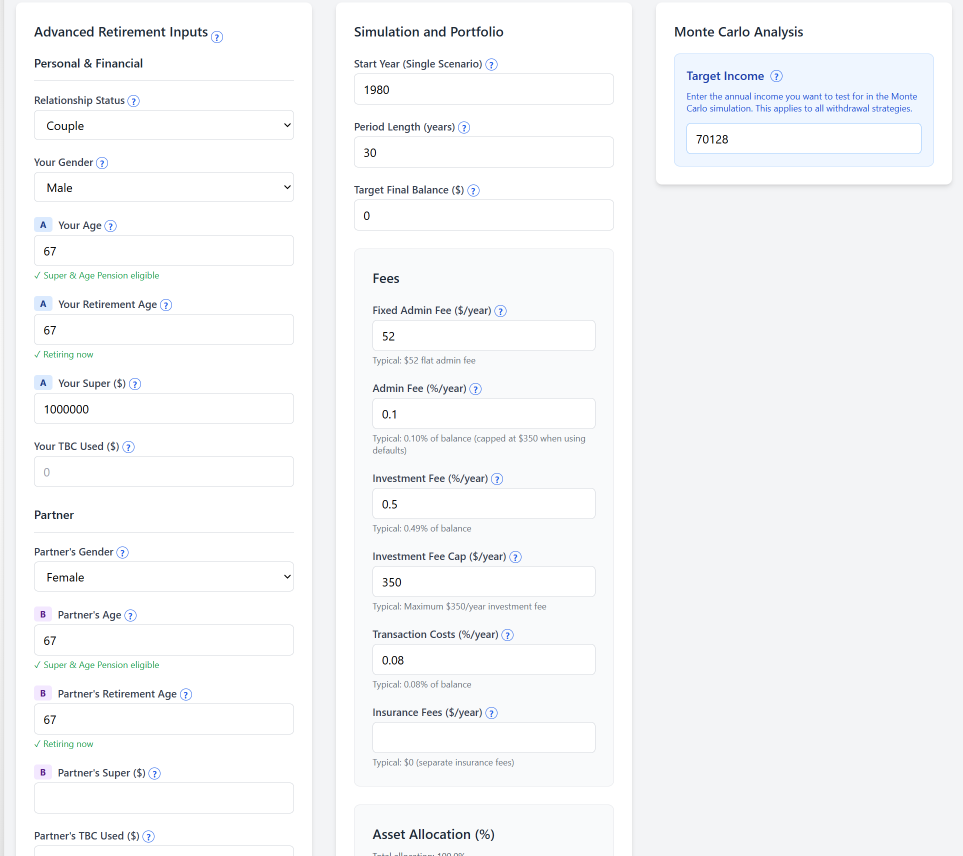
Advanced calculator with couple inputs for balance equalisation planning
Transfer Balance Cap, Age Pension, estate planning. $1M in one account vs $500K each = $100K+ difference over retirement. Calculate the precise impact for YOUR couple. Model spouse contribution strategy →
Contribution Splitting
Contribution splitting is different from spouse contributions. Completely different mechanism. It lets you transfer up to 85% of your concessional contributions to your spouse's super. There's no tax offset for doing this, but it's another way to equalise balances.
The key difference is this. Spouse contributions are non-concessional. You're putting after-tax money into your spouse's account. Contribution splitting moves concessional contributions. Employer contributions, salary sacrifice contributions. They're already in your account, you're just moving them to your spouse's account.
Both methods help equalise balances. Which one you use depends on your income levels, contribution caps, and whether you want the $540 offset.
Eligibility
To claim the spouse contribution tax offset you need to meet these conditions. You must be married or in a de facto relationship. Your spouse must be under 75. If they're between 67 and 74, they must meet the work test. That means 40 hours work in a consecutive 30-day period. Your spouse's total income must be under $40,000. Total income includes assessable income, reportable fringe benefits, and reportable super contributions.
The contributions count toward your spouse's non-concessional cap. You need to make sure they don't exceed $120,000 per year. Or $360,000 if using the bring-forward rule. If they're already contributing heavily to their own super, the spouse contribution might push them over the cap. That triggers excess contribution tax. Not ideal.
When Spouse Contributions Make Sense
Spouse contributions make sense when one partner earns significantly more than the other. Especially if the lower-earning partner has little super. The earlier you start, the bigger the compounding effect. This isn't revolutionary advice, it's just maths.
For a couple in their 40s or 50s with unequal super balances, $3,000 per year for 10 or 15 years makes a material difference to combined retirement outcomes. The $540 annual tax offset is a bonus. The real payoff is in retirement when your combined Age Pension entitlements and tax-free pension caps are optimised.
If you're close to retirement and one partner has a large super balance while the other has little, balance equalisation becomes urgent. Once you're both in pension phase, it's harder to move money between accounts. The contribution rules change. The Transfer Balance Cap limits what you can do. Spouse contributions and contribution splitting need to happen while at least one of you is still in accumulation phase. Once you've both started pensions, your options narrow considerably.
Contribution Splitting vs Spouse Contributions
Some people use both strategies. You might salary sacrifice into your own super. Those are concessional contributions. Then you split 85% of those contributions to your spouse's account. Separately, you make spouse contributions. Non-concessional contributions to your spouse's account. You claim the $540 offset on those.
The limits stack. You can split your concessional contributions AND make spouse contributions in the same year. As long as you don't breach your spouse's non-concessional cap. Both methods move money from your account to theirs. Both methods help equalise balances. The mechanics are just different.
Which strategy works best depends on your income, your spouse's income, your existing super balances, and how far you are from retirement. There's no one-size-fits-all answer. Some couples benefit more from splitting. Some benefit more from spouse contributions. Some use both. The right approach depends on your specific numbers.
Model Your Couple Strategy
Compare balanced vs unbalanced super accounts. See the precise impact on Age Pension, Transfer Balance Cap, and total retirement income over 30 years.
Run the Couples Stress-TestDisclaimer
This article contains factual educational information only. It is not financial product advice, personal financial advice, or a recommendation. SuperCalc Pro does not hold an Australian Financial Services Licence (AFSL).
This article does not consider any person's objectives, financial situation, or needs. It does not recommend any product, strategy, fund, or approach. It does not suggest when, whether, or why any concept might apply to any individual. It cannot replace licensed financial advice.
No Affiliation: We have no affiliation with any financial advice provider, super fund, or financial institution. This article is not a critique or endorsement of any person, product, or strategy.
Before making any financial decisions, seek advice from a licensed financial adviser (AFSL holder), read relevant Product Disclosure Statements, and ensure advice considers your personal circumstances. Past performance does not guarantee future results.