Important: This article is general educational information only. It is not personal advice, not financial product advice, and not a recommendation. SuperCalc Pro Pty Ltd does not hold an Australian Financial Services License (AFSL). Rules and thresholds can change. If you need advice for your situation, speak to a licensed financial adviser.
Your 50s are the most powerful decade for building retirement wealth. You are likely at peak earnings. You can use catch-up contributions. Every dollar you add has 10 to 15 years to compound. These years matter more than any other decade.
Why your 50s are different
You are probably earning more than you ever have. Higher income means higher marginal tax rate. That means every dollar you salary sacrifice saves more tax than it would have in your 30s or 40s.
Your financial obligations are often reducing. Kids are mostly independent. Your mortgage is lower. You have spare cash flow that did not exist in earlier decades. That cash can go straight to super.
You can access catch-up contributions. If your super balance is under $500,000, you can use unused concessional caps from the previous five years. Many people in their 50s have tens of thousands in unused cap capacity sitting there waiting to be used.
You still have time. Ten to 15 years of growth is substantial. A dollar contributed at 50 has time to double before you retire at 65, assuming 7% returns. A dollar contributed at 55 still has a decade to compound.
This is the decade where retirement gets built. Not your 30s, not your 40s. Your 50s.
50s = peak earnings + 15 years to compound. $12K/year salary sacrifice becomes $300K by 65. Add catch-up caps and it doubles. Model YOUR exact contribution strategy. Calculate your 50s strategy →
Strategy one: max out concessional contributions
The concessional cap is $30,000 per year for 2024-25. This includes your employer's Superannuation Guarantee contribution of 12%.
If you earn $150,000, your employer contributes $18,000. That leaves $12,000 of cap space for salary sacrifice.
At a 37% marginal tax rate, that $12,000 salary sacrifice saves you $2,640 in tax immediately. The money goes into super, where it is taxed at 15% instead of 37%. That is a 22% saving right there.
But the real benefit is compounding. That $12,000 per year, contributed for 15 years, becomes $300,000 at 7% returns. And it grows tax free in pension phase.
This is the single most powerful strategy available to you in your 50s.
Strategy two: use catch-up contributions
If your total super balance is under $500,000, you can carry forward unused concessional caps from the previous five years.
Many people have $30,000 to $50,000 in unused cap capacity. This is contribution space you have already earned. You just did not use it in previous years, perhaps because your income was lower, you had career breaks, or you simply did not know about it.
You can access that unused cap now. If you have the cash flow, you can make a larger contribution this year to catch up.
To check your unused cap, log into MyGov. Go to ATO, then Super, then Carry-forward contributions. It will show exactly how much unused cap you have available.
This is free money sitting there. Use it.
Strategy three: non-concessional contributions
Once you have maxed your concessional cap, consider non-concessional contributions. The non-concessional cap is $120,000 per year.
You can also use the bring-forward rule to contribute up to $360,000 in a single year if you are under 75. This is useful if you have received an inheritance, a work bonus, sold a property, or have accumulated savings outside super.
There is no immediate tax benefit. You are contributing after-tax money. But the earnings on that money grow tax free in super. Once you start a pension, those earnings are completely tax free.
This becomes more attractive as your balance grows. Outside super, investment earnings are taxed at your marginal rate. Inside super, they are tax free in pension phase.
For high earners in their 50s with spare cash, non-concessional contributions are a powerful way to build wealth in a tax-free environment.
Strategy four: spouse contributions
If your spouse earns under $40,000, you can contribute to their super and receive a tax offset of up to $540. That is nice, but it is not the main reason to do this.
The real benefits are strategic.
First, equalizing balances helps with Age Pension optimization. The asset test applies to each person separately. Two balanced accounts often provide better outcomes than one large account.
Second, each person has their own Transfer Balance Cap of $2.0 million. Equal balances maximize your combined tax-free pension space.
Third, estate planning. If you die, super paid to your spouse is tax free. But super paid to adult children can be taxed at up to 17%. Spreading balances between partners reduces this risk.
The $540 tax offset is the smallest benefit. The strategic advantages are substantial.
Strategy five: review asset allocation
In your 50s, you are transitioning from pure accumulation to pre-retirement. Your asset allocation needs to reflect this.
You should stay growth oriented. You still have 10 to 15 years before retirement. That is enough time to recover from market downturns.
But you need to be aware of sequence risk. A market crash in the years immediately before retirement can be devastating, even if markets recover later. If you retire at 60 and the market crashes at 58, you do not have time to recover before you start drawing down.
This means gradually de-risking in your late 50s if you are planning to retire at 60. Shift some assets from growth to defensive positions to protect the wealth you have accumulated.
The exact timing depends on your situation. But the principle is clear. Stay growth oriented, but build in protection as retirement approaches.
Essential actions for your 50s
Check your unused concessional cap on MyGov. Go to ATO, then Super, then Carry-forward contributions. See how much catch-up capacity you have.
Calculate how much salary sacrifice you can afford. Look at your current expenses and cash flow. Every dollar you contribute now has 10 to 15 years to compound.
Review your super fund's fees and performance. High fees erode returns significantly over time. Poor performance might warrant a change.
Consider spouse contribution strategies if your partner earns less. This provides tax benefits while equalizing balances for Age Pension and Transfer Balance Cap optimization.
Update your beneficiary nominations. Make sure your super goes to the right people if something happens to you.
Model your retirement income needs. Understand how much you will need and whether you are on track. Use a retirement calculator to run different scenarios.
Understand your Age Pension eligibility. Even if you do not think you will qualify, understanding the thresholds helps you make informed decisions about asset structures and contribution strategies.
The power of your 50s: A 50 year old who contributes an extra $15,000 per year for 15 years (total $225,000) could have an extra $400,000 at retirement, assuming 7% returns. That is $20,000 per year in extra retirement income. Every year. For the rest of your life.
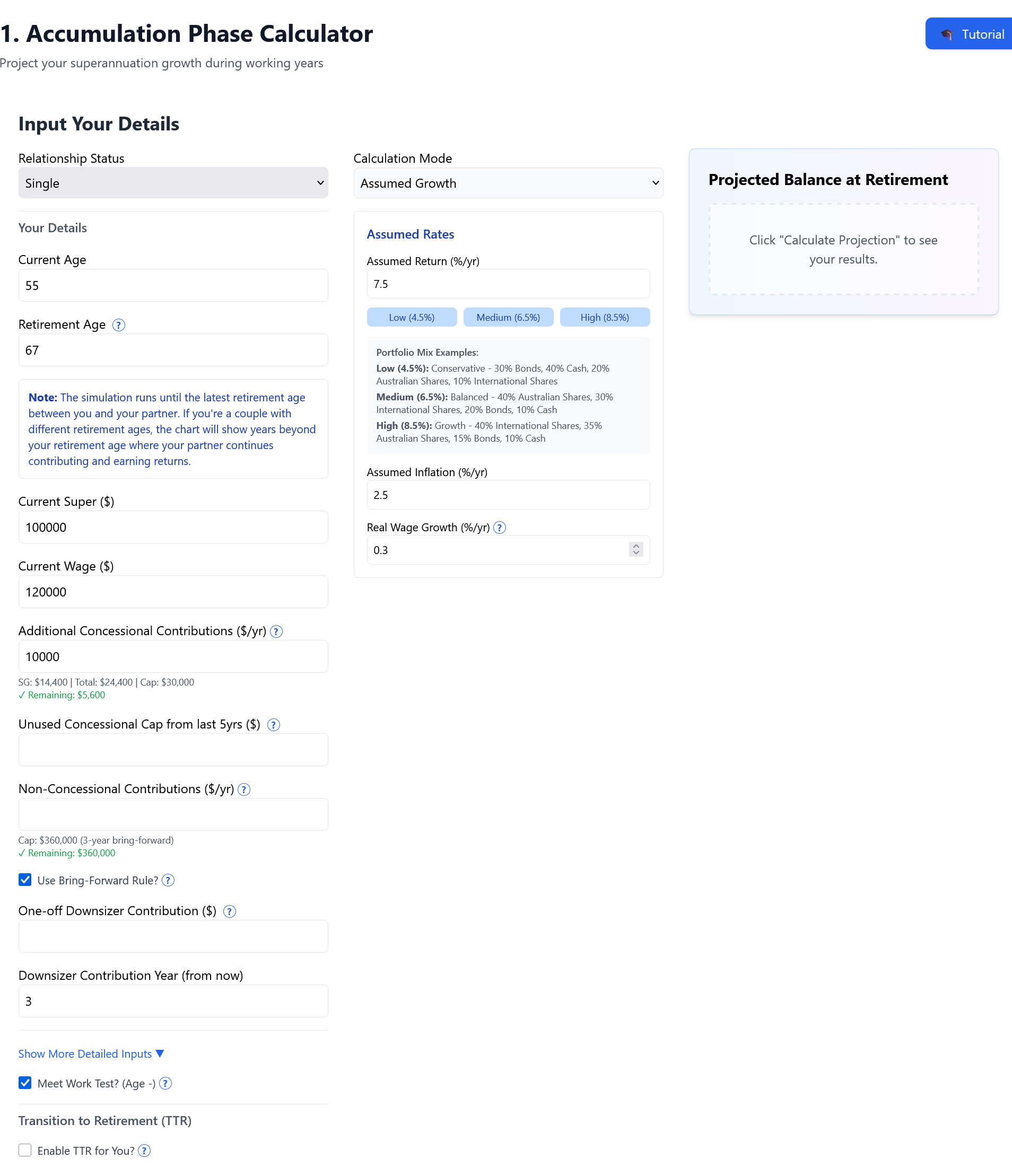
Model the impact of extra contributions over 10 to 15 years
$15K/year for 15 years = $400K extra at retirement. That's $20K/year for life. But only if you start now. See the exact compounding impact for YOUR contributions and timeline. Model your 50s contribution strategy →
How the Advanced Calculator helps: Enter your current balance, age, and planned salary sacrifice amount. The app projects how the extra contributions compound over your remaining working years and shows the retirement balance at 67 compared to no catch-up strategy — including the tax saving from contributing at 15% instead of your marginal rate. Open the Advanced Calculator →
Model your 50s strategy
See how extra contributions, catch-up amounts, and different retirement ages affect your outcome.
Run the 60-Second Stress-TestDisclaimer: This article is for general informational and educational purposes only and does not constitute financial product advice or a recommendation. SuperCalc Pro Pty Ltd (ABN 31 692 042 872) does not hold an Australian Financial Services License (AFSL). The information provided does not take into account your personal circumstances, financial situation, or needs.
Before making any financial decisions, consider whether the information is appropriate for your circumstances and consider seeking professional advice from a licensed financial adviser. Tax and super rules can change. All investments carry risk.