Transfer Balance Cap: The $2M to $2.1M Limit Explained
The Transfer Balance Cap limits how much super you can move into tax-free pension phase. It is $2.0M in 2025-26 and increases to $2.1M from 1 July 2026.
What is the Transfer Balance Cap?
The Transfer Balance Cap is the limit on how much super you can transfer into tax-free retirement phase income streams. It is $2.0 million in 2025-26 and increases to $2.1 million from 1 July 2026, but your personal cap can be lower or only partly indexed if you have already used some of it.
The Transfer Balance Cap is one of the most misunderstood rules in Australian superannuation. It limits how much you can move into the tax-free pension phase of super: currently $2.0 million for 2025-26, increasing to $2.1 million from 1 July 2026. But the real complexity isn't the cap itself. It's how your personal cap changes over time. If you run an SMSF pension, the same cap applies; understanding drawdown rules alongside the TBC helps you plan.
$2.0M
Current TBC (2025-26)
$2.1M
From 1 July 2026
80,000+
Australians over TBC
$100K
Indexation increments
Model Your Transfer Balance Cap
The Advanced Calculator projects your retirement with the full TBC and Age Pension built in. See how much pension-phase room you have and how your income stacks up year by year.
No signup required · Instant results · 100% private
What is the Transfer Balance Cap?
The TBC is a lifetime limit on how much superannuation you can transfer into the pension phase. Why does this matter? Because earnings in pension phase are completely tax-free, while earnings in accumulation phase are taxed at 15%.
Before the TBC was introduced in 2017, wealthy Australians could have unlimited amounts in tax-free pension phase. Someone with $10 million in super pension could earn $500,000 per year completely tax-free. The TBC was designed to stop this.
Exceeding the cap started at $1.6 million in 2017 and is indexed to CPI in $100,000 increments. It reached $1.7 million, then $1.9 million, and will hit $2.0 million when cumulative indexation reaches that threshold.
Test the moving parts: You enter your current super and pension-phase balance; the app applies the TBC and Age Pension rules across your whole retirement. You see year-by-year how much is in pension phase, how much pension you get, and how much you draw from super. One plan, not a separate TBC snippet.
Transfer Balance Cap: Historical Growth (2017-2026)
$1.6M
2017-2021
$1.7M
2021-2023
$1.9M
2023-2025
$2.0M
Expected 2025-26
The general Transfer Balance Cap steps up in $100,000 CPI increments. It does not rise every 1 July automatically; it moves when cumulative CPI growth crosses the next threshold. The ATO has confirmed the general cap is $2.1 million from 1 July 2026.
The Proportional Indexing Trap
Here's where most people get it wrong. If you've already used some of your TBC, your remaining cap doesn't increase by the full indexation amount. It increases proportionally.
Test the moving parts: Proportional indexing is built in. The app tracks how much of your cap you have used and how much room you have left as the cap indexation applies. You see the impact on your tax-free pension phase and total income over time.
Example: The Common Mistake
Sarah started a pension of $800,000 in 2017 when the TBC was $1.6 million.
When the TBC rose to $2.0 million, she assumed she had $1.2 million of cap room left. From 1 July 2026, the same proportional indexing logic applies to the $2.1 million general cap. That is the mistake most trustees make.
Wrong calculation:
Current TBC: $2.0M
Minus used: $800K
Remaining: $1.1M (this is the common mistake)
The difference is $150,000. That's $150,000 less that Sarah can move into tax-free pension phase than she might have expected. This proportional indexing catches many people off guard.
Think you have $1.2M TBC remaining? Proportional indexing says $1.0M. Calculate your exact remaining transfer balance cap after indexation.
Model your TBC strategy →
Once you use a percentage of your Transfer Balance Cap, that percentage stays used. Later indexation only lifts the unused slice. Waiting until you are ready to fill most of the cap is how people keep more of the indexed headroom.
Your Remaining Cap:
Proportion used:
Current TBC: $2,000,000 in 2025-26, rising to $2,100,000 from 1 July 2026
Instant calculation: For complete TBC strategy and retirement projections,
use the full calculator →
What Counts Toward the TBC?
Not everything in super counts toward your Transfer Balance Cap. Only amounts transferred into pension phase are counted.
Counts toward TBC:
Account-based pensions
Transition to retirement pensions (once you meet a condition of release)
Defined benefit pensions (special calculation applies)
Death benefit pensions received from a spouse
Doesn't count:
Super in accumulation phase
Super you haven't converted to pension yet
Transition to retirement pensions while still working (before retirement)
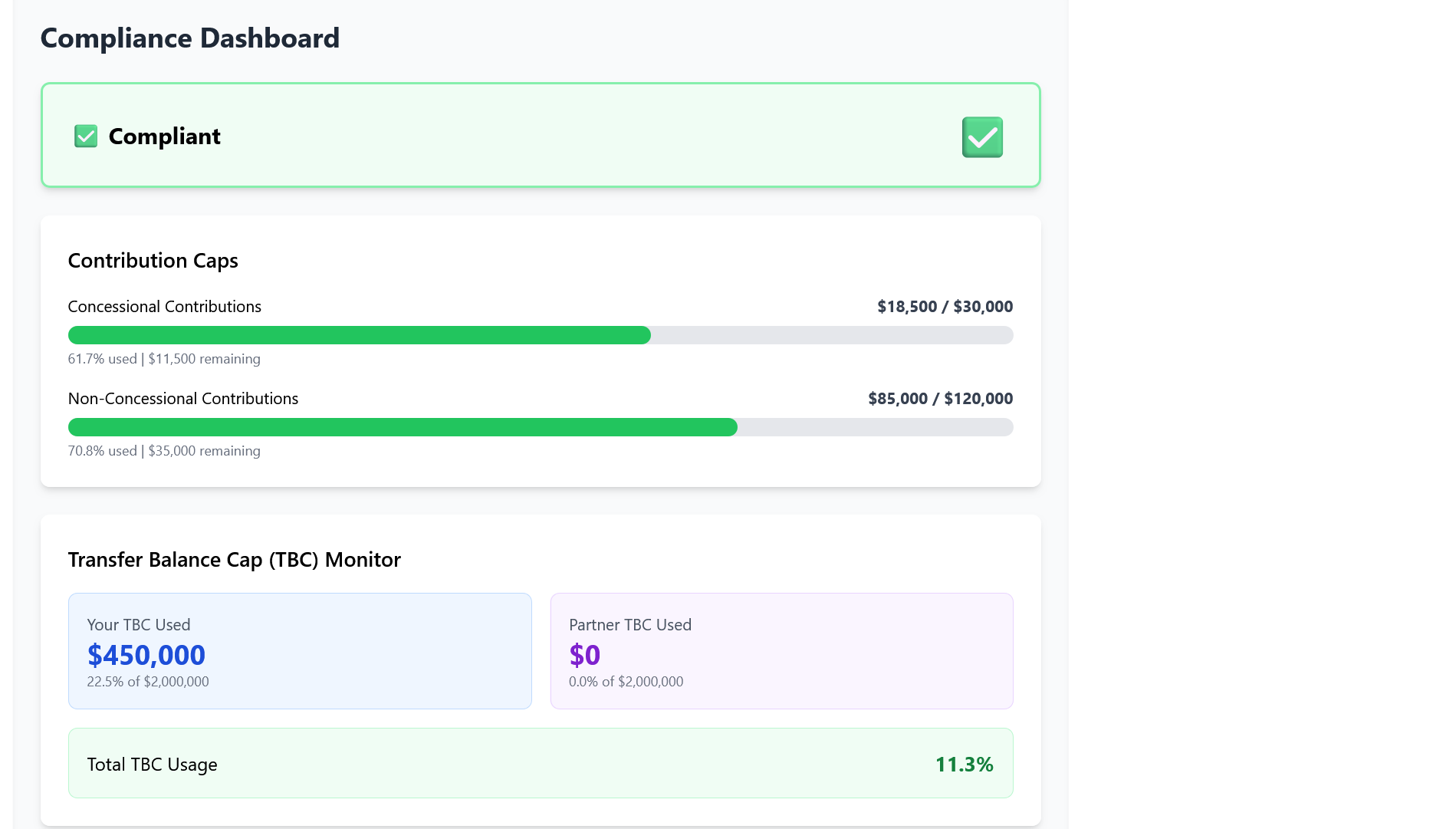
Transfer Balance Cap tracking in the SMSF Compliance Dashboard
What Happens If You Exceed the Cap?
Exceeding your TBC isn't the end of the world, but it does have consequences. The excess amount must be "commuted" (moved back from pension phase to accumulation phase). You can't just leave it there.
On top of that, you'll pay Excess Transfer Balance Tax on the notional earnings of the excess amount. For your first breach, this is 15%. For subsequent breaches, it's 30%. The ATO calculates notional earnings using the general interest charge rate, regardless of what your investments actually earned.
Warning: The ATO monitors TBC automatically through event-based reporting from super funds. You'll receive a determination if you exceed your cap, and you have 60 days to commute the excess. Don't ignore these notices.
Strategies for Couples
Each person has their own TBC. For a couple, that means up to $4.0 million combined in 2025-26 (2 × $2.0M), or up to $4.2 million for people starting their first retirement-phase income streams after 1 July 2026 (2 × $2.1M). This creates planning opportunities.
If one partner has significantly more super than the other, contribution splitting can help equalise balances. You can split up to 85% of your concessional contributions to your spouse each year. Over time, this ensures both partners can fully utilise their TBC.
When one partner dies, things get complicated. A reversionary pension continues in the surviving spouse's name, but it counts toward their TBC. If the surviving spouse is already at or near their cap, they may be forced to commute some pension back to accumulation within 12 months.
Death and the TBC
Estate planning around the TBC requires careful thought. When you die, your super can pass to your spouse as a reversionary pension or as a lump sum that they then use to start a new pension.
Reversionary pension: Automatically continues in spouse's name. Counts toward their TBC from the date of your death (but they get 12 months to sort out any excess).
Non-reversionary: Spouse receives lump sum, can start new pension. More flexibility, but no automatic continuation.
The choice between reversionary and non-reversionary depends on your spouse's existing TBC usage and their likely super balance at the time of your death.
Planning Around the TBC
If you haven't started a pension yet and the TBC is expected to increase, there's an argument for waiting. Starting a pension now locks in your proportional usage at the current cap. Waiting until after indexation means your full cap is higher.
However, this needs to be balanced against other factors. The tax-free earnings in pension phase are valuable. Delaying pension just to get a slightly higher cap might cost you more in tax than you save.
For those with super well above the TBC, the decision is simpler: move up to the applicable cap into pension phase, leave the rest in accumulation. The general cap is $2.0M in 2025-26 and $2.1M from 1 July 2026. The accumulation portion still earns returns, just taxed at 15% instead of 0%.
Couple with $3M super? Two personal caps can create up to $4.0M in 2025-26, or $4.2M from 1 July 2026 if both are eligible. Model your couple TBC strategy for maximum tax-free pension phase.
Calculate TBC optimization →
The Bottom Line
The Transfer Balance Cap limits tax-free pension phase super to $2.0 million in 2025-26 and $2.1 million from 1 July 2026. The key trap is proportional indexing: once you use a percentage of your cap, that percentage is used forever. Couples can have up to two personal caps combined in pension phase. For people starting their first retirement phase income streams after 1 July 2026, that can be up to $4.2M combined. Exceeding the cap triggers commutation requirements and excess transfer balance tax.
For most Australians, the TBC won't be a constraint. The average super balance at retirement is well under $1 million. But for those approaching or exceeding the cap, understanding these rules is essential for tax-efficient retirement planning.
📄 FREE DOWNLOAD
Transfer Balance Cap Guide 2025
Complete 2-page guide explaining the transfer balance cap, proportional indexing trap, and strategic approaches. Includes real calculations and common misconceptions.
Run Advanced Retirement free first. Unlimited scenarios, historical stress tests, and PDF exports are $149 a year, or $14.99 a month if you’d rather not commit upfront, typically less than one hour of paid advice for the same modelling work.
No card required to try it. Subscribe only if the model is useful enough to keep using.
General information only. SuperCalc Pro provides educational calculators and articles, not personal financial advice. Consider speaking with a licensed financial adviser before making financial decisions.