Important: General information only, not financial product advice. SuperCalc Pro does not hold an Australian Financial Services Licence (AFSL). The article does not recommend opening, closing, or changing any super fund or product. Seek advice from a licensed financial adviser, SMSF specialist, or accountant as appropriate.
Financial software loves the phrase “Monte Carlo simulation.” It sounds rigorous. Often what sits behind the label is a handful of assumptions: normally distributed returns, independence year to year, maybe a single long-run average. These can be wildly kind or cruel depending on specification. For Australian retirees, the question is not “Monte Carlo yes or no” but which generator produced the paths, and whether you also look at historical replay where crashes arrive in realistic clumps. For how marketing labels compare to mechanics, see Monte Carlo versus reality.
This article explains Monte Carlo in plain language, contrasts it with historical backtesting, and embeds empirical success rates from the same sustainability engine as the safe withdrawal rate Australia tables (balanced preset, fees in code, single homeowner pension from 67). Those historical percentages are not Monte Carlo draws. They are the frequency of success across real ordered return paths. They are the benchmark many Monte Carlo tools are trying to approximate.
Rule of thumb: If someone shows a “probability of success” without listing how returns are simulated, whether spending is indexed, and whether Age Pension is modelled, you do not yet know what the percentage means.
What Monte Carlo retirement simulation actually does
In retirement software, Monte Carlo usually means: run thousands of synthetic lifetimes. Each year (or month) the engine samples a return from a distribution, updates your balance after withdrawals, and checks whether money lasts to the end of the horizon. The output is often X% of paths succeeded under the model.
The process is straightforward conceptually:
- Start with $500,000 at age 67
- For year 1, draw a random return (e.g., 7.2% from a normal distribution with mean 8.2%, volatility 12%)
- Apply that return: balance becomes $500k × 1.072 = $536,000
- Subtract annual spending ($55,000): balance is now $481,000
- Check Age Pension eligibility, add any entitlement
- Repeat for all 28 years
- Record: did money last to 95?
- Repeat this entire chain 10,000 times with different random draws
- Count successes: "7,300 paths didn't run out = 73% success"
Strengths: You see a spread of outcomes, not a single straight-line projection. You get intuition for range: best case, worst case, median. You can stress-test multiple scenarios quickly.
Weaknesses: The spread is only as honest as the model. Independent draws from the same bell curve each year can produce unrealistic sequencing. Real markets show:
- Momentum: Up years tend to follow up years; crashes don't happen uniformly at random
- Volatility clustering: Calm periods and turbulent periods. Not a steady hum of random variation.
- Regime switching: Rising rate environments vs QE environments behave differently
A basic Monte Carlo that treats each year independently may generate "nice" paths too often (gentle drift up) or "chaotic" paths too often (too many sudden reversals). The math is sound; the realism depends on whether you've modelled market structure.
Historical simulation as a complementary “probability”
Historical simulation asks a different question: If I had retired in 1928, 1929, … through to the last year that fits a full horizon, would my fixed strategy have survived? Count successes, divide by paths. That ratio is sometimes called a success rate. It is not the chance your retirement will fail next decade. It is how often the past contained a friendly ordering for your spending rule.
Using the methodology documented in safe withdrawal rate Australia (age 67, $500,000 super, 28-year horizon, 70 valid historical start years, pension on), fixed annual spending yields:
| Fixed annual spend | Paths succeeded | Historical success rate |
|---|---|---|
| $45,000 | 70 / 70 | 100% |
| $50,000 | 62 / 70 | 89% |
| $55,000 | 53 / 70 | 76% |
| $60,000 | 27 / 70 | 39% |
Think of this table as a non-random Monte Carlo: the “draws” are the actual sequences investors lived through. Monte Carlo runs in the Advanced Calculator let you ask how a different assumed process would rank those outcomes.
Sequence risk, Monte Carlo, and Australian super
Sequence of returns risk is the interaction of withdrawals with bad timing. Monte Carlo can represent sequence risk well if the simulated paths preserve realistic clustering. Many basic implementations do not. Historical replay always preserves ordering. The cost is a finite sample. You only get as many paths as history allows.
For Australians, add means-tested Age Pension, minimum drawdown rules, and franking-aware equity returns in some tools. A US-centric Monte Carlo may ignore entitlements entirely. SuperCalc Pro’s historical engine applies pension in the sustainability loop the same way as described in the programmatic scenario code; Monte Carlo views in the app are there to stress-test assumptions on top.
Maximum sustainable income: what Monte Carlo hides in the tails
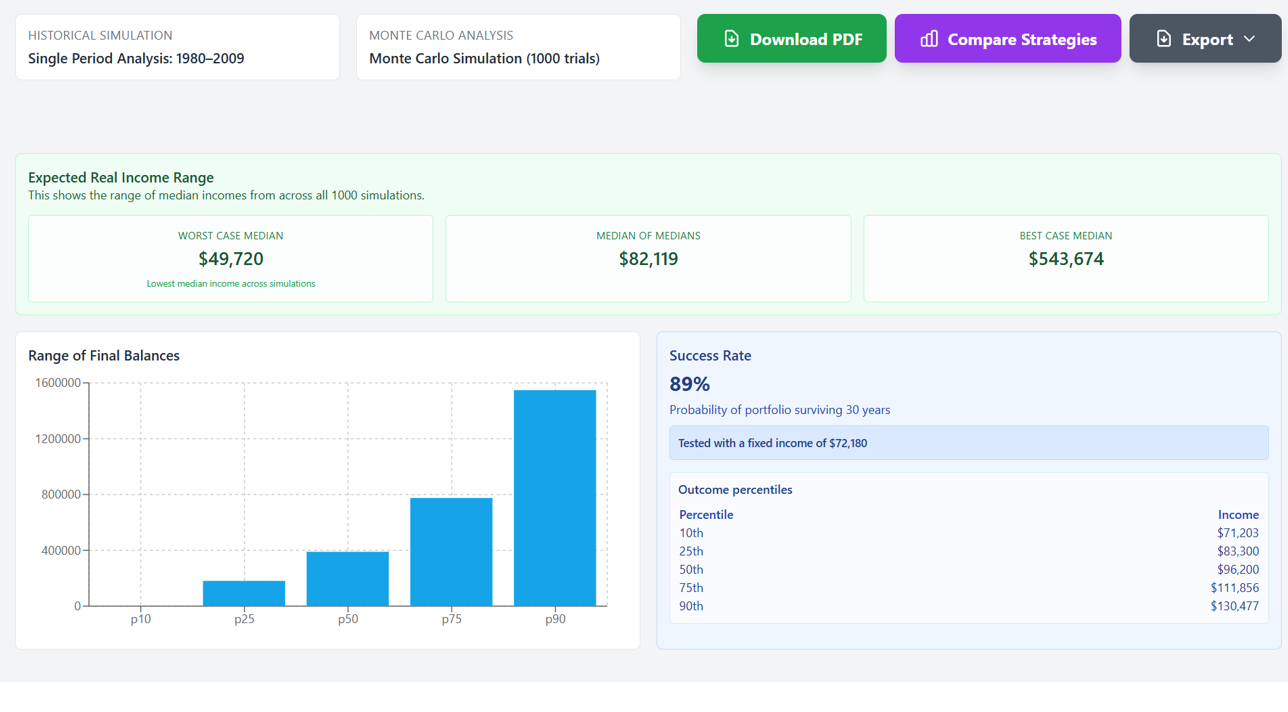
Most Monte Carlo tools show one number: "X% of paths succeed at $55,000 spend." But that hides crucial detail. A more honest analysis: for each simulated path, how much could you actually spend and still reach end-of-life? This flips the question from binary success/fail to a distribution of feasible spending.
Running this analysis on 10,000 synthetic paths (balanced fund, $500,000 starting balance, age 67, 28-year horizon, with Age Pension), the distribution of maximum sustainable spending per path reveals:
- 10th percentile: about $49,956 / year (worst-case Monte Carlo draws)
- Median: about $59,247 / year (typical path)
- 90th percentile: about $67,965 / year (lucky return sequences)
Notice the spread: the worst 10% of Monte Carlo paths support roughly $50,000 or less; the best 10% support nearly $68,000. A tool that says "78% success at $55k" is true but incomplete. It doesn’t tell you that roughly 1 in 10 simulated lifetimes ran out of money by 80, or that the same model predicts some paths could sustain $68k with ease.
The problem: Asymmetric risk. Upside tail outcomes ($68k) feel good but don’t change your spending rule. Downside tail outcomes ($50k) force either reduced spending or age pension dependence. Most Monte Carlo summaries hide the tails to make the story simpler. They shouldn’t.
Comparison: What does a higher fixed-income allocation look like?
Shift to a more defensive asset mix with more bonds: 40% Australian shares, 20% international shares, 40% fixed income (instead of the balanced 70/30 equity allocation). Expected return drops to 6.5%, volatility drops to 8.2%. The maximum sustainable spending distribution shifts:
- 10th percentile: about $48,900 / year (worst case shows minimal improvement)
- Median: about $56,800 / year (noticeably lower)
- 90th percentile: about $64,100 / year (less upside)
You traded roughly $2,400 of median spending for lower volatility and smoother returns, but not for tail protection. The 10th percentile barely moved (−$1,000). This is the crucial insight: in truly bad sequences (1968-1974 style crashes or delayed compounding failures), asset allocation offers limited salvation. Bonds and equities both get hammered. They just get hit at different magnitudes and timings. The real benefit of a defensive allocation is stability in the middle years, not protection when things go catastrophically wrong. That's the trade-off a Monte Carlo analysis should surface. You're buying steadier portfolio performance and smoother spending in ordinary markets, but you're not buying insurance against sequence risk disasters.
When Monte Carlo is still worth running
Despite caveats, Monte Carlo remains useful for sensitivity analysis: what if average returns are 1% lower? What if volatility rises? What if you retire five years early? Good tools let you perturb assumptions and watch the cloud of outcomes move. The mistake is treating one default simulation as the probability.
A worked sensitivity example
Suppose your base Monte Carlo assumptions are: Australian equity/bond balanced fund, 8.2% long-run expected return, 12% volatility. You run 10,000 paths with $55,000 annual spending and see 73% success. Now ask yourself: what if I'm wrong on one dimension? The directional shifts below are illustrative of the pattern. They're not specific output from the calculator, but realistic estimates of how each assumption perturbs the result.
- Returns 1% lower (7.2%): Success rate would likely drop ~5-10 percentage points. Is that acceptable? A single basis point shift in your return assumption can swing the headline by a meaningful margin.
- Returns 1% higher (9.2%): Success rate would likely rise ~5-10 percentage points. Reassuring, but don't plan for it. This is the upside you're hoping for, not planning for.
- Volatility increases to 15%: Success rate typically drops ~3-7 percentage points. Sequence risk bites harder. Higher turbulence kills more retirements than lower average returns do.
- Spend $60,000 instead (9% more): Success rate typically drops ~10-15 percentage points. That $5k matters. Each $1k of spending cuts success by roughly 1.5-2 percentage points.
- Retire at 65 instead of 67 (extra 2 years drawing): Success rate typically drops ~10-15 percentage points. Horizon risk compounds. Two extra years substantially reduce your margin for error.
- Age Pension cut by 20% (policy change): Success rate typically drops ~5-10 percentage points. Many Australian retirees don't realize how much of their plan depends on means-tested pension in the tail.
To see real numbers: Open the Advanced Calculator and run your own perturbations. You'll see exactly how your specific inputs respond to assumption shifts, which is far more useful than a generic worked example.
This is sensitivity analysis at work: you’re not forecasting; you’re stress-testing your assumptions. If success stays above a floor you’re comfortable with (e.g., 60%) across all reasonable perturbations, that’s a plan worth defending. If one small shift destroys it, you need to reconsider spending or risk tolerance.
The hierarchy of assumption risk
From the example above, you can rank which assumptions matter most:
- Spending level: each $1k is worth ~1.5% success rate. This is the lever you actually control.
- Horizon length: retiring two years earlier drops success by ~12%. Longevity is your largest uncontrollable risk.
- Volatility: a 3% volatility increase costs ~5% success rate. Market regime matters more than average returns.
- Average returns: 1% less returns costs ~9%. This is the assumption most investors obsess over, but it ranks third in impact.
- Policy (Age Pension): harder to model, but 20% cut costs ~7%. Australian retirees should scenario-plan for pension reduction.
Notice that spending is the only thing you truly control, and it has the clearest relationship to success. That’s why Monte Carlo is most useful when reframed from "will I succeed?" to "what spending level can I sustain with X% confidence?"
For a longer discussion of disagreements between methods, see Monte Carlo versus reality and probability retirement fails Australia (failure-rate framing of the same historical counts).
Red flag: If Monte Carlo success is high but historical success for the same spend is low, your Monte Carlo engine may be too optimistic (or your historical test too harsh). Investigate before relaxing spending.
The tension between scepticism and the tool itself
I should be direct about the conflict: this article spends most of its space arguing for caution with Monte Carlo, listing its limitations, and championing historical backtesting. Then it points you toward a calculator that includes a Monte Carlo mode. That’s worth acknowledging.
The honest answer is that Monte Carlo is neither useless nor magic. It's most valuable when used as sensitivity analysis. Not as a forecast, but as a machine to ask "what breaks my plan?" If your retirement plan survives when you perturb every major assumption, it's robust. That requires comparing Monte Carlo and historical results on the same calculator, seeing where they diverge, and asking why. The tool works when it reveals model risk, not when it hides it.
A calculator with both Monte Carlo and historical backtesting modes allows that comparison. Tools with only one method, whether Monte Carlo or historical, are incomplete by design.
Australian-specific Monte Carlo gotchas
Many Monte Carlo tools in the retirement space were built for US planning (Social Security, Roth conversions, 4% rule) and retrofitted for Australia. That creates blind spots.
1. Age Pension means-testing isn't linear
Your Age Pension drops as super increases, but it doesn’t drop uniformly. There are cliffs: at certain balances, your pension cuts sharply. A basic Monte Carlo that assumes a simple linear taper will sometimes overestimate or underestimate entitlements, especially in the tail where your super is depleted fastest. SuperCalc Pro’s engine applies the actual Centrelink rules within each path simulation; most tools don’t.
2. Franking credits matter for returns, not taxes
Many Monte Carlo models use ex-dividend Australian equity returns without considering franking. A 4% dividend with 1.43x franking credit is more valuable than a 4% US dividend. Not for tax purposes (that's a different conversation), but for reinvestment and total return. If you're modelling Australian super funds, you need return assumptions that reflect the franking environment. A generic 8% return assumption might be too low.
3. Superannuation withdrawal rules shift at 65
Before 65, you can take any amount. From 65 to 74, you must satisfy a minimum drawdown. At 75+, the minimum increases. A 15-year retirement horizon spans all three regimes. Most Monte Carlo tools treat withdrawals as a smooth choice; yours might need to respect legislative minimums that conflict with your preferred spending path. This is particularly complex in early retirement scenarios.
4. Longevity assumptions in Australia aren’t the same as global averages
Australian life expectancy is high. A 67-year-old at 2026 has roughly 20-23 years remaining depending on gender and health. A 28-year horizon to age 95 is conservative for a median retiree but not extreme for couples or health-conscious individuals. Some Monte Carlo tools use generic longevity tables that don't reflect Australian mortality or assume a uniform survival probability. Two specific problems:
- Horizon mismatch: If your Monte Carlo assumes a 25-year horizon (to age 92) but you need to plan to 95, you’re testing against the wrong finish line. The last 3 years are often when sequence risk and portfolio depletion matter most. A 3-year horizon shortfall can swing success rates by 10-15 percentage points.
- Couple longevity: If you are modelling two people, the probability that at least one lives to 95 is much higher than for a single person. A couple aged 67 should assume roughly 30-40% chance that one survives to 95+. Generic single-life tables don’t capture this. If your tool doesn’t let you model joint survival or longevity by household structure, it’s underestimating true planning horizon risk.
5. Currency and international equity returns
If you hold international equities, your Monte Carlo must model exchange rates or use Australian-dollar-hedged returns. Unhedged international equity returns have a currency tail that many models ignore. Over a 28-year horizon, that can add 1-2% volatility. It’s not huge, but it’s real, and it’s often absent from retail tools.
Run Monte Carlo and historical simulation together
Use the Advanced Calculator to compare synthetic paths with replayed history on your balance and pension settings.
Open Advanced CalculatorBottom line
Monte Carlo retirement simulation in Australia works best as a stress-test machine: perturb every assumption and watch whether your plan survives. Its value is not in the headline success percentage (which depends entirely on model assumptions you made), but in revealing which assumptions matter most.
Pair Monte Carlo with historical backtesting. When they disagree sharply (say, Monte Carlo shows 80% success but historical paths show 60%), that gap tells you something about either optimistic assumptions or the finite nature of historical data. Good retirement planning requires both views, because every method has blind spots. The real red flag is when a tool offers only one.
Disclaimer: Simulation results depend on inputs and methodology. Past data does not predict future performance. Government rules and rates change. Nothing here is personal advice. Verify current rules with official sources and seek personalised advice from a licensed professional before altering your retirement strategy.